If you have found a spelling error, please, notify us by selecting that text and pressing Ctrl+Enter.

Biographies of Romans

The history of ancient Rome saw the emergence of many outstanding figures who left a lasting mark on the history of the world. Some of them are remembered by posterity as cruel tyrants, such as Caligula, Nero, and Caracalla. Others became renowned as reformers and builders of the Roman state’s power, including Augustus, Claudius, Marcus Aurelius, Diocletian, and Constantine the Great. It is also impossible to ignore the Roman generals, who often saved the state from collapse.

History also includes outstanding figures of Roman culture – writers, philosophers, and artists whose work had a profound impact on the development of European civilization. In this section, I present profiles of individuals who achieved great deeds or whose actions left a lasting mark on the pages of history.

Constantius I Chlorus

(31 March 250 - 25 July 306 CE)

Almost everyone knows the achievements of Constantine the Great. However, not everyone knows that Constantine the Great owes the most to his father - a good and efficient emperor who rose to the top of his career almost from scratch. Who was the father of the great emperor? What has he done? Under what circumstances did he receive the purple? How did he end up in a relationship with a saint? What kind of man was Constantius Chlorus?

Constantius I Chlorus

Eusebius of Caesarea

(c. 263 - 339 CE)

Eusebius of Caesarea, active in the time of Constantine the Great, is considered the greatest Christian historian of antiquity.

Eusebius of Caesarea

Constantine I the Great

(27 February 280 - 22 May 337 CE)

Constantine I the Great was a Roman emperor who ruled in 306-337 CE. He was reformer and the first Christian ruler of the Roman Empire.

Constantine I the Great

Fausta

(after 290 - 326 CE)

The life of Constantine the Great was not an easy one. He had to face more and more new problems, and the higher he climbed in his political career, the more of them there were. The emperor had an ambitious and clever woman at his side - Fausta. One time she saved his life by defending him from his own father. However, this made Constantine decide to get rid of her.

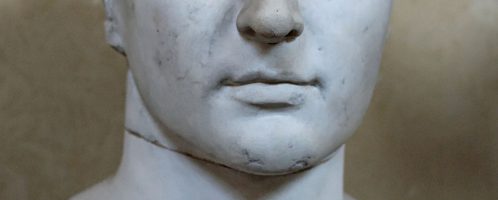
Fragment of a sculpture depicting Empress Fausta

Constantius II

(7 August 317 - 3 November 361 CE)

Constantius II was a Roman emperor in the years 337-361 CE, who, after a period of internal struggles, took over the entire country. Opponent of traditional beliefs.

Constantius II

Constans

(320 - 18 January 350 CE)

Constans was a Roman emperor who ruled in the years 337-350 CE. He was the son of Constantine I, who fell to the central part of the Empire: Italy with the Alpine lands as far as the Danube, and part of the Balkans and North Africa (without Egypt).

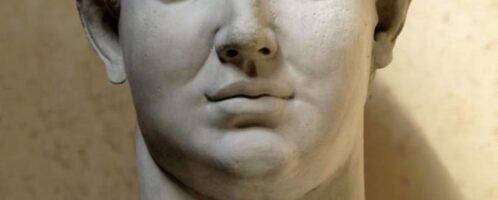
Emperor Constans

Valentinian I

(3 July 321 - 18 November 375 CE)

Valentinian I was a Roman emperor in the years 364-375 CE. He ruled the western and eastern parts of the empire; over time, he handed over the rule in the eastern part to his brother - Valens. After a few years, he appointed Gratian as co-emperor. He died of nervousness.

Valentinian I

Ammianus Marcellinus

(c. 330 - after 392 CE)

Ammianus Marcellinus was born around 330 CE in Antioch, the capital of Syria. He was a historian and Roman commander of Greek origin.

Logo IMPERIUM ROMANUM

Jovian

(c. 331 - 17 February 364 CE)

Jovian was Roman emperor in the years 363-364 CE. He received power after the death of Emperor Julian the Apostate, when a military council met.

Jovian

Julian the Apostate

(331/332 - 26 June 363 CE)

Julian the Apostate was a Roman emperor in 361-363 CE. He strived to restore the pagan religion and became famous as a great reformer.

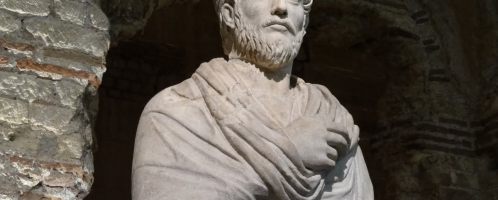
Sculpture of a priest; so far it was considered the image of Julian

Spelling error report

The following text will be sent to our editors: