If you have found a spelling error, please, notify us by selecting that text and pressing Ctrl+Enter.

Biographies of Romans

The history of ancient Rome saw the emergence of many outstanding figures who left a lasting mark on the history of the world. Some of them are remembered by posterity as cruel tyrants, such as Caligula, Nero, and Caracalla. Others became renowned as reformers and builders of the Roman state’s power, including Augustus, Claudius, Marcus Aurelius, Diocletian, and Constantine the Great. It is also impossible to ignore the Roman generals, who often saved the state from collapse.

History also includes outstanding figures of Roman culture – writers, philosophers, and artists whose work had a profound impact on the development of European civilization. In this section, I present profiles of individuals who achieved great deeds or whose actions left a lasting mark on the pages of history.

Pomponia Graecina

(? - 84 CE)

Pomponia Graecina lived in the 1st century CE. She was the wife of the Roman commander and conqueror of Britain Aulus Plautius. She was accused in 57 CE of professing "foreign superstition", which is often associated with Christianity.

Danuta Stenka as Pomponia Graecina in the film Quo vadis (2001).

Suetonius

(c. 69 - after 122 CE)

Suetonius was a writer and Roman historian. Creator of the biography of Roman emperors. He wrote in both Latin and Greek.

Suetonius

Gaius Fulvius Plautianus

(c. 150-205 CE)

Gaius Fulvius Plautianus was the praetorian prefect during the reign of Emperor Septimius Severus and one of the most powerful officials in Roman history.

Plautianus

Polybius

(c. 200 - c. 118 BCE)

Polybius was a Greek historian and chronicler during the Republic. He was famous for his care for historical truth and his critical attitude towards sources.

Polybius

Lucius Cornelius Sulla

(138 - 78 BCE)

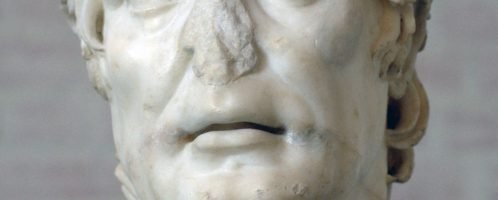
Lucius Cornelius Sulla was a Roman commander and politician - the optimist. In 82 BCE Sulla was given dictatorial power. In the following years, he carried out a number of political reforms.

Bust of Lucius Cornelius Sulla without a nose

Lucius Cecilus Iucundus

(? - c. 62 CE)

Lucius Cecilus Iucundus was a Roman banker who lived in Pompeii in the years 20-62 CE. Some of his house and bills have survived to our times.

Lucius Cecilus Iucundus

Marcus Terentius Varro

(116 - 27 BCE)

Marcus Terentius Varro was a Roman scholar and writer. A true erudite, considered one of the best educated people in the history of ancient Rome.

Logo IMPERIUM ROMANUM

Emperor Tacitus

(200 - 276 CE)

The Roman emperor Tacitus ruled in 275-276 CE. Tacitus was to cooperate with the senate and initiated many reforms. In addition, he honored the tragically deceased Aurelian with numerous statues, and punished his murderers.

Emperor Tacitus

Aemilianus

(c. 210 - October 253 CE)

Roman emperor Aemilianus ruled for several months in 253 CE. Raised to purple by his faithful legions, he overthrew the legal ruler Trebonian Gallus and assumed the throne of Rome for 88 days. The changeling was overthrown by the heir - Valerian.

Emperor Aemilianus

Pliny the Younger

(61 - c. 113 CE)

Pliny the Younger was a lawyer, writer and Roman official. He witnessed the eruption of Mount Vesuvius in 79 CE, in which his uncle Pliny the Elder was killed.

Pliny the Younger

Spelling error report

The following text will be sent to our editors: