If you have found a spelling error, please, notify us by selecting that text and pressing Ctrl+Enter.
Curiosities of ancient Rome (Artifact)
Artifacts is a collection of curiosities dedicated to objects left behind by the ancient Romans. This category features lesser-known facts and interesting information about archaeological finds, such as tools, weapons, coins, inscriptions, and everyday objects, which provide a deeper understanding of life in the Roman Empire.
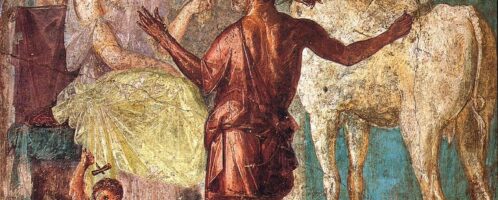
Roman fresco showing Heracles and Omphale
Roman fresco depicting Heracles and Omphale, mythical figures from Greek mythology. The object is located at the National Archaeological Museum in Naples, Italy.
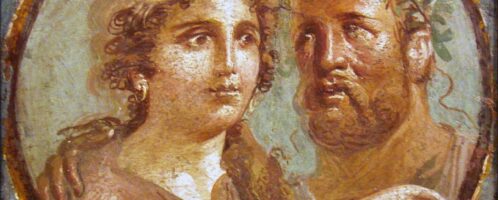
Roman portrait from late 1st century CE
Roman portrait from the late 1st century CE, currently located at the Walters Art Museum, Baltimore (USA).

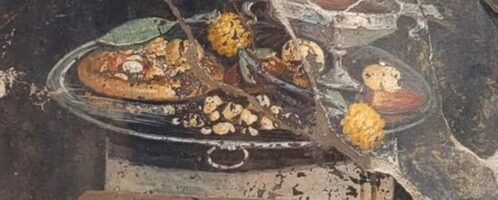
Flatbread in Roman fresco
Roman fresco discovered in Pompeii depicts a flatbread that resembles, but isn’t, a modern pizza. This bread features fruits (including dates and pomegranates), spices, and perhaps sauce or cheese, all arranged in a decorative manner.
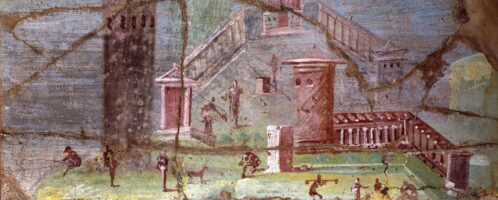
Roman fresco showing maritime villa
Roman fresco depicting a maritime villa. The object dates to 20–45 CE; found in Pompeii.
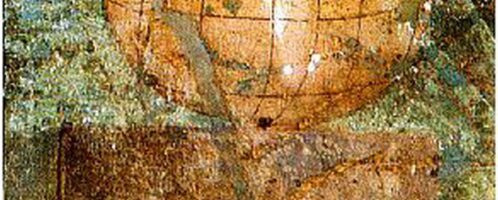
Roman fresco showing globe with mountain
Roman fresco depicting a globe with a mountain. The object dates to the 1st century CE and was found at the Villa Boscoreale near Pompeii. The artifact is located at the Metropolitan Museum of Art, New York (USA).
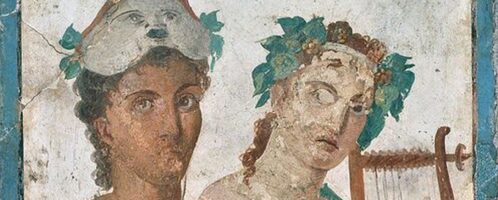
Roman fresco from Pompeii depicting man in theatre mask and woman with wreath
Roman fresco from Pompeii depicting a man wearing a theatrical mask and a woman with a wreath playing a lyre. The object is located at the National Archaeological Museum in Naples, Italy. Dated to the 1st century CE.
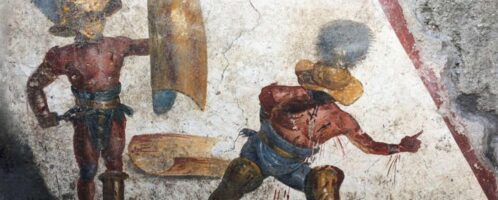
Fragment of Roman fresco depicting fight between two gladiators
Fragment of a Roman fresco depicting a fight between two gladiators. The painting was found north of the Pompeii archaeological park.
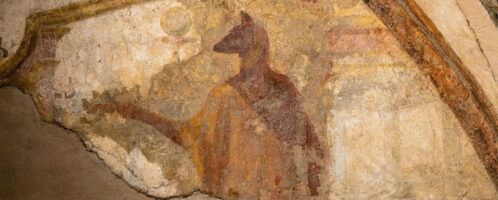
Anubis on Roman fresco
In the Roman baths of the Emperor Caracalla (reigned 211-217 CE), there is a preserved fresco depicting Anubis, which dates back to the 2nd century CE.
Roman amforiskos
Roman amphorae made of banded agate, dating from around 1st BCE – 1st century CE. An amphorae was a small, amphora-shaped vessel usually used for storing expensive oils, perfumes or aromatic essences.