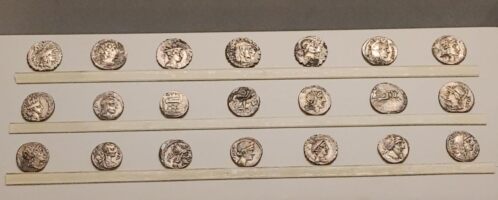
Roman denarii found in Spain
Roman denarii found in Spain. Objects dated to the 2nd-1st century BCE; discovered in La Grajuela, in south-eastern Spain. Currently, the artifacts are on display at the Archaeological Museum of Murcia.
If you have found a spelling error, please, notify us by selecting that text and pressing Ctrl+Enter.
Artifacts is a collection of curiosities dedicated to objects left behind by the ancient Romans. This category features lesser-known facts and interesting information about archaeological finds, such as tools, weapons, coins, inscriptions, and everyday objects, which provide a deeper understanding of life in the Roman Empire.
Roman denarii found in Spain. Objects dated to the 2nd-1st century BCE; discovered in La Grajuela, in south-eastern Spain. Currently, the artifacts are on display at the Archaeological Museum of Murcia.
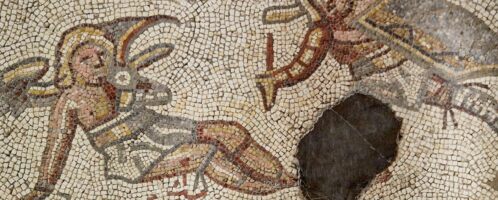
Roman mosaic showing a gladiator fight. The scene shows a defeated retiarius (“net-man”) who is seriously wounded in the chest and leg; at his side lies a trident.
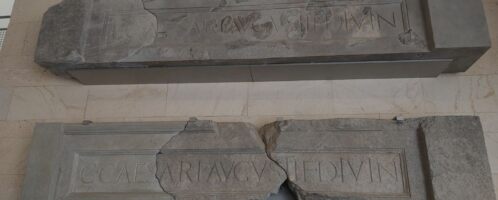
Preserved lintels from the entrances to the Roman theater in Cartagena. On the stone, made of gray sandstone, which was located at the eastern entrance, there is an inscription honoring Lucius Caesar; when on the west – probably Gaius Caesar. The objects are dated to the 1st century BCE.
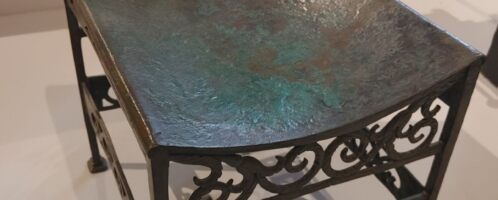
Roman table, made of bronze, which was discovered in Pompeii. Dated to the 1st century CE. The artifact is in the National Archaeological Museum in Naples.
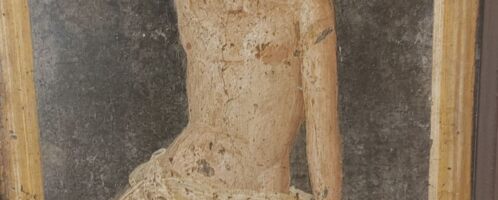
Roman fresco showing a young man resting. The object was discovered in Stabiae; dated to the 1st century CE. The artifact is in the National Archaeological Museum in Naples.
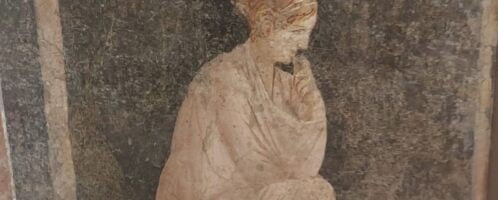
Roman fresco showing a pondering, seated woman. Object dated to the 1st century CE. The artifact was discovered in Stabiae; it is now in the National Archaeological Museum of Naples.
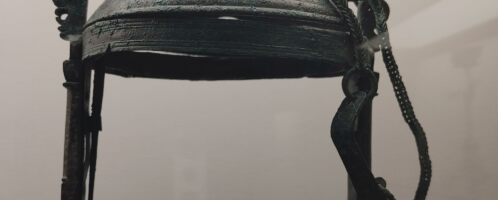
Small Roman oil lamp made of bronze with a lid. Object dated to the 1st century CE; discovered in Pompeii. The artifact is in the National Archaeological Museum in Naples.
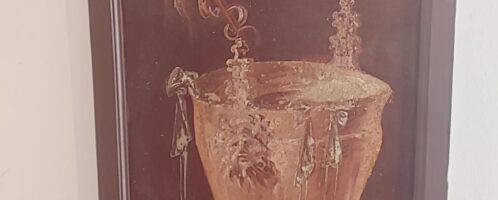
Roman fresco showing a silver vessel (situla) used in antiquity to collect water. The object dates back to the 1st century BCE. The artifact is in the National Archaeological Museum in Naples.
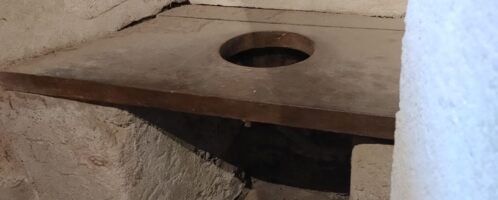
Toilet in a Pompeian brothel. The person using the toilet defecated into the potty/vessel which was located under the hole. The excrement and urine were then immediately disposed of in the sewers outside the house.
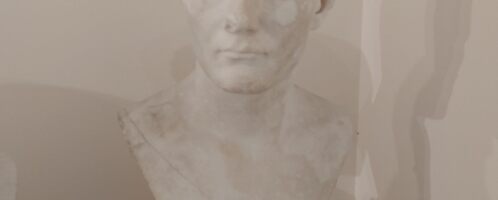
Roman bust showing a certain Coelius Caldus. Object dated to the reign of Tiberius (14-37 CE). The artifact is in the National Archaeological Museum in Naples.