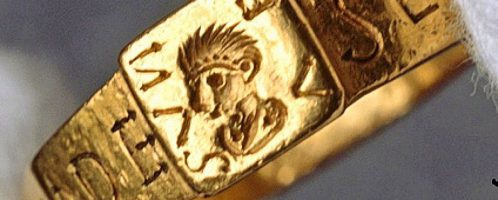
Intriguing Roman ring from Silchester
In 1785, an amazing golden Roman ring was discovered in a field near Silchester (southern England). As it turns out, the artifact changed its owners.
If you have found a spelling error, please, notify us by selecting that text and pressing Ctrl+Enter.
The world of the ancient Romans was rich in extraordinary, and sometimes even surprising, facts. We draw our knowledge of Roman daily life, customs, and mentality primarily from works left by ancient writers and historians. It is thanks to them that we discover information that is astonishing today – sometimes even hard to believe. Below are some interesting facts that reveal a lesser-known and less obvious side of the Roman world.
I encourage you to submit your own suggestions and to report any corrections or inaccuracies.
In 1785, an amazing golden Roman ring was discovered in a field near Silchester (southern England). As it turns out, the artifact changed its owners.
Roman glass bowl with painted garlands. Object dated to the late 1st century BCE.

Roman bone charm with a faullus and a manus fica gesture that was shown for good luck. The object was found in London and was probably worn around the neck as a symbol of good luck in warding off evil. The artefact is in the Museum of London.

Roman coin, minted between 206-195 BCE, shows Castor and Pollux (also known as Dioscuri), twins whose deeds were celebrated in Greek mythology, incl. as participants of the Argonauts expedition.

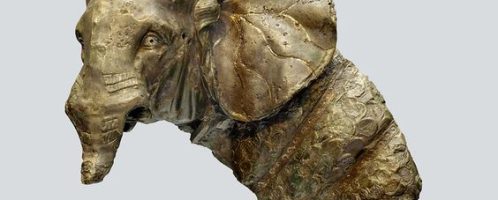
Roman statuette depicting a war elephant. The object was a decoration of a Roman bed and is made of bronze and silver.
Roman fish-shaped crystal. Dated to the 1st century CE.

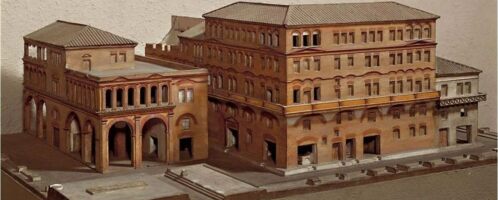
In 1884, the first skyscraper was built in Chicago, USA. It was 42 meters high. Shortly afterwards, the New York World Building exceeded a hundred meters. In both cases, however, it was only an imitation of the ancient Romans. The first skyscrapers grew in ancient Rome. They were insulae, including the most famous of them, the real miracle and singularity of the city – Insula Felicles.
In 2013, the remains of a Roman cemetery were found in south-eastern France. This year, hundreds of Roman graves were discovered, among which were chained skeletons.