

If you have found a spelling error, please, notify us by selecting that text and pressing Ctrl+Enter.
Curiosities of ancient Rome
The world of the ancient Romans was rich in extraordinary, and sometimes even surprising, facts. We draw our knowledge of Roman daily life, customs, and mentality primarily from works left by ancient writers and historians. It is thanks to them that we discover information that is astonishing today – sometimes even hard to believe. Below are some interesting facts that reveal a lesser-known and less obvious side of the Roman world.
I encourage you to submit your own suggestions and to report any corrections or inaccuracies.
Suffocated with pear
Claudius Drusus, son of emperor Claudius (10 BCE – 54 CE) and Plautia Urgulanillia, suffocated when he tossed a pear for fun and this one fell his open mouth.


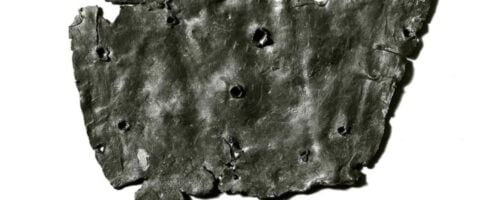
Roman curse tablet
Roman curse tablet found in London. Dated back to I-IV century CE.
Oldest inscription with ROMA
Probably the oldest inscription with the words ROMA, preserved on the sword, which is dated back to IV century BCE. The “San Vittore Sword” was discovered in 2003 by Dante Sacco. The clue to making the assessment of sword’s origin was the style of engraving Macedonian stars on the sword. The inscription itself says:


Fresco showing Chiron and pupil
Roman fresco of the centaur Chiron instructing the young Achilles in the playing of the lyre. Object found in Herculaneum. Dated back to I century CE; located in Naples Archeological Museum.

Herma
Herma was an architectural decorative element in the form of a square pole tapering downwards, and at the top ended with a bust or a sculpture of the head. Initially (up to the 5th century BCE) the form used in Greece only for the representation of Hermes, the god of the journey. On herma also was placed the image of the phallus, which in ancient times was a symbol of happiness. Later, other gods and heroes were presented in this way.

Satyr annoying panther
A marble sculpture depicting a Satyre annoying the panther. Object dated to the 1st century CE.

Roman dices for game
Roman dices found in a Roman camp near Thrace, in Macedonia. Those probably belonged to one of the legionaries stationed there. Dated back to 3rd century CE.
