If you have found a spelling error, please, notify us by selecting that text and pressing Ctrl+Enter.

Curiosities of ancient Rome

The world of the ancient Romans was rich in extraordinary, and sometimes even surprising, facts. We draw our knowledge of Roman daily life, customs, and mentality primarily from works left by ancient writers and historians. It is thanks to them that we discover information that is astonishing today – sometimes even hard to believe. Below are some interesting facts that reveal a lesser-known and less obvious side of the Roman world.

I encourage you to submit your own suggestions and to report any corrections or inaccuracies.

Falcata – Iberian weapon

Falcata, an Iberian weapon that was used, among others, during the Second Punic War. The Carthaginian army, recruiting warriors from the Iberian Peninsula, had this type of armament in stock. The object is in the Archaeological Museum of Murcia (southern Spain).

Falcata

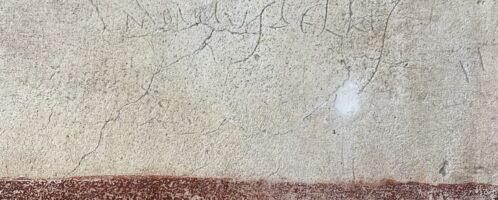
Inscription carved on wall of Roman House of Vettii

An inscription carved on the wall of the Roman House of the Vettii in Pompeii. The graffiti is on the left wall in the entrance hall. The inscription reads: EUTYHIS GRECA ASSIBUS II MORIBUS BELLIS, meaning “Eutychis Greek nice mannered for two asses”. It is not clear whether Eutychis was a domestic slave offering love services or a local prostitute.

Inscription carved on wall of Roman House of Vettii

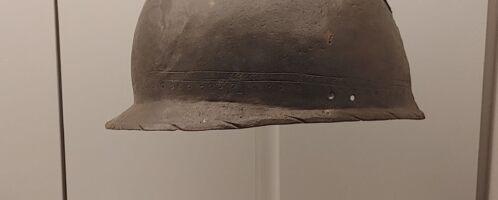
Montefortino type helmet

Roman Montefortino type helmet made of bronze. Object dated to the 3rd-2nd century BCE; discovered in Granada (southern Spain). Currently on display at the Archaeological Museum of Murcia.

Montefortino type helmet

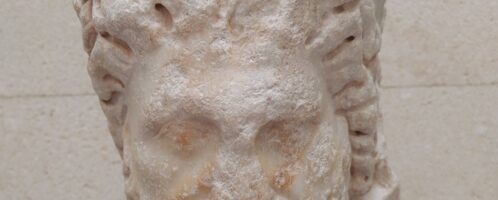
Roman sculpture showing bearded man

Roman sculpture showing a bearded man, possibly one of the emperors. Object dated to the end of the 2nd or the beginning of the 3rd century CE. An artifact made of marble; it is now in the museum of the Roman theater in Cartagena.

Roman sculpture showing bearded man

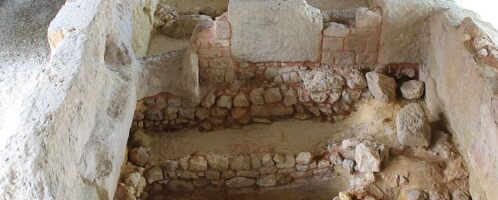
Punic walls in Cartagena

In Cartagena (south-eastern Spain) there are remains of the Punic walls of Cartagena, which date back to the 3rd century BCE. Scientists have found traces of fire, which proves that a battle and probably looting really took place here.

Punic walls in Cartagena

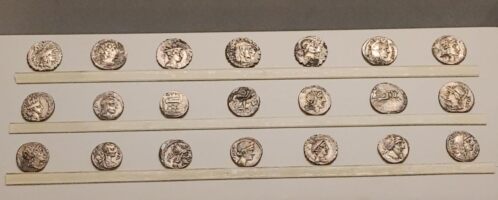
Roman denarii found in Spain

Roman denarii found in Spain. Objects dated to the 2nd-1st century BCE; discovered in La Grajuela, in south-eastern Spain. Currently, the artifacts are on display at the Archaeological Museum of Murcia.

Roman denarii found in Spain

Roman theater in Cartagena

Roman theater in Cartagena (southern Spain) was built in the late 1st century BCE. The facility is hidden among the modern buildings of the city.

Roman theater in Cartagena

Brief history of title changes of governor of Judea in 1st century CE

The title praefectus Judeae was held by the Roman governors of Judea from 6 CE. Then, after removing the son of Herod the Great – the ethnarch of Samaria, Idumea, and Judea – Herod Archelaos (4 BCE – 6 CE)1 from power and accession Quirinius for the implementation of the census ordered by the emperor Octavian Augustus riots broke out. They were used by Judah the Galilean, who led an uprising against Rome and founded together with the Zadok the Pharisee the Zealot party2. He himself died during the uprising.

A replica of the so-called Pilate's Stone, Caesarea Maritima, the original is in the Israel Museum in Jerusalem

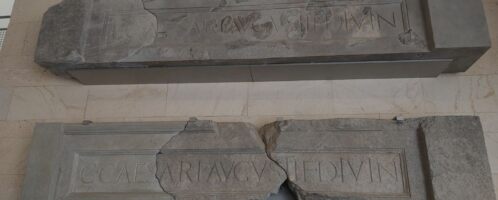
Preserved lintels from entrances to Roman theater in Cartagena

Preserved lintels from the entrances to the Roman theater in Cartagena. On the stone, made of gray sandstone, which was located at the eastern entrance, there is an inscription honoring Lucius Caesar; when on the west – probably Gaius Caesar. The objects are dated to the 1st century BCE.

Preserved lintels from entrances to Roman theater in Cartagena

Spelling error report

The following text will be sent to our editors: