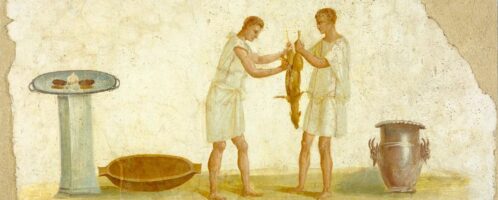
Fragment of Roman fresco depicting preparation of meal
Fragment of a Roman fresco depicting the preparation of a meal. The object dates to the 1st century CE.
If you have found a spelling error, please, notify us by selecting that text and pressing Ctrl+Enter.
The world of the ancient Romans was rich in extraordinary, and sometimes even surprising, facts. We draw our knowledge of Roman daily life, customs, and mentality primarily from works left by ancient writers and historians. It is thanks to them that we discover information that is astonishing today – sometimes even hard to believe. Below are some interesting facts that reveal a lesser-known and less obvious side of the Roman world.
I encourage you to submit your own suggestions and to report any corrections or inaccuracies.
Fragment of a Roman fresco depicting the preparation of a meal. The object dates to the 1st century CE.
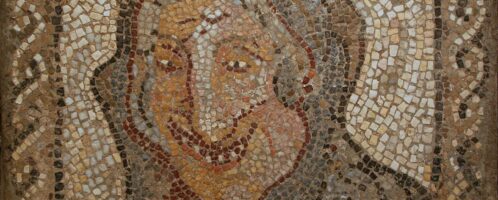
Roman mosaic depicting an elderly woman. The artifact was discovered in Italica, southern Spain. Dated to the 3rd century CE, it is located at the Archaeological Museum of Catalonia in Barcelona, Spain.
The gray dormouse (Glis glis) is a rodent similar in size to a rat, found throughout almost all of Europe. The ancient Romans valued it for its meat – initially, they only hunted it, but by the 1st century BCE, it was already widely farmed. Varro describes dormouse rearing in his work De re rustica (“On the Rural Economy”), while Apicius provides a recipe for its preparation in De re coquinaria libri decem (On the Ten Books of Culinary Art).
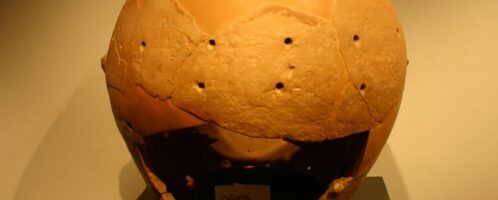
“Béziers Antique” is the reproduction of the city of Béziers (south of France) as it was in Roman times, highlighting the techniques and methods used during Antiquity. Starting in 2028 for at least 30 years, workers and craftsmen will be working on this huge construction site open to the public. Various trades and crafts will be showcased during the visit. Activities, shows, and demonstrations will be offered throughout the year.

In 51 BCE, Marcus Tullius Cicero, Rome’s greatest orator and one of its leading intellectuals, was reluctant to travel east to assume the office of governor of Cilicia. For a man whose entire life revolved around the political intrigues of the Roman Forum, a year’s administration of a remote province in Asia Minor was tantamount to exile. He wanted to participate actively in the political life of the capital and had successfully avoided any governorship in previous years. This time, he couldn’t refuse.

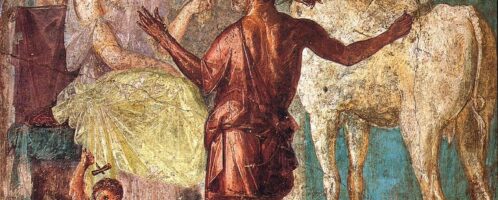
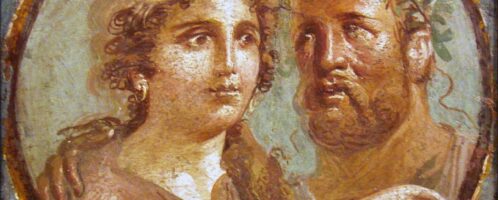
Roman fresco depicting Heracles and Omphale, mythical figures from Greek mythology. The object is located at the National Archaeological Museum in Naples, Italy.
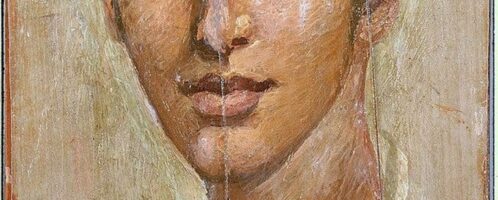
Roman portrait from the late 1st century CE, currently located at the Walters Art Museum, Baltimore (USA).
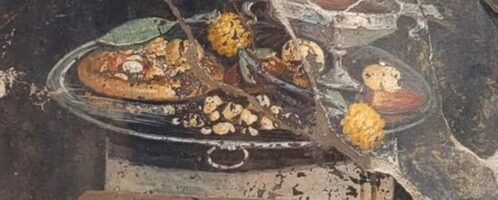
Roman fresco discovered in Pompeii depicts a flatbread that resembles, but isn’t, a modern pizza. This bread features fruits (including dates and pomegranates), spices, and perhaps sauce or cheese, all arranged in a decorative manner.