Roman folding knife with bone handle
Roman folding knife with a bone handle and a bronze or iron blade. This item is on display at the Museum of Art and History in Geneva, Switzerland.
If you have found a spelling error, please, notify us by selecting that text and pressing Ctrl+Enter.
The world of the ancient Romans was rich in extraordinary, and sometimes even surprising, facts. We draw our knowledge of Roman daily life, customs, and mentality primarily from works left by ancient writers and historians. It is thanks to them that we discover information that is astonishing today – sometimes even hard to believe. Below are some interesting facts that reveal a lesser-known and less obvious side of the Roman world.
I encourage you to submit your own suggestions and to report any corrections or inaccuracies.
Roman folding knife with a bone handle and a bronze or iron blade. This item is on display at the Museum of Art and History in Geneva, Switzerland.

Pair of Roman earrings made of gold and semi-precious stones from the 3rd/4th century CE. The objects are located in the Archaeological Museum of the University of Münster (Germany).

Curule chair (sella curulis) is a folding stool with crossed straight or curved legs, originally backless. It was known to many ancient cultures of the Mediterranean basin, including the Greeks and Egyptians (it reached China via the Silk Road). The ancient Romans most likely adopted it from the Etruscans.

This ancient Roman bronze stylus, discovered in Tiel (central Netherlands), is a small, elongated writing instrument used during the Roman Empire. Made of bronze, it has a slender shape – one end is pointed, while the other is flattened or slightly flared.

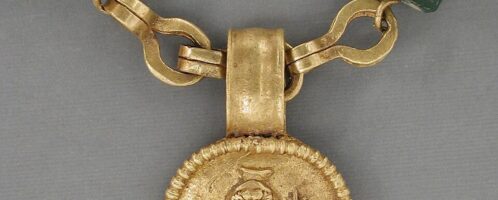
Gold necklace with a medallion depicting a goddess is an example of jewelry from the period when Egypt was under Roman rule (30 BCE – 300 CE). This unique piece combines jewelry craftsmanship, religious symbolism, and the multicultural identity of the era.
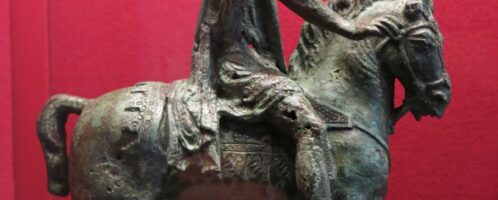
The monumental figure of Marcus Aurelius, depicted on horseback, evokes the ideal of the philosopher-ruler: composure, dignity, and inner strength. The piece is located at the Museo Frédéric Marès in Barcelona.
The collections of the Kunsthistorisches Museum in Vienna include an inconspicuous, yet extremely telling monument of Roman culture – a bronze fork, dated to the 2nd/3rd century CE.

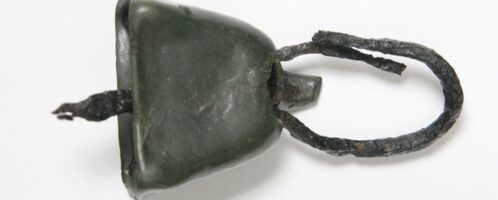
Roman bronze bell (tintinnabulum) found in a tomb was associated with funeral rites. This artifact is in the collection of the Civic Museum of Crema (northern Italy).
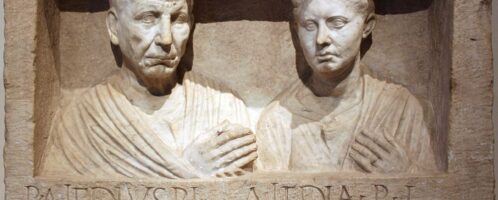
The funerary relief of Publius Aiedius Amphion and his wife Aiedia Faustra Melior is a moving example of Roman funerary art from the turn of the ages – dating to around 30 BCE. It comes from Rome, from the area of the famous Via Appia, one of the most important arteries of the ancient world, along which the tombs of elites and freedmen were built.