Roman decoration in shape of tiger’s muzzle
Roman decoration in the shape of a tiger’s face, which was located on the fountain. The artifact is in the National Archaeological Museum in Naples.
If you have found a spelling error, please, notify us by selecting that text and pressing Ctrl+Enter.
The world of the ancient Romans was rich in extraordinary, and sometimes even surprising, facts. We draw our knowledge of Roman daily life, customs, and mentality primarily from works left by ancient writers and historians. It is thanks to them that we discover information that is astonishing today – sometimes even hard to believe. Below are some interesting facts that reveal a lesser-known and less obvious side of the Roman world.
I encourage you to submit your own suggestions and to report any corrections or inaccuracies.
Roman decoration in the shape of a tiger’s face, which was located on the fountain. The artifact is in the National Archaeological Museum in Naples.

In the ranking of people who had the greatest influence on the history of mankind, announced at the end of 2013, Octavian Augustus was ranked 30th place.

The Greek historian Polybius mentions that when he participated with Scipio Africanus in conquering (in 146 BCE) Carthage saw lions crucified. As it turned out, such decisions were made by the Romans.

The nearly 2,000-year-old leather bikini on display at the Museum of London is one of four found at the Queen Victoria Street excavation site in London in 1953. Like the modern bikini bottom, it has adjustable sides at the hips, and the garment is believed to have been used by gymnasts and acrobatic dancers. Roman bronze figurine from Rennes depicts an acrobat wearing similar underpants.

Tribulus was a Roman weapon consisting of four sharp spikes or nails arranged in such a way that one of them always protruded vertically upwards.

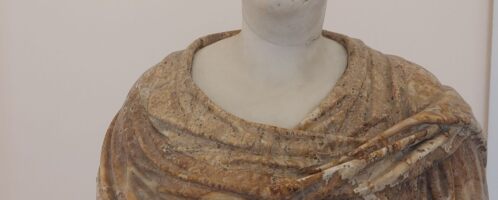
Bust of Faustina the Elder from around 138-141 CE. The object was placed in a contemporary alabaster bust. The artifact is in the National Archaeological Museum in Naples.
In ancient Rome, it was realized that a high number of births guaranteed the proper development of the state and society. During the rule of Octavian Augustus (27 BCE – 14 CE), it was decided to outlaw abortion and contraception. As it turns out from paleopathological studies, the most common reason for the population decline was a low number of births, not infanticide or high infant mortality at birth.

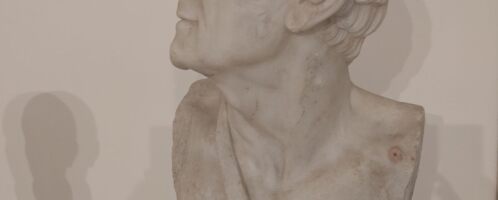
Roman sculpture showing Lysimachus, one of the generals of Alexander the Great. The object dates back to the 2nd century BCE. The artifact is in the National Archaeological Museum in Naples. It is a copy of the Greek original.