If you have found a spelling error, please, notify us by selecting that text and pressing Ctrl+Enter.

Curiosities of ancient Rome (Unknown facts)

Unknown Facts are curiosities revealing little-known, surprising, or rarely discussed information from the world of ancient Rome and antiquity. This category includes unusual details, curiosities, and facts that offer a less obvious perspective on the Roman Empire.

Hannibal’s elephants

Hannibal became famous not only for his great victories over disciplined Romans during the Second Punic War but also for his surprising march through the Pyrenees and the Alps. During his trip, he had 38 elephants with him – animals that were not used to the cold climate and mountains.

Hannibal on an elephant in the Alps

Roman tablets from Vindolanda camp

In 1973, an unusual discovery was made in the Vindolanda Roman camp (England). Water-soaked tablets with Roman notes were extracted from the ground. After conservation, it turned out that the artifacts are a great source of information about the life of people who were in the camp in antiquity.

Roman tablet from the Vindolanda camp

Roman woman in male world

Women in the Roman Empire did not enjoy equal rights with men. Traditionally, a single woman was looked after by her father and then by her husband if the woman got married in manu. Then, the chosen one, or more often her father, took over her dowry.

Roman bust of a woman

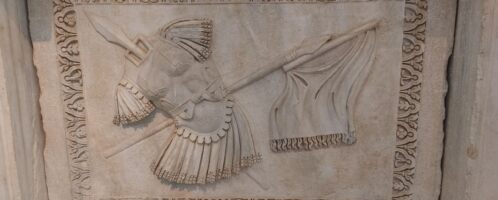
Tropaion

Tropaion, also simply called the trophy (tropaeum) is a form of military monument erected by Greeks and Romans in honour of victory in the battle. It was usually a vertical pole in the shape of a tree with outstretched arms (later crossed with two sticks), to which captured military items were attached. The trophy was next sacrificed to deities for victory.

Roman relief showing tropaion

Values professed by Romans

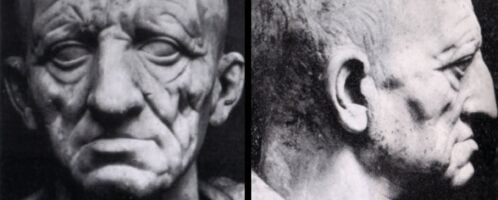
Ancient Romans believed that their ancestors gave them a catalogue of values ​​to live by. They called him the term mos maiorum, or “the customs of the ancestors.” In practice, the Roman believed that the old is good because it has already been used in practice. In turn, “new things” (res novae) were, according to the Romans, a form of revolution that they associated with chaos and violence.

Bust of an elderly man - the so-called patrician of Torlonia

Spelling error report

The following text will be sent to our editors: