If you have found a spelling error, please, notify us by selecting that text and pressing Ctrl+Enter.

Curiosities of ancient Rome (Unknown facts)

Unknown Facts are curiosities revealing little-known, surprising, or rarely discussed information from the world of ancient Rome and antiquity. This category includes unusual details, curiosities, and facts that offer a less obvious perspective on the Roman Empire.

Theatrical masks in antiquity

The only ancient source of information about masks that were used in ancient times during theatrical performances is Julius Pollux, a Greek scientist from the 3rd century CE, who wrote the work Onomasticon. In his work, he lists a total of 44 different comic masks that could be used during the performance.

Roman mosaic showing theatrical masks

What did greats of ancient world hide under their pillows?

Plutarch in his work (“Life of Alexander”, 8) mentions that Alexander the Great kept a special copy of the “Iliad” under his pillow while sleeping, with Aristotle’s commentaries. This was largely due to the love of the leader of this Greek epic and the character of Achilles.

Alexander the Great

Selenite – valued material

In ancient Rome, selenite (referred to as lapis specularis, meaning “mirror stone”) was a valued mineral. Pliny the Elder emphasized the advantages of this mineral, which could be cut into thin layers through which light with a characteristic soft glow, similar to moonlight, passed.

Selenite

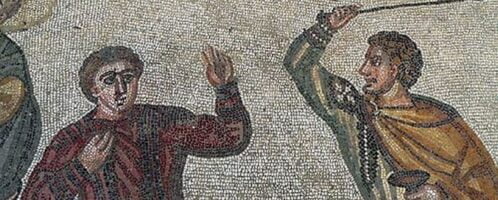
Mandatory torture for slaves

In a situation where the Roman slave could only determine whether the accused was guilty or not, he had to be subjected to mandatory torture. Only such testimony of a slave was considered true and certain.

Mosaic showing a master beating a slave

Tribulus – Roman echidnas

Tribulus was a Roman weapon consisting of four sharp spikes or nails arranged in such a way that one of them always protruded vertically upwards.

Tribulus - Roman echidnas

Birth control under Augustus

In ancient Rome, it was realized that a high number of births guaranteed the proper development of the state and society. During the rule of Octavian Augustus (27 BCE – 14 CE), it was decided to outlaw abortion and contraception. As it turns out from paleopathological studies, the most common reason for the population decline was a low number of births, not infanticide or high infant mortality at birth.

Augustus

Spelling error report

The following text will be sent to our editors: