
Chapters

At the time of death, Theodosius, Honorius was only 12 years old. In the last days of his father’s life, he accompanied him in Milan. Minor Honorius was looked after by Stilicho, of Vandal origin, who often made himself known through his tactical and organizational talents.
In 396 CE, Stilicho wandered down the Rhine to the mouth of the river into the North Sea, making contact with local tribes along the way. After this diplomatic mission, Stilicho hurried to Greece to stop the Visigothic invasion under the leadership of Alaric. He carried out this action, at the request of the ruler of the Eastern Empire – Arcadius. After solving the problem, at the request of the same person, Stilicho had to leave the saved provinces.
The following year, 397 CE, there was a rebellion in Africa. So far obedient to Honorius – Gildon, he was in favour of Arkadius, who, without lingering long, took advantage of the offer submitted to him. But Gildon’s power did not last long. Already in 398 CE, he was removed by his brother, who soon got rid of Stilicho himself. The case of the recovery of the African diocese was over and these lands again found themselves in the zone of Honorius’s influence.
Successful news also came from another corner of the Empire, from Britain, where Namely managed to stop the attacks of Saxons, Scots and Picts.
After a short period of calm, the threat came with 401 CE. Committed to repelling Vandal attacks over the Upper Danube, the Romans could not protect all borders. This situation was eagerly used by Alaric, who in November 401 CE crossed the Alps and entered the Po valley. Honorius, terrified by this unexpected situation, hurriedly left Milan and went to the safe Ravenna, hence the headquarters of the ruler. The final clash took place on April 6, 403 CE near Police. The victorious battle for the Romans ended in a peace treaty. The aggressors left Italy and went to the Alps.
The further policy of Stilicho led in 405 CE to an open conflict between east and west. Stilicho, referring to Theodosius’ alleged last will, demanded that Arkadius return Ilyrikum. In the same year, huge masses of Goths led by Radagaisus entered the Po valley. Rome itself was within their reach. In the face of the danger weighing on the capital, Stilicho decided to take a very fatal step. He summoned the Huns and Goths for help.
In the summer of 406 CE, Radagajs began to besiege Florence. The city, which was opening to open its gates, was saved thanks to the sudden appearance of Stilicho with his allies. Radagaisus’ encircled armies surrendered. Most of the Goths were taken prisoner, but some of them were conscripted into the Roman army. The fate of Radagajs was not different from many others before him. He was beheaded at the gate in Florence.
When Stilicho was struggling with Radagajs, the Vandals and Swews pushed against the Rhine border, who were valiantly resisted by the Franks, who were in a military alliance with Rome. Increasing attacks brought results and the Franks capitulated. Hordes of barbarians have invaded the lands of Gaul. The disaster in Gaul had an adverse effect on the image of Stilicho, who was widely regarded as a traitor. Panic gripped Italy. Under her influence, the last traces of ancient faith were destroyed, including the Sibylline books.
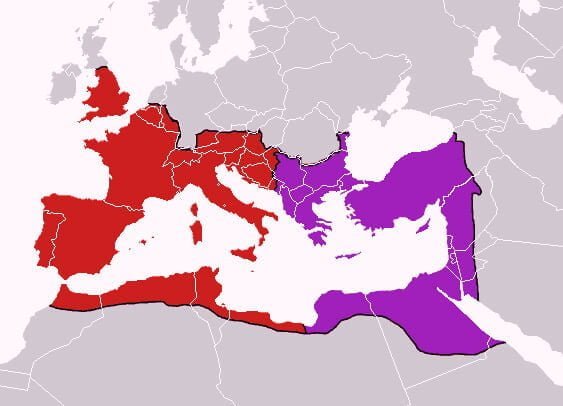
But the problem of the Swews and Vandals was not very concerned with Stilicho, who was increasingly trying to get Ilyrikum. This led to an armed conflict between the east and west of the Roman Empire. Command in this war was entrusted to the Visigoth chief Alaric.
As if misfortune was not enough, a self-stylist appeared in Britain. Already in 406 CE, Marcus briefly lasted in Britain, then Gratian. The last of them was Flavius Constantine, also called Constantine III. In 407 CE he transferred his troops from Britain to Gaul, awaiting the trial with Stilicho. Britain, deprived of any support from Roman soldiers, proved to be easy prey for the Saxons, Scots and the English.
The arrival of Constantine was met with enthusiastic welcome by the inhabitants of the land because he decided to help the inhabitants in defence against constant attacks from the barbarians. He had some successes in the fight with them, but his army failed to repel the Swews and Vandals for the Rhine, but Constantine III had other problems – the attack of Stilicho. Constantine, anticipating the actions of Stilicho, sent his leader Saruss, who defeated Honorius’s army and occupied Provence. After this success, he appointed his elder son Constantia, who had identical success in Spain. Visigoths were not idle at that time, invading the Alps to open their way to Italy. Taking advantage of the disadvantage, they demanded huge sums as payment for the services they gave Rome in the fight in Illyria. Their request was granted.