If you have found a spelling error, please, notify us by selecting that text and pressing Ctrl+Enter.

Articles

Roman state existed for nearly thirteen centuries, repeatedly exerting a profound influence on the course of history. I present the history of ancient Rome in the individual articles below, which not always refer solely to the Eternal City itself but encompass the wider world of the Roman Empire.

I encourage you to submit your own articles and to report any corrections or factual inaccuracies.

Stipulation in Roman law

In the Roman law there were many kinds of agreements and contracts which could be used to bind sides. There were real, consensual, literal and verbal contracts. Among the verbal contracts, which were carried out by saying strictly defined words in strictly defined situations, there was a promise of a dowry (dotis dictio) and freedmen’s oath (iusiurandum liberti) but the most important was the stipulatio.

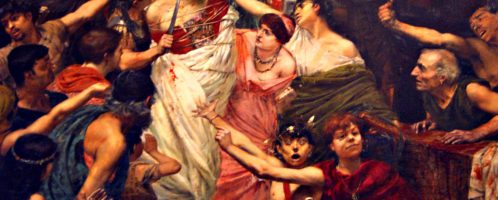
Court scene in old Rome expulsion of the Sophists

Fall of Domitian

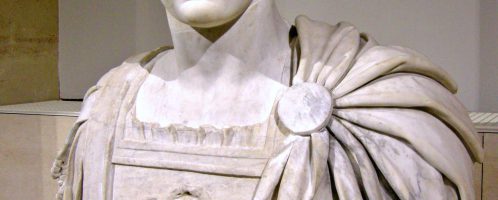
The younger son of Vespasian did not seem to be a bad ruler. With time, however, he turned into a cruel man, who was decided to be removed from the throne by force. What was the fall of the last emperor from the Flavian dynasty and what signs were to accompany him?

Domitian

Roman villa in Eigeltingen

The Roman villa in Eigeltingen, Germany, is one of approximately 3,500 Roman farms in what is today the Land of Baden-Württemberg. The area on which the farm was located is looked after by the Association for the Support of the Roman Farm in Eigeltingen.

Rebuilt farm building in Eigeltingen

Why are ancient monuments so deep underground?

Regularly, from time to time, we receive information about the discovery of ancient monuments, including those that date back to Roman times. We can see photos showing mosaics hidden a few meters below the road, pavement or the present ground level. How is this possible?

In 2020, an exceptionally well-preserved Roman mosaic was discovered under a vineyard near the city of Negrar (northern Italy)

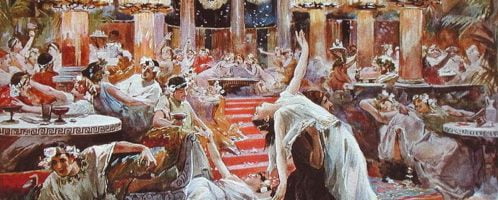
“Trimalchio’s dinner” – work showing richness of Roman feasts

“Trimalchio’s dinner” (Cena Trimalchionis) is a preserved fragment of the Roman novel Satyricon, which in a mocking and realistic way depicts Roman society from the middle of the 1st century CE. The work itself it has been preserved only fragmentarily, and to this day there are disputes about its authorship.

Ulpiano Checa y Sanz, Banquet in Nero's Palace

Senatus consultum Silanianum – resolution authorizing torture of slaves whose owner was murdered

During the existence of the Republic, the Senate had mainly an advisory function. However, after Octavian Augustus took power in 27 BCE, the role of the Senate changed. Since then, this institution had a legislative function, and the adopted resolutions had the force of binding law and often rewarding the upper classes. The resolution of the Senate was called Senatus consultum. In 10 CE, one of the most brutal resolutions was adopted – Senatus consultum Silanianum.

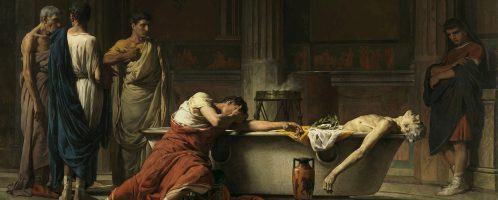
Manuel Domínguez Sánchez, Suicide of Seneca

Embankment on Hadrian’s Wall

Hadrian’s Wall, Vallum Hadriani, is perhaps the most famous of the Roman limes. It was built in the years 121-129 CE and stretched 117 kilometres in the present-day village of Bowness on the Solway Firth to the Segedunum fortress (today it is Wallsend on Tyne).

Hadrian's Wall

One more secret of Petra

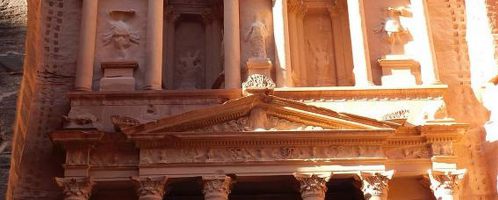
One of the most interesting – and possibly the most beautiful – cities of the Roman Empire was the former capital of the Nabataean Kingdom: Rakmu, better known as Petra. Incorporated into the empire during the reign of Trajan in 106 CE, it became the capital of the Arabia province and began to develop dynamically.

Tomb in Petra

Spelling error report

The following text will be sent to our editors: