If you have found a spelling error, please, notify us by selecting that text and pressing Ctrl+Enter.

Biographies of Romans

The history of ancient Rome saw the emergence of many outstanding figures who left a lasting mark on the history of the world. Some of them are remembered by posterity as cruel tyrants, such as Caligula, Nero, and Caracalla. Others became renowned as reformers and builders of the Roman state’s power, including Augustus, Claudius, Marcus Aurelius, Diocletian, and Constantine the Great. It is also impossible to ignore the Roman generals, who often saved the state from collapse.

History also includes outstanding figures of Roman culture – writers, philosophers, and artists whose work had a profound impact on the development of European civilization. In this section, I present profiles of individuals who achieved great deeds or whose actions left a lasting mark on the pages of history.

Britannicus

(12 February 41 - 11 February 55 CE)

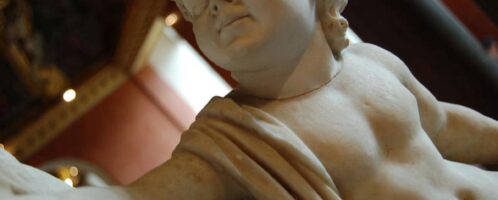
Britannicus was the son of the emperor Claudius and Messalina. He received the nickname to celebrate the conquest of Britain by his father in 43 CE. He was murdered by order of Nero, as a rival to the throne.

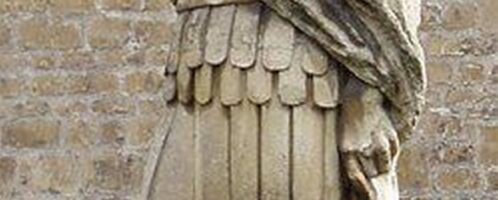
Detail of the statue showing Britannicus

Martial

(c. 40 - c. 102-104 CE)

Latin poet, considered to be the creator of the epigram (a short lyrical piece with an expressive punch line). Author of 15 books of epigrams.

Martial

Gnaeus Julius Agricola

(13 June 40 - 23 August 93 CE)

Julius Agricola was a Roman commander who in the years 77-84 CE was governor in Britain. In 80 CE he undertook an expedition to conquer Caledonia (currently Scotland).

Statue of Julius Agrykoli in Bath (England)

Titus Flavius

(30 December 39 - 13 September 81 CE)

Titus Flavius was a Roman emperor in 79-81 CE. He ended the Jewish war. During his reign, there was also the eruption of Vesuvius.

Titus Flavius

Flavius Josephus

(37 - after 94 CE)

Flavius Josephus ​​was a Jewish historian who, after being liberated by Vespasian, devoted himself entirely to literary work. He described the Jewish uprising.

Flavius Josephus

Nero

(15 December 37 – 9 June 68 CE)

Nero was the Roman emperor ruling in the years 54-68 CE. He is known in history as a tyrant. He was considered the first emperor persecuting Christians.

Nero

Statilia Messalina

(c. 35 - after 69 CE)

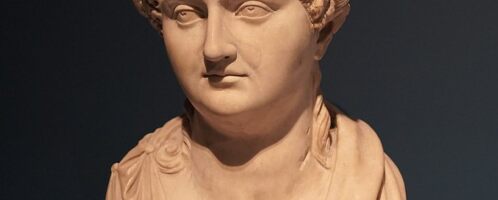
Statilia Messalina was the third and last wife of Emperor Nero. She came from a senatorial family, which enjoyed great fame.

Statilia Messalina

Marcus Salvius Otho

(28 April 32 - 16 April 69 CE)

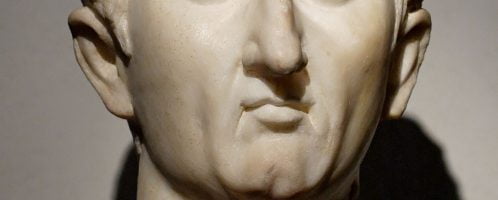
Marcus Salvius Otho, after the murder of Galba, became the Roman emperor as a candidate of praetorians. He was the emperor from January to April 69 CE.

Marcus Salvius Otho

Nerva

(8 November 30 - 27 January 98 CE)

Nerva was a Roman emperor in the years 96-98 CE. The progenitor of the Antonine dynasty, which gave Rome five good emperors. He adopted Trajan.

Nerva

Flavia Domitilla

(before 20 - before 69 CE)

Flavia Domitilla (before 20-before 69 CE) was the wife of Vespasian, the mother of the Flavian dynasty and its successors: Titus and Domitian. She came from the city of Ferentium in central Italy. Her father Flavius ​​Liberalis was a modest official. Some sources even say that he was a scribe. Domitilla herself was forced to prove her free birth and Roman citizenship several times.

Flavia Domitilla

Spelling error report

The following text will be sent to our editors: