
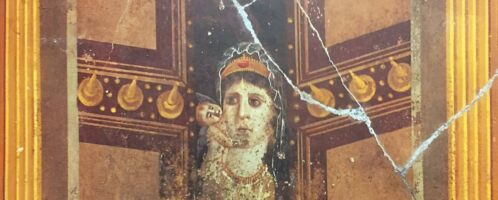
Cleopatra and her son Caesarion on Roman fresco
Roman fresco discovered in Pompeii that depicts queen Cleopatra and her son Caesarion as Venus and Amor. Dated to the 1st century CE.
If you have found a spelling error, please, notify us by selecting that text and pressing Ctrl+Enter.
Artifacts is a collection of curiosities dedicated to objects left behind by the ancient Romans. This category features lesser-known facts and interesting information about archaeological finds, such as tools, weapons, coins, inscriptions, and everyday objects, which provide a deeper understanding of life in the Roman Empire.
Roman fresco discovered in Pompeii that depicts queen Cleopatra and her son Caesarion as Venus and Amor. Dated to the 1st century CE.
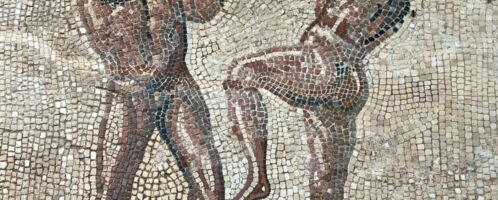
Roman mosaic showing a boxing match. The object was discovered on the site of the Roman Augusta Treverorum (present-day Trier, in western Germany). Dated to the mid-4th century CE. The artifact is located in the Rheinisches Landesmuseum in Trier.
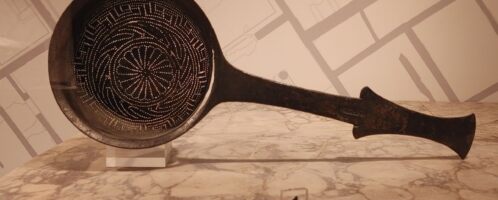
Roman colander, made of bronze, discovered in Herculaneum. The object is on display in the museum in Herculaneum. The colander was used, among other things, to strain and cool wine and other liquids with snow1.
Roman sculpture showing man in military uniform, with a modern head of Julius Caesar. The object dates back to the 2nd-3rd century CE. The artifact is located in the National Archaeological Museum of Naples.

Roman relief from the 3rd century CE showing Mithras killing a bull. When the photo was taken, the object was on display at the National Archaeological Museum of Naples.

Roman fresco depicting a fountain and a bird. The object dates back to the 1st century CE; found in Pompeii. The artifact is located in the National Archaeological Museum of Naples.

Roman wall fresco from Herculaneum or Pompeii showing a view of a seaside villa and sailing boats. The artifact is located in the National Archaeological Museum of Naples.

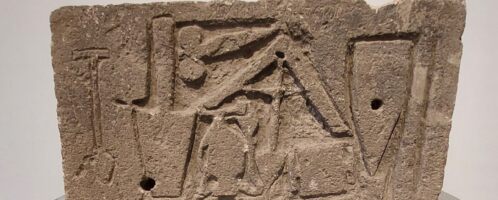
Roman relief from Pompeii showing construction tools used by the “master builder” (structor): trowel, plumb line, hammer, scalpel. There is also a phallus visible on the stone – a symbol of prosperity and happiness. The facility is located in the Antiquarium Parco Archeologico Pompei.
Roman bas-relief depicting a juggler. The object dates back to the 1st century CE. The artifact is in the Atestino National Museum in Italy.

Roman sculpture showing a Hellenistic ruler. The artifact is located in the National Archaeological Museum of Naples.
