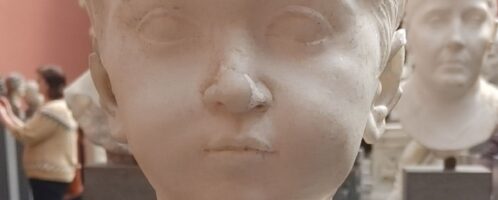
Roman woman with lush curls on sculpture
Roman woman with lush curls on sculpture. The object dates back to the 3rd century CE. The artifact is located in Ny Carlsberg Glyptotek in Copenhagen (Denmark).
If you have found a spelling error, please, notify us by selecting that text and pressing Ctrl+Enter.
The world of the ancient Romans was rich in extraordinary, and sometimes even surprising, facts. We draw our knowledge of Roman daily life, customs, and mentality primarily from works left by ancient writers and historians. It is thanks to them that we discover information that is astonishing today – sometimes even hard to believe. Below are some interesting facts that reveal a lesser-known and less obvious side of the Roman world.
I encourage you to submit your own suggestions and to report any corrections or inaccuracies.
Roman woman with lush curls on sculpture. The object dates back to the 3rd century CE. The artifact is located in Ny Carlsberg Glyptotek in Copenhagen (Denmark).

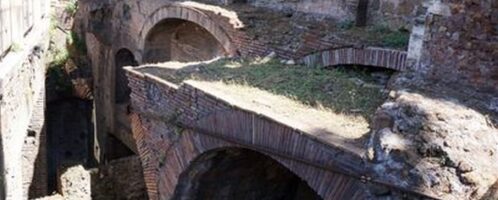
The insula was built at the turn of the 1st and 2nd centuries CE and was later rebuilt many times. It is located at the foot of the Capitoline Hill, from Via del Teatro di Marcello, and is perfectly visible to everyone heading from Piazza Venezia towards the monumental stairs leading to Piazza dell Campidoglio. Today, only three floors of the tenement house protrude above the street level – the second and third floors, as well as a small part of the fourth floor. The ground floor and first floor are located in a deep excavation and can only be seen by leaning over the railing (be careful!). Unfortunately, only the second and third floors can be visited. The rest are closed and even with a reservation it is impossible to see them.
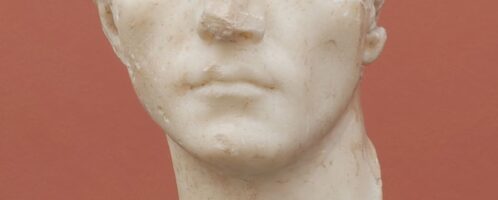
Preserved sculpture of Germanicus, which dates back to 15 BCE – 19 CE. The artifact is located in Ny Carlsberg Glyptotek in Copenhagen (Denmark).

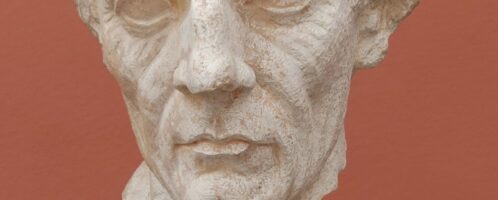
Realistic sculpture of Roman. The object dates back to the 1st century BCE. The artifact is located in Ny Carlsberg Glyptotek in Copenhagen (Denmark).
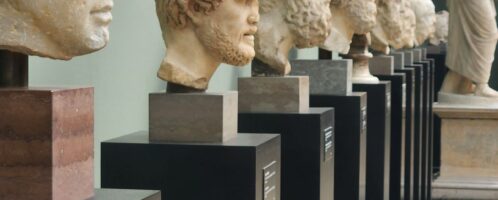
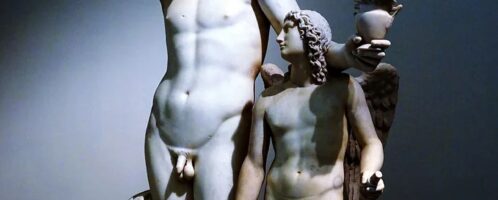
Preserved Roman and Greek sculptures on display at the Ny Carlsberg Glyptotek in Copenhagen (Denmark).
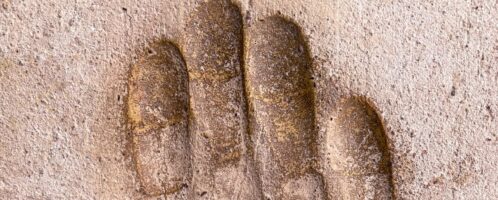
Preserved Roman brick that shows the handprint of a man who probably placed his hand on the material while it was drying after kneading. The object is about 2,000 years old and was found in Algeria, in the city of Cherchell. The artifact is located in the Archaeological Museum in Cherchell.
Here is a sculpture from the 2nd century CE, probably a Roman copy of an older Greek work. Its detailed origin is unknown. At first, the entire group may evoke mixed feelings and unhealthy associations. Indeed – from our perspective, a naked adult young man with a much younger and also naked boy does not look good.
Young man from the reign of Emperor Nero (54-68 CE). The Roman sculpture is in the National Archaeological Museum of Naples.
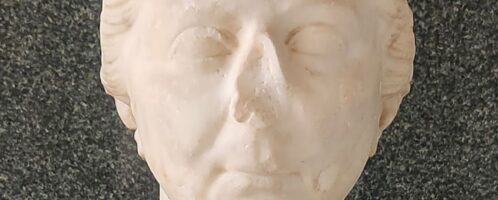
Roman matron depicted in a sculpture. Object made of marble; dating back to the 1st century BCE.
Roman sculpture of a young boy. Object dated to 30-50 CE; discovered in a tomb in Rome. Portraits of children were not common until the reign of Emperor Augustus (27 BCE – 14 CE).