Chapters
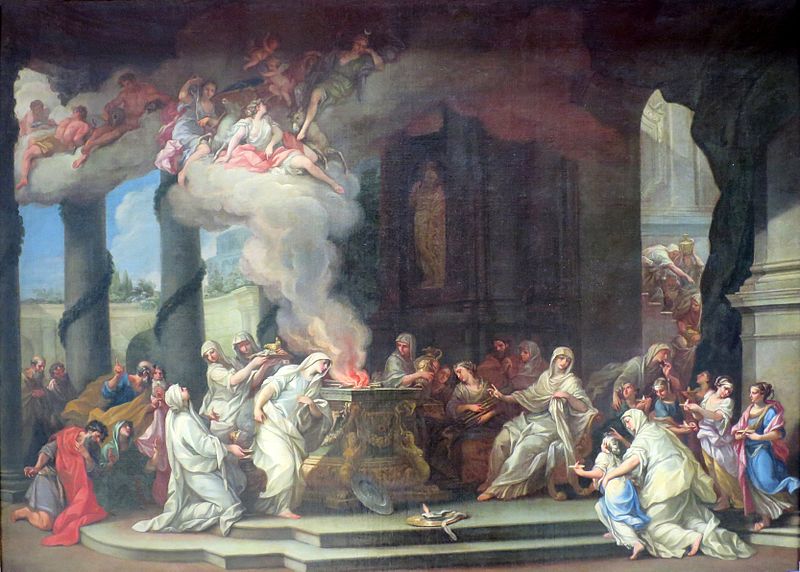
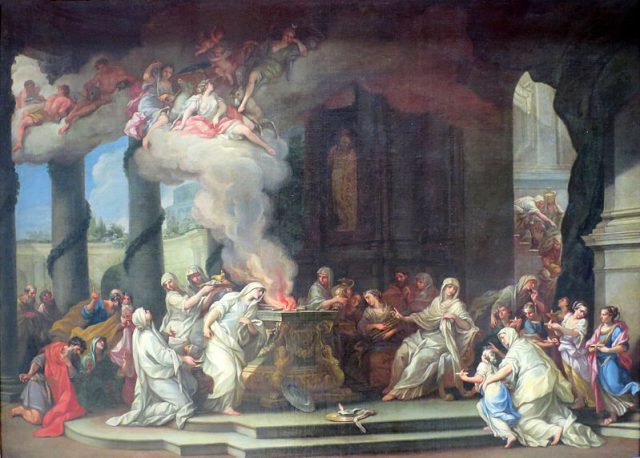
Vestal virgins (Virgines Vestales) were virgins who guarded the sacred fire goddess Vesta (goddess of the hearth and state) in the temple at Forum Romanum. The superior of the Vestals was Virgo Vestalis Maxima, the oldest Vestal, and their religious guardianship was exercised by Pontifex Maximus. He also selected the girls for the ministry.
We do not know the origins of the “Order of Vestals” – just like the Romans themselves, for whom it was also a mystery. According to Roman myth, the mother of Romulus and Remus – Rhea Sylvia – was a Vestal. She was the daughter of the king of the city of Alba Longa, Numitor, who was exiled by Amulius. the new ruler forced Rhea to enter the priesthood; she, however, became pregnant by the god Mars himself. From their union were born twins, which later gave rise to Rome. Rhea herself was condemned to be buried alive, and her cult was revered in Rome.
Vestal virginity
It is commonly believed that the Vestals were appointed by the second king of Rome – Numa Pompilius, who reigned in the years 715 – 673 BCE. According to the adopted laws, a vestal woman had to remain in service for 30 years (for the first 10 years she learned the rules, for the next 10 she performed the proper duties, and in the third decade she took care of novices) and keep her virginity during this time. It is not entirely clear why such restrictions were introduced in the life of priestesses. Plutarch of Chaeronea wrote:
Numa is ascribed the consecration of the Vestal virgins, and in general the worship and care of the perpetual fire entrusted to their charge. It was either because he thought the nature of fire pure and uncorrupted, and therefore entrusted it to chaste and undefiled persons, or because he thought of it as unfruitful and barren, and therefore associated it with virginity.
– Plutarch, Numa, 9
Modern scholars suspect that the Vestal Virgins were originally girls who were to be sacrificed at the appropriate moment. Any transgressions of the Vestal were punished by the high priest with flogging.
The loss of virginity by a Vestal while on duty was one of the greatest crimes that could be committed in ancient Rome – the so-called incestum. It was an immoral and downright godless act. This was a kind of betrayal of the Roman people, which could bring Vesta’s wrath upon Rome. Fornication itself – crimen incesti– was considered one of the greatest offenses. Anyone could report the guilt – even a woman or a slave. The decision was greatly influenced by whether there were ominous signs (prodigia) at that time: the defeat of the Roman army or a threat to the state. The high priest decided the guilt – if he found the vestal woman guilty (she was guilty even when she lost her virginity as a result of rape[note id=”1″]) she was immediately buried alive in an unmarked grave in a place called “Bad Field” (Scelera Campus), near the Kollin Gate. This is how the whole process of burying the Vestal was described by Plutarch:
Here a little ridge of earth extends for some distance along the inside of the city-wall; the Latin word for it is “agger.” Under it a small chamber is constructed, with steps leading down from above. In this are placed a couch with its coverings, a lighted lamp, and very small portions of the necessaries of life, such as bread, a bowl of water, milk, and oil, as though they would thereby absolve themselves from the charge of destroying by hunger a life which had been consecrated to the highest services of religion. p345 6 Then the culprit herself is placed on a litter, over which coverings are thrown and fastened down with cords so that not even a cry can be heard from within, and carried through the forum. All the people there silently make way for the litter, and follow it without uttering a sound, in a terrible depression of soul. No other spectacle is more appalling, nor does any other day bring more gloom to the city than this. When the litter reaches its destination, the attendants unfasten the cords of the coverings. Then the high-priest, after stretching his hands toward heaven and uttering certain mysterious prayers before the fatal act, brings forth the culprit, who is closely veiled, and places her on the steps leading down into the chamber. After this he turns away his face, as do the rest of the priests, and when she has gone down, the steps are taken up, and great quantities of earth are thrown into the entrance to the chamber, hiding it away, and make the place level with the rest of the mound. Such is the punishment of those who break their vow of virginity.
– Plutarch, Numa, 10
In turn, the man who copulated with the holy priestess was scourged to death.
Roman historians describe several cases of this punishment: the delinquent was buried alive in the grave, leaving her some food and water and a lamp; then she was left to die and no more interest was given to her. In 1000 years, only 10 Vestals have received this punishment.
Priestly service
Originally, the sacred fire was guarded by two Vestals, then four, in the late republic and early empire, six, to establish seven at the end of the empire. The Vestals lived in a house by the temple in the Roman Forum – the so-called atrium vestae – and were thus the only priestesses with their own “menial quarters”. Their duties included, among others: carrying water from the holy spring of the nymph Egeria, with whom the temple was cleansed.
The aforementioned high priest – Pontifex Maximus – was the superior of the Vestals and chose new adepts from among the girls aged 6-9. Very often “recruitment” took place among nobles; sometimes, however, the fathers of the families did not agree to give their daughters 30 years of service.
Despite their very strict life, the Vestals enjoyed many privileges, e.g. not subject to the authority of their fathers or brothers, could watch the shows in the places of honor. Even consuls gave way to them in the streets, and a convict who met a vestal woman could count on a pardon. By contrast, a person who passed under the Vestal’s litter was immediately lost. The position of the Vestals was so great that sometimes they supported Roman politicians with their status – thanks to them, e.g. young Julius Caesar escaped death when Sulla reigned in Rome.
After finishing her service, a vestal woman could marry and have children. This is how the life of a Vestal “retired” is described by the aforementioned Plutarch:
[…] a priestess, if she wanted, could marry and change her lifestyle, but after having renounced the priesthood. They say that only a few enjoyed this freedom, and that the dissatisfied did not succeed in practice and spent the rest of their lives seized with some madness and shame, which in turn gave rise to such superstitious fear in others that throughout their old age and until death they lived abstinently, keeping their virginity .
Finally, it is worth noting that the Vestals were a really important part of the socio-religious life of Rome and were held in great esteem. The proof of this is the ode Horace Exegi monumentum, in which the writer mentioned as symbols of the eternity of Rome: the high priest (Pontifex Maximus ), The Capitol and the silent Vestal.
The end of the Vestal ministry
The Vestals held office until the late period of the Roman Empire. In 357 CE the Christian ruler Constantius II approved the privileges of the Vestals and confirmed the old Roman customs.
The end of the existence of the “virgin priestesses” came in 391 CE, when Theodosius I the Great defeated the Western emperor Eugene – a supporter of paganism. Apparently, during the battle, the faces of Eugeniusz’s soldiers, tipping the scales of victory in their favour, were hit by a hurricane. This led to the defeat of the western leader. Theodosius I recognized this as proof of the victory of Christ’s faith over the pagans.
Christian messages say that in 394 CE “older vestal woman” (virgo Vestalis maxima) – Coelia Concordia – accepted the Christian religion, which was also proof of the end of the era. A different story is told by the pagan historian Zosimos (5th century CE). He mentions that Serena – the wife of the Roman general Stilicho and a Christian – entered the temple of Vesta, took off the necklace from the statue of Rhea Sylvia and put it on herself. An old woman, one of the last Vestals, was indignant at such an act of sacrilege. Due to the priestess’s boldness, Serena banished her and her companions. The Vestal in return cursed her, her husband, and her children. Serena later reportedly had dreams in which she saw her own death. She was finally hanged in 408 CE because of the accusation of conspiring with the Goths.
Finally, it is worth mentioning that Christian writers, such as the bishop of Milan – Ambrose (339-397 CE), had a very negative attitude towards the Vestals. A Christian author claimed, for example, that the seven Vestals are nothing compared to the multitude of Christian virgins who voluntarily live in chastity and vows.