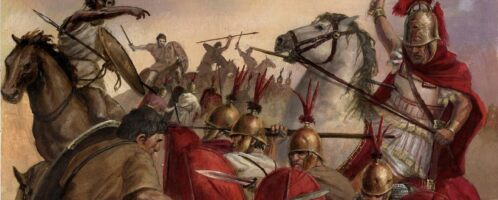
Centurions of Gaius Julius Caesar
The wars fought by the Romans in the late Republic era made many legions, and even individual soldiers, almost as famous as their leaders. At that time, the Roman army was practically a professional army.
If you have found a spelling error, please, notify us by selecting that text and pressing Ctrl+Enter.
Roman state existed for nearly thirteen centuries, repeatedly exerting a profound influence on the course of history. I present the history of ancient Rome in the individual articles below, which not always refer solely to the Eternal City itself but encompass the wider world of the Roman Empire.
I encourage you to submit your own articles and to report any corrections or factual inaccuracies.
The wars fought by the Romans in the late Republic era made many legions, and even individual soldiers, almost as famous as their leaders. At that time, the Roman army was practically a professional army.

When the Visigoths conquered Rome in 410 CE, contemporaries thought that the end of the civilized world had come. In fact, Rome was no longer the capital of the Empire and was no longer as important as it used to be, but it was still a symbol of Roman civilization.
The purpose of this text is to introduce a little symbolism and also to take a closer look at one of the most terrifying punishments of the Roman judiciary. Poena cullei, or the so-called punishment of the sack, is most commonly known as the one suffered by patricides in ancient Rome. The condemned man was sewn up in leather sackcloth with the company of four animals – a dog, a monkey, a snake and a rooster. Then the sack, along with the live contents, was thrown into the river. But this is just one of the harsh faces of Roman justice administered through poena cullei. What else do we know about it?

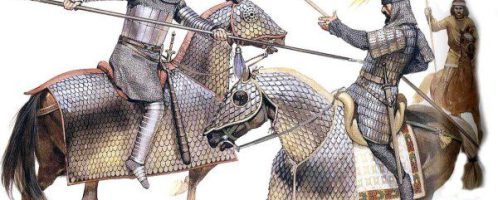
The history of the heavily armed cavalry probably dates back to the steppe areas, where it developed among the Turkestan nomads. Herodotus, known as the “father of history”, mentions in his work the heavy Massagec cavalry fighting in the army of the kings of the Achaemenid dynasty. Heavy cavalry was the basis of the Persian military power, and the main role was played by the Median cavalry.
In ancient times, the inhabitants of a given country (city) considered their land to be the centre of the world, having the form of a flat disk. Moreover, according to them, the ends of the world were inhabited by mysterious beings and barbarians who were a threat to the civilized world.

The declining period of the Roman Republic was full of violent political conflicts ending in bloodshed. Groups of people who in modern times would undoubtedly deserve the name of political militias had a large share in this.
In ancient Rome, dogs were written relatively much and rather flatteringly. It was an animal ubiquitous in the culture and everyday life of the Romans and the inhabitants of the Roman Empire. They wrote about him Pliny the Elder, Cicero, Columella, Cato the Elder and many other less famous authors.

We associate a lawyer with a highly rational person, based on irrefutable evidence and facts, respecting the written law. Religion, faith and worship do not go hand in hand with this profession, at least not in terms of judgment, but you should be aware that the lawyers of ancient Rome, known for their activities during the times of the emperor Septimius Severus (by the way, a great lover of law since his childhood), their roots go back to the function of a pontiff, that is, an archaic priest.

Jugurtha (born around 160 BCE and died in 104 BCE) was the grandson of Masinissa, meaning the ruler of Numidia who at the end of the Second Punic War went over to Rome, contributing to the victory of Scipio Africanus the Elder took over Hannibal in the battle of Zama in 202 BCE and which he acknowledges he was crowned Numidia.
Berenice, the Jewish queen from the east, almost became empress of the then-largest state – the Roman Empire.