

Chapters
One of the most famous events in human history is undoubtedly the crucifixion of Jesus Christ in the early 30s of the 1st century CE. For this reason, along with the development of cinematography, many works were created to show the life of Christ: his birth, teaching, death and resurrection. Most of these works show Roman soldiers, specifically – legionarys, who most of the time appear only as a background.
It is only when Christ is handed over to Pilate on Good Friday that the legionaries become active participants in these memorable events, either as flagellants, mocking the Messiah1, or as people praising Christ2. In this work, I will address the issue of the reconstruction of these people in movies on biblical themes and compare their appearance in the movies to the actual appearance of a legionary stationed on the eastern edge of the Roman Empire.
A legionary in the east – actual armament, clothing, service
Before I turn to the above-mentioned topic, I would like to write about the greatest paradox of the whole situation. Well, no legion was stationed in Judea in the 1930s. The closest ones were stationed in Syria (e.g. legio III Gallica, legio VI Ferrata) and Egypt (legio XXII Deiotariana). It is known, however, that auxiliary troops were stationed in Judea. These were namely: ala I Sebastian, cohors I Sebastian, and 4 other auxiliary infantry cohorts3. The Jerusalem garrison itself consisted of auxilia soldiers. This means that it was the soldiers of these formations who were probably responsible for the passion of Jesus Christ (there is a small chance, however, that there were some small groups of legionaries in Judea who were stationed there in a police capacity, but there are no sources for this). However, since only legionaries are reconstructed in (not only biblical) films, I will focus on them, apart from the fact that legionaries probably did not take part in those events.
So let us introduce the figure of the eastern legionary: his everyday clothes consisted of a tunic, a belt and shoes. As for the tunics, they were of different colours and did not differ much from those used by civilians. The belt and boots, on the other hand, were typically military. Balteus took the form of a belt decorated with silver plates. It was a symbol of a legionary, so taking it off meant “suspension” in being a soldier4. Boots, meaning the leather caligae or calcei, were another soldier’s mark. Their characteristic feature was a thick, studded sole, which announced from a distance who you were dealing with.
The most famous weapon of the legionary was the short sword – called gladius by the contemporaries (for the Romans the word “gladius” simply meant “sword”, whether it was long or short). In the times discussed in this work, the Mainz type gladius was dominant, compared to its predecessor, the Spanish type, it had a shorter and wider blade (about 40 cm) and a longer and tapering point. Despite popular thinking, gladius was used not only to inflict thrusts but also cuts5.
The pilum was a heavy javelin about 2 meters long. The pilum was used by the legionaries at the beginning of the battle – Roman ranks threw javelins to pierce the opponents’ shields and rendered them useless. This was possible due to the fact that the pilum had a spindle of about 90 cm, ended with a pyramidal or flat point, which often bent when piercing the shield, which made it impossible to get rid of the spear. The maximum range was 30 meters. The pilum was not used in close combat.
The Scutum legionary’s shield was made of planed wooden slats, laminated in three alternate horizontal and vertical layers. It was covered with linen and animal skin. At the beginning of the 1st century CE, scutum took the form of a convex, rectangular plate. An important element of the shield, which was used to deal blows with the shield, was umbo, i.e. the iron, central part of the shield, most often characterized by a circular shape.
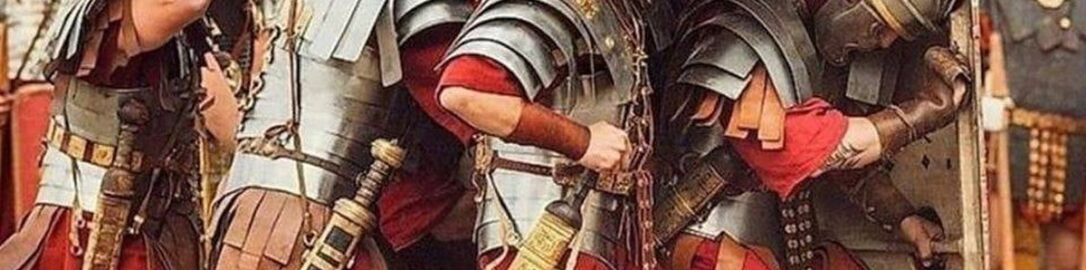
In the 1st century CE, the Roman army was dominated by three types of armour. Lorica segmentata was an armour made of iron plates. It provided good protection for the shoulders, chest and abdomen. The next armour was lorica squamata, that is, scale armour. Made of metal plates, it was very popular with centurions and other officers6. The last type of armour, lorica hamata, was the most popular in the east (segmentata never replaced it). The chain mail consisted of many chains joined together, had short sleeves and reached the thighs.
In the 1930s, most legionaries wore Gallic helmets. These were modified iron Gallic helmets of the Port and Agen types. The helmet consisted of a one-piece canopy, with “eyebrows” at the front of the canopy, and a pleated nape. The helmets also covered the cheeks and had ear holes so that the soldiers could better hear the orders of their superiors.
Roman soldiers during peace (and this was the state then in most Roman provinces in the 30s CE; peace was interrupted only in 35 years of the fight for Armenia, in which the governor of Syria, Lucius Vitellius, was involved) performed various activities to bring development and peace to the provinces. Thus, the soldiers served as messengers