Chapters
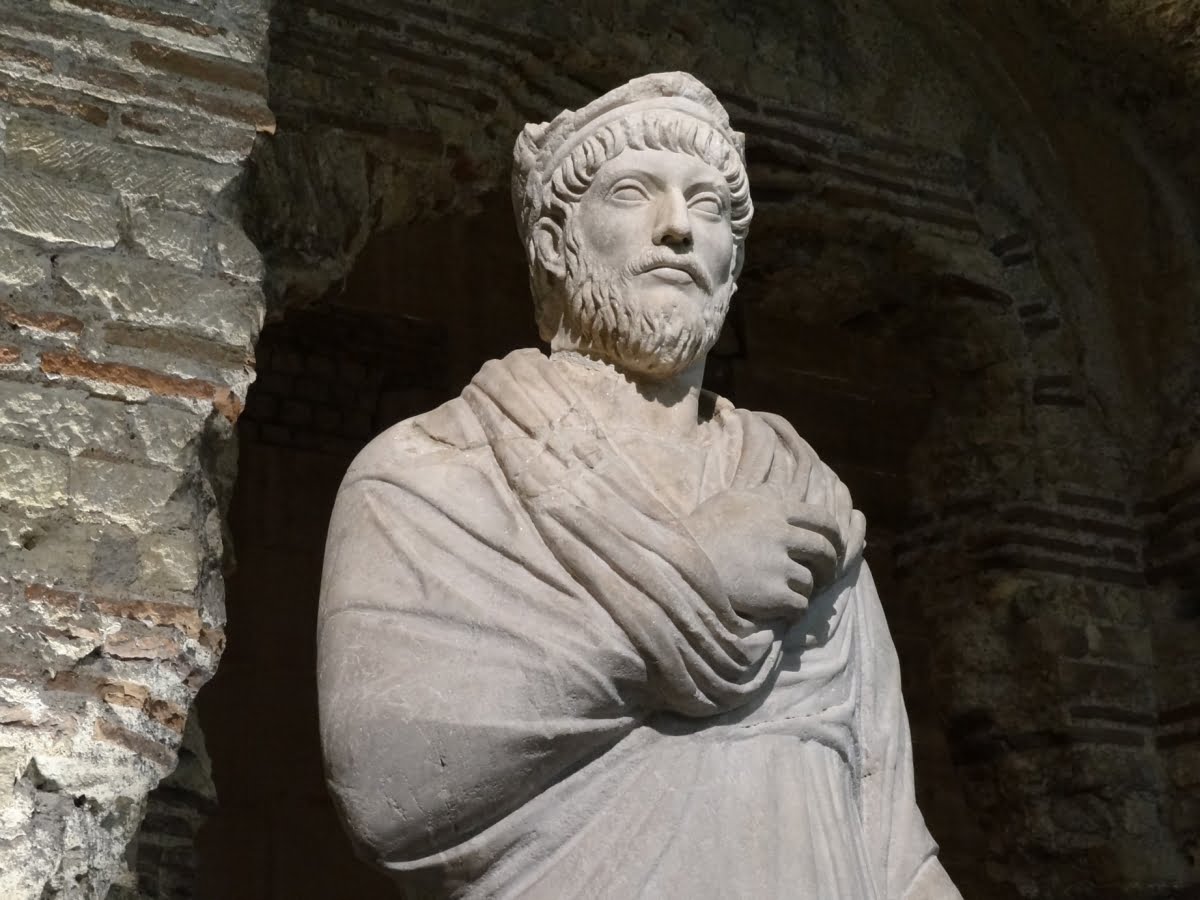
Roman Emperor Julian, called the “Apostate” by Christians, reigned in the years 361-363 CE. He was the greatest of Roman rulers. Living in difficult times, he was able to carry out numerous internal reforms and conduct an active foreign policy. At the same time, he was a lover of ancient Roman deities, which created a conflict with the growing Christianity. What was the religious policy like under the Emperor Julian the Apostate?
Family murder and Julian’s upbringing
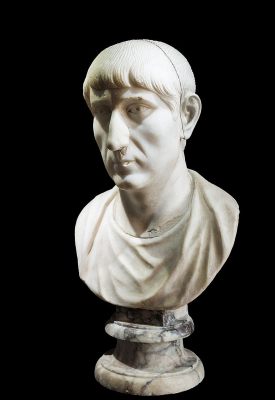
Flavius Julian was born in the year 331 or the spring of 332 in Constantinople. He was the son of Julius Constantius, who in turn was the half-brother of Emperor Constantine I and his second wife Basil, women with Greek roots. Both his parents were Christians, but it was Julian’s mother’s house that was more closely related to the achievements and values of ancient culture. Julian’s paternal grandfather was the emperor of the west, Constantius Chlorus.
When Constantine the Great died in 337 CE, there was a serious turmoil in the government. Wanting to stabilize and strengthen his position, Constantius II, the son of the deceased emperor, shortly after his death, ordered the massacre of his relatives from the second marriage of his grandfather Constantius I Chlorus. Eutropius, a Roman historian writing between 350 and 370 CE, argued that Constantius approved more than ordered1; Julian later had a different opinion, accusing his cousin of murdering his father in a “Letter to the Athenians”. Two of Constantius’s uncles (including Julian’s father) and six cousins, including Dalmatian and Hannibalianus, stewards of (successively) Moses and Pontus, were killed. The massacres were avoided by two brothers of Constantius II: Konstantyn II (the elder) and Konstans (the younger) and three cousins: Gallus, Nepocjan and Julian himself. It was Julian’s family that suffered the most in this family murder.
Shortly thereafter, Constantius II met his brothers in Pannonia in the city of Sirmium to divide the Empire. Eventually, Constantius received the eastern provinces, including: Constantinople (which was the capital from his father’s time), Thrace, Asia Minor, Syria, Egypt and Cyrenaica. His brother Constantine II received: Britain, Gaul, Spain and Mauritania; when Konstans had to be content with: Italy, Africa, Illyria, Pannonia, Macedonia and Achaea.
Julian and Gallus were excluded from public life and were under guard in their youth. At the behest of Constantius II, who professed Arianism, the stepbrothers were to be brought up in the Christian faith. The very fact of saving the two heirs probably resulted from their young age and the instigation of Empress Eusebia herself, the second wife of Constantius, who clearly favoured Julian in particular (the later emperor was very grateful to her for this). If Julian’s writings are to be believed, Constantius would later regret his decision to murder his family in 337 CE.
Julian originally grew up in Bithynia under the care of his maternal grandmother. At the age of seven, the boy was brought up by Eusebius – the Christian bishop of Nicomedia, the capital of Bithynia on the southern shore of the Black Sea. The boy spent two years there, and when Eusebius became Bishop of Constantinople, he moved with him to the Bosphorus. Julian’s teacher was also Mardonius – a Gothic eunuch and follower of Christ. Thanks to his teachings, Julian got to know not only the old Greco-Roman culture but also the holy writings of Christians. When Eusebius died in 342 CE, both Julian and Gallus were transferred to an imperial villa in Macellum, Cappadocia. This is how Julian describes this time in his memoirs:
For we lived as though on the estate of a stranger, and were watched as though we were in some Persian garrison, since no stranger came to see us and not one of our old friends was allowed to visit us; so that we lived shut off from every liberal study and from all free intercourse
– Julian, Letter to the Athenians
It was also there that Julian met the Christian bishop Jerzy (called Gregory of Cappadocia), who provided young Julian with books of classical culture, which he, in turn, wanted to explore. In Macellum, Julian and his brother were presumably also baptized. When Julian reached the age of 18, Constantius allowed him to leave Macellum and go to Constantinople and Nicomedia.
Conversion to paganism and education
In Constantinople, Julian became a lector (low position in the Christian Church). His later works show that he knew the Bible to a large extent and he was eager to study it in his youth. Later in CE 362, when Julian was 31, he stated that he had spent over 20 years in harmony with Christianity, only to devote 12 years to a good way of life in accordance with the god Helios.
In Constantinople, Julian, because he was a Christian, could not attend the school of rhetoric led by Libanius, one of the most outstanding non-Christian intellectuals of the 4th century CE, however, despite the fact that he could not attend lectures, he observed his work and achievements from a distance with sympathy. schools.
In 351 CE, Julian studied Neoplatonism in Asia Minor under Edesius and then Maximos of Ephesus. There, he had a spiritual breakthrough. This is how Libanius related it:
[He] at last having got into company with those who were full of Plato, and hearing from them about the gods and genii, and those that had really created, and do maintain the universe, and what the soul is, and whence it came, and whither it goes, and by what things it is submerged, and by what is it captured, and by what it is weighed down, and by what it is elevated; also what are its bonds, and what its liberation
– Libanius, Libanius’ funeral oration upon the emperor Julian
So young Julian secretly broke up with Christianity. The young man was particularly impressed by the theurgy proposed by Maximus, which Professor Aleksander Krawczuk translates as “God’s action”, that is, cooperation with the gods to pursue their intentions. Though theurgy was not based on magic, it was certainly a secret science. Its basis, however, was the philosophy cultivated by the Platonists at the time.
At that time, Julian began to notice the conflict of the Christian environment. He was offended by the dogmatic disputes with which the followers of Christ devoted themselves with aggression in the 4th century CE. The Arians – the adherents of the theory that Jesus was the highest of God’s creatures – opposed the Orthodox believers who considered Jesus consubstantial with God the Father. Julian was also offended by the ostentatiously devout Christianity of Constantius, whom he considered the murderer of his father.
Then, in 354 CE, Julian was summoned to the Mediolanum (now Milan), where he was in court, and then in 355 CE he could study in Athens. There he met two men who later became important figures in the Church: Basil the Great and Gregory of Nazianzus. The latter later interpreted Julian’s arrival in Greece as follows:
At that time, therefore, I remember that I became no bad judge of his character, though far from being of much sagacity in that line; but what made me a true guesser was the inconsistency of his behaviour and his extreme excitability (that is, if he be the best diviner who knows how to guess shrewdly). A sign of no good seemed to me to be his neck unsteady, his shoulders always in motion and shrugging up and down like a pair of scales, his eye rolling and glancing from side to side with a certain insane expression, his feet unsteady and stumbling, his nostrils breathing insolence and disdain, the gestures of his face ridiculous and expressing the same feelings, his bursts of laughter unrestrained and gusty, his nods of assent and dissent without any reason, his speech stopping short and interrupted by his taking breath, his questions without any order and unintelligent, his answers not a whit better than his questions, following one on top of the other, and not definite, nor returned in the regular order of instruction.
– Gregory of Nazianzus, Second invective against Julian
Probably such an unfavourable assessment of Julian was due to the fact that he turned away from the teachings of Christ and returned to the ancient Roman tradition. For example, non-Christians (including Libanius) wrote enthusiastic characteristics of Julian – they praised his taste for philosophy and the literary value of the writings he left behind. Ammianus Marcellinus also presented Julian favourably, in direct contrast to the description of Gregory. As professor Krawczuk claims, perhaps both descriptions are correct – Grzegorz shows Julian from his studies and Marcellinus from his mature period.
During his stay in Athens, Julian also participated in the Eleusinian Mysteries which lost their symbolism in the Mediterranean world (finally banned in 391 CE by Emperor Theodosius). They belonged to the most important and sacred religious cults of the Greek world. To participate in the rituals, it was enough to speak Greek and be in a state of ritual purity. Anyone could have the initiation: regardless of social status (free and slaves), sex or origin. The possibility of obtaining initiation was associated with the so-called purity of heart. The exact secret of the mysteries is said not to be revealed by any of the initiated.
When Constantine II died in 340 CE during the campaign against his brother Constantius, Constantius II became the only emperor of the West, and in practice 2/3 of the territory of the Empire. This state of affairs continued until 350 CE when Constans was murdered by forces loyal to the usurper Magnentius. Constantius II, as the only surviving son of Constantine the Great, considered himself the sole and rightful ruler of the entire Empire. He decided to retake the western lands and unify Rome. He decided to march west, led by 40,000 men, to defeat the usurper Magnentius.
At that time Constantius, wanting to strengthen his position and secure the rear, decided to make Julian’s brother Gallus the Caesar of the East. To make sure that his cousin did not decide to go against him, he married his scary sister, Constantine, for him. During his reign, Gallus introduced a time of terror that led to the decision to remove him from office and execute in 354 CE. Julian himself was summoned to the one-year trial on charges of the treacherous plot – allegedly tied together with his brother, and then Claudius Silvanus. In the end, Julian was cleared of the charges (Empress Eusebia herself had a large share in this, for which Emperor Julian was immensely grateful to her later) and went to Athens.
Coming to power
Constantius II, after defeating Magnentius and Silvanus, decided that he must entrust the management of Gaul to a trusted person. In 355 CE, Julian was summoned to Mediolanum before the Emperor, who on November 6 made him Caesar of Gaul, sealing this fact by giving him his sister, Helena, as a wife. Constantius, remembering the excesses and brutal decisions of Gallus, told Julian to have composure and the role of a puppet rather than a legal ruler. Julian set off for Gaul at the head of a small detachment, and the prefects of Constantius would wait for him on the spot, to follow his every move. Already during the journey, Julian was to notice that his soldiers were more devoted to prayers than to warriors. Julian had no experience in either military or administrative matters. At first, he was reluctant to make any political and military decisions, which was contrary to his enlightened education.
The young Caesar, however, quickly adapted to the new conditions. He turned out to be an excellent administrator. He was distinguished by enthusiasm, diligence and a desire to win over people. He tried to ease the population by reducing huge taxes. However, he turned out to be, above all, an excellent commander. He drove the Germans across the Rhine, captured the city of Colonia Agrippina (present-day Cologne) in 356 CE, and dealt a tremendous defeat to the Alamans in the Battle of Argentorate in 357 CE, although his forces were three times smaller. The battle stopped the plundering attacks of the barbarians on the territory of the Empire for a while.
Julian’s successes, both in the administrative and military fields, pleased Constantius on the one hand and disturbed him on the other. What he disliked most was the fact that Julian was gradually getting out of control of the prefects faithful to Constantius. At the end of 357 CE, Julian, shining with the glory of the victor, prevented the taxation of the praetorian prefect Florentius and personally took over the province of Belgica Secunda under his sovereignty. Julian sought to gain the support of the civilian population and tried to prove to them that it was worth remaining under the authority of the Empire. Julian’s broad and good education from his youth allowed him to introduce sensible reforms and curb corruption at the highest levels of government. Constantius, admiring Julian’s resourcefulness, decided to remove Salustios from the circle of his advisers (he later collaborated with Julian on the restoration of paganism), thus wanting to have some influence on his decisions.
In the fourth year of Julian’s reign, the Sassanid ruler Shapur II invaded Mesopotamia and captured the city of Amida (now Diyarbakir) after 73 days of siege. Constantius, realizing the gravity of the situation, demanded reinforcements from Caesar of the West in February 360 CE. Julian’s soldiers, coming from Gallic territories (the so-called petulantes), did not intend to march to the East, so in their chief’s favourite city – Lutetia (today’s Paris) – declared him Augustus. Despite his initial reluctance to this decision, Julian eventually took the title. However, he decided to write a letter to the emperor with an assurance of loyalty, which he, however, ignored and immediately began to prepare for the fight against the self-proclaimed one.
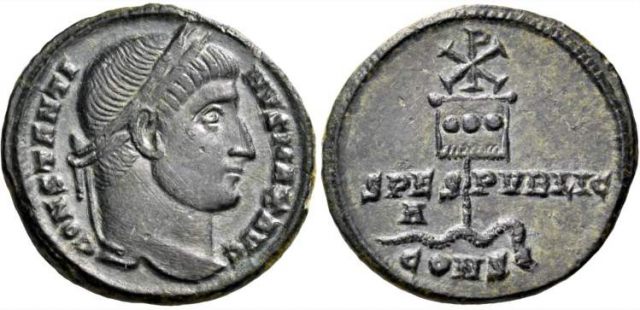
Julian then waged a war with the Franks in 360 CE from June to August. In November he officially started using the title Augustus; Coins with the title of Augusta were minted, with time without the image of Constantius. For the five years of his reign in Gaul, he organized major games.
In the spring of 361 CE, Julian led his army into the lands of the Alamanni, where he also managed to capture their king – Vadomarius. Fearing a simultaneous attack by Constantius and the barbarians, Julian divided the army into two groups. One crossed the Alps and walked along the Po valley; the second from the Rhine set off towards the Danube. Julian’s troops had captured several great fortresses, but a decisive clash with Constantius seemed inevitable. The army of Constantius marched from the east, and Julian could only wait for the enemy and write letters to the Greek cities in which he translated his actions. Unexpectedly, on November 3, 361 CE, Emperor Constantius died of an attack of fever. He appointed Julian as his successor in his will, who assumed full power.
Religious reform
Julian was the last emperor to profess the religion of the ancient Romans; both his uncle – Constantine and the whole family already professed Christianity. The reign of Julian (361-363 CE) is still a large division between the followers of ancient Roman deities and Christians. A great example was Rome, which was not dominated by either side. The empire, however, experienced a strong expansion of Christianity, especially in the cities that dominated the public sphere and teaching. The facilities of the last emperors played a large role in this.
Emperor Julian professed ancient Roman beliefs, which he closely connected with philosophy. As a follower of Neoplatonism, he was guided by the principles of impartiality and justice in his rule. He noticed the not entirely sincere and human face of faith in Christ – numerous divisions and quarrels, privileges of the clergy towards the rest of society and the wealth that was accumulated in the Church. His conversion to the pagan faith resulted, in part, from his fascination with culture and classical beliefs, as well as the murder of his family. The massacre committed on his relatives created for him the image of fanatical and wild Christians with whom he did not want to identify. This did not mean, however, absolute and mindless hostility; when the situation required it, as a seasoned politician he was ready to take part in services or to say goodbye to the deceased Constantius II.
Julian began his reign by criticizing his further predecessor – Constantine I, whom he blamed for the condition of the imperial administration (extremely extensive) and the departure from the ancient Roman tradition. After taking power, Julian began reforms aimed at restoring ancient Roman values and strengthening polytheism. In his actions, he modelled on the first Emperor Octavian Augustus, Trajan, and above all, Marcus Aurelius.
Julian primarily chose to return to the path of religious syncretism, placing worship of the Sun at the centre. Sol was the sun god; identified with the Greek Helios, who in the 3rd century took the form of the cult Sol Invictus (“Invincible Sun”). It was a new syncretic cult combining elements of Mithraism, the cult of El Gabal, Baal, Astarte, and the Roman solar deity Sol, who worshipped the sun as the embodiment of all other deities.
The return to ancient Roman ideals required a revival of the pagan faith in society. To this end, former pagan temples were recovered and restored after they had been confiscated or taken over by private persons under Constantine; the property of the temples was returned and the ritual sacrifice and pagan rites were restored. The privileges given to Christian priests were extended to pagan priests. The labarum bearing the Christian symbol was abolished, and the eagle banners reappeared on the battlefields. Images of pagan deities on coins have been restored.
Edict of tolerance
On 4 February 362 CE Julian issued an edict guaranteeing religious freedom – thus all faiths became equal before the law. This movement, apart from its obvious virtues, also had another, secretive purpose aimed at Christians. Julian aimed to reduce the role of Christians in the state and their quarrels. Christians opposed the edict on the grounds that it allowed for the existence of various Christian sects, which in turn increased divisions within the Church. Numerous representatives of various factions who were persecuted during the reign of Constantine and Constantius II returned from exile. Julian even arranged a meeting in the palace, inviting representatives of different versions of the religion. Ammianus claims that the emperor then realized that no wild animals are as hostile to man as some Christians are to another.
In the eyes of Christians, the edict was also intended to improve the situation of Jews at their expense. This seems to be a questionable assumption; probably the emperor just wanted to “tease” the Christians. After the suppressed uprisings in Judea, the Jews did not have a good record in the Empire. A signal suggesting the emperor’s positive attitude towards Jews was the consent to rebuild the Jewish Temple in Jerusalem, which was destroyed in CE 70. The destruction of the Temple was to be predicted by Jesus, and the eventual reconstruction would invalidate the prophecy of the Messiah. Finally, the reconstruction was blocked in 363 CE – according to Christians as a result of divine judgment, according to researchers due to the earthquake in Galilee.
What’s more, by Julian’s decision, the port of Majuma, which was dominated by Christians, lost the city rights that had been granted to it recently.
Competing with Christianity
The emperor’s attitude towards Christians deteriorated when the beautiful temple in Daphne and the statue of Apollo burned down in 362. It was suspected that the followers of Christ started the fire in order to take revenge for the exhumation of the body of Babylas – the Christian martyr. According to John Chrysostom, Emperor Julian was to consult the oracle of Apollo in Daphne. However, he did not receive a reply. The ancient site was considered desecrated by the presence of the remains of Saint Babylas, Patriarch of Antioch from the middle of the 3rd century CE, who died during the persecution initiated by Emperor Decius. Hence the decision to transfer the body of the deceased patriarch and subsequent events.
The destruction of the temple and the suspicions against the Christians enraged the emperor. Julian ordered the main church in Antioch closed; People began to avoid appointing Christians to offices as incapable of performing their functions for ideological reasons. Moreover, Julian withdrew some of his powers for bishops and stopped paying the scholarship initiated by Constantine I. He removed Christians from his immediate surroundings.
Julian’s subsequent decisions hit primarily the wealthy and educated representatives of Christianity, who increasingly held government offices. Thus, Julian’s goal was not to abolish the religion of Christ as such, but only to curb its ambitions and limit the impact on the governance sphere of the Empire. The world Julian believed was not connected with the Christian denomination. The emperor realized that the earlier persecution of Christians only strengthened and cemented the followers of Christ. His attitude to Christianity was based on a gradual “sticking in needles” rather than on an open conflict.
Ammianus Marcellinus mentions that the emperor was to issue an ordinance by which he would approve each public teacher; the decree was intended to curb the procedure of analyzing ancient works (eg “The Iliad”) by Christian teachers; Christians used ancient works to show the superiority of Christian messages over traditional, pagan values. It is worth mentioning that the public jobs of teachers were paid from the state budget, and Christian tutors were often hit in the process, without appointing them or limiting scholarships. The personal oversight of the appointment of teachers was probably also intended to reduce Christian teachers in education; it should be noted, however, that the disciples who believed in Christ could still receive their education without any problems.
However, all Julian’s actions against the Church were devoid of strength. As the Christian Sozomenos claims, Christians were not forced to sacrifice to ancient Roman deities and no acts of aggression were supported2 against members of the community.
In order to strengthen the pagan faith, Julian ordered the creation of a charity institution, following the example of Christians, so that the state would control the support of the neediest, not the Church. In his letters to the high priests, he recommended decent and kind behaviour towards others; he suggested praying at least two or three times a day and basing his knowledge on Plato, Aristotle or the Stoics. In addition, the ruler tried to introduce elements of Christianity to the Roman religion that could make it more attractive and strengthened, for example:
- introducing a hierarchy of priests with the emperor as the high priest (Pontifex Maximus) and the high priests subordinate to him who exercise supremacy over the priests of pagan cults. This would create a network of high priests who would be subordinate to specific regions.
- mass rituals were made similar to Christian ones.
Julian could also be mean. For example, when there were riots between Christian sects in Edessa, he issued an edict:
Therefore, since by their most admirable law they are bidden to sell all they have and give to the poor that so they may attain more easily to the kingdom of the skies, in order to aid those persons in that effort, I have ordered that all their funds, namely, that belong to the church of the people of Edessa, are to be taken over that they may be given to the soldiers, and that its property be confiscated to my private purse. This is in order that poverty may teach them to behave properly and that they may not be deprived of that heavenly kingdom for which they still hope.
– Julian, Letter to Hecebolius
Julian showed sensible governance and the ability to calm situations down. In 361, upon hearing of the death of Constantius II, an enraged mob of pagans and Christians in Alexandria dragged the hated Bishop Georgios into the streets and brutally killed him. The emperor officially scolded the inhabitants. He said that such terrible deeds of Alexander’s descendants were unworthy and that the bishop and his abuses should be dealt with by the court. It is worth mentioning that almost all sources describe Georgios as a tyrant and a person prone to corruption.
Decline of times
Despite Julian’s zealous efforts, the process of “spiritual renewal” of the Romans was difficult. In the middle of the 4th century CE, festivals and large-scale sacrifices were largely abandoned. Julian also had problems with clear public support for his reforms. The earlier rule of Christian rulers made the people of the Empire afraid of openly supporting their emperor, for fear of a possible future policy change after his death. The Christians, dissatisfied with the emperor, incited others – they laughed at his way of walking, his short stature, and a stubble beard that no member of the Constantine dynasty had.
John Chrysostom, the later bishop of Constantinople, recalls the story of two soldiers from the personal guard of Emperor Julian, who also before the expedition against the Sassanid Empire dared to criticize the emperor’s religious reforms and the order to sacrifice in a pagan way (animal blood sacrifice). According to the message of a Christian theologian, Julian, having learned about the words of a certain Juventinus and Maximinus, and unable to force them to withdraw their words, ordered their arrest and then beheaded. Naturally, the writer later urged believers to visit the tombs of the dead as martyrs of the Christian faith.
Julian’s actions, aimed at the moral and religious renewal of the Romans, were dictated by the need for a stronger unification of the Empire. Julian hoped that the Roman people would experience revelation and would focus on cultivating old values and continuing pagan traditions and holidays. Julian saw this as the key to cementing an extremely divided society that was increasingly dominated by Christianity. Several months of Julian’s reign did not stop Christianity from later fully dominating the Empire.
Julian naturally noticed the positive sides of faith in Christ, which he wanted to use when reforming ancient Roman beliefs. His policy initially assumed full tolerance, which, however, changed over time.
Death of Julian
On March 5, 363 CE, Julian left Antioch and led the Roman armies against the Sassanids. The three-month campaign initially looked good; many Persian cities were captured. However, in the face of food supply problems and the “scorched earth” tactics used by the Persians, they began to withdraw.

According to Ammianus Marcellinus, one night a tired emperor dreamed of a ghost that was supposed to symbolize something disturbing. Julian was trying to appease the deities with sacrifices when, unexpectedly, a falling comet was noticed during the rituals. The next day, the emperor rode unarmored at the head of his army in the Maranga Valley near today’s Samarra. At one point he was informed that the Persians had attacked the rear guard, so he grabbed his shield and started back. Manoeuvring between the troops, Julian suddenly felt that he had been hit in the stomach by a spear that lightly brushed his arm, pierced his ribs and liver. He tried to pull the blade out with his right hand, but it only cut his fingers. Julian fell off his horse and his soldiers carried him to a tent, where he lost a lot of blood.
No one could help him, and blood was still seeping from the wound. Apparently, the gathered soldiers sobbed loudly, and the emperor rebuked them, saying that they were not allowed to cry over the ruler who was just going to the sky and the stars. Late at night he asked for cold water, drank it, and died a few moments later. Before his death, he did not appoint a successor; as he explained:
This is enough for me to say, since my strength is failing me; but I designedly forbear to speak of creating a new emperor, lest I should unintentionally pass over some worthy man; or, on the other hand, if I should name one whom I think proper, I should expose him to danger in the event of some one else being preferred. But, as an honest child of the republic, I hope that a good sovereign will be found to succeed me.
– Ammianus Marcellinus, Roman history, XXV.III.20

To this day, it is uncertain whether the emperor died at the hands of a Persian or a legionary who was a zealous follower of Christ, a god rejected by Julian. Libanius openly called for the search for conspirators, refusing to agree to such a fate of the emperor.
The Catholic Church attributed to Julian the words on his deathbed: “Galilaee, vicisti”, which means “You have conquered, O Galilean”, meaning Christ. Thus, the Church wanted to present the Emperor’s death as God’s punishment for his actions. It was also believed that the announcement of his death was the appearance of the said comet in the sky.
After Julian’s death, Christians referred to him as the “Apostate”, referring to the fact that he had abandoned the Christian faith. In the eyes of many, however, Julian is considered one of the most faithful to his values and an exemplary and obedient emperor to his state.