Chapters
Battle of Alesia (52 BCE) was further evidence that Julius Caesar was an outstanding commander. In Alesia, he had to face the simultaneous attacks of the besieged troops of Vercingetorix and the army of Gauls, coming to their rescue. The actions of the legions near Alesia constitute the largest siege operation in antiquity.
Background of events
A Roman leader Gaius Julius Caesar, as proconsul of Cisalpine Gaul in 58-51 BCE conquered all of Gaul all the way to the English Channel and the Atlantic Ocean. Meanwhile, he also made an attempt to conquer Britain and the lands beyond the Rhine, which resulted in the Romans having less power in Gaul itself. The ambitious Gallic chiefs tried to take advantage of the situation, trying to unite the conflicted barbarian tribes. The first attempts were unsuccessful, but in early 52 BCE the young prince of Arverni – Vercingetorix finally joined forces. Using scorched earth tactics, he had some success, temporarily cutting off even Caesar’s main force in Pre-Alpine Gaul.
Uprising outbreak
The leader of the allied Gallic tribes raised the insurrection to drive the Romans out of Gaul. For this purpose, a huge crowd of soldiers was called up, almost 200,000 warriors. The young commander forced/encouraged other tribes to revolt, except the Aedui allied with Rome and other lesser tribes. Julius Caesar upon learning of the rebellion, he immediately set off to the various camps scattered throughout Gaul to assemble an army. With a smaller but more experienced army at his disposal, he was able to react faster to any threats. He was aware that this trip would be longer, so he needed more supplies as well. The allied tribes did not send him food, either for fear of Vercgetorix or for lack of it.
Caesar began his campaign by capturing small towns and seizing supplies. After a streak of small victories, there was a shortage of grain and food. Caesar, discouraged, began the siege of Avaricum. After a long siege, he captured the city and plundered it completely. The Gallic chieftain, Vercingetorix, “sat on the tail” of Caesar the whole time, attacking his rearguard with his cavalry.
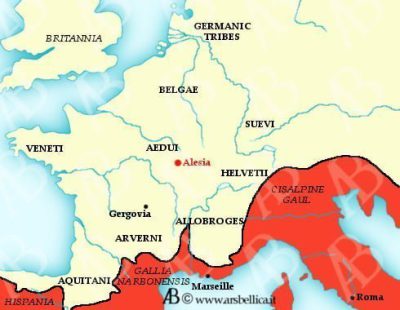
After the fall of Avaricum, Caesar directed his troops to the hill of Gergovia. The city, however, after long battles, repelled the Roman army and forced them to retreat. Caesar, attacked from the rear at the same time by the Edu (who had gone over to the Gauls), had to join Titus Labienus – commander of some of his troops in the fighting in the east. Labienus had a reputation for being a very good commander who (later) betrayed Caesar and went over to Pompey in the Civil War.
After joining forces and recruiting new troops, Caesar headed east against the Sequans and the Lingons. Vercingetorix, wishing to destroy the Roman army, set a trap during the march, which, unfortunately, was not successful for him. Caesar’s troops repelled his rival and forced him to retreat. A discouraged Gallic commander retreated to Alesia(today’s Auxois hill – about 30 kilometers west of today’s Dijon) to rest there and renew the army. However, he did not expect Caesar to follow the army of Gauls and surround his forces in the city. This was how the long blockade of Alesia was to begin.
Armies
Roman army amounted to nearly 60,000 soldiers (12 legions with cavalry and auxiliaries). When it comes to riding, it could have been from 1,000 to 1,500 horsemen, as Caesar recruited an additional unit of 500 Germanic horses in Germania.
The Gallic army was around 80,000 soldiers under the personal command of Vercingetorix and 120-250,000 in support. The cavalry of the Gauls was larger in numbers and could have amounted to about 4,000. According to Plutarch’s data, the support forces could be as high as 300,000 people. According to modern data, they could be around 100,000.
Siege
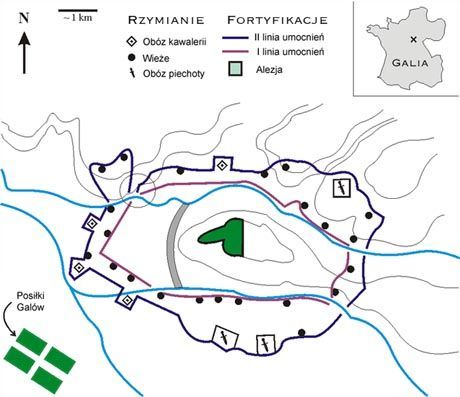
The fortress of Alesia was situated on a high hill in the fork of the Lutosa and Osera rivers, practically inaccessible to the advancing troops. Therefore, Caesar decided on a long-lasting siege and forcing the defenders to surrender through starvation. This is how Caesar himself describes the fortress and fortifications of the Romans:
The actual stronghold of Alesia was set atop of a hill, in a very lofty situation, apparently impregnable save by blockade. The bases of the hill were washed on two separate sides by rivers. Before the town a plain extended for a length of about three miles; on all the other sides there were hills surrounding the town at a short distance, and equal to it in height. Under the wall, on the side which looked eastward, the forces of the Gauls had entirely occupied all this intervening space, and had made in front a ditch and a rough wall six feet high. The perimeter of the siege-works which the Romans were beginning had a length of eleven miles. Camps had been pitched at convenient spots, and three-and‑twenty forts had been constructed on the line. In these piquets would be posted by day to prevent any sudden sortie; by night the same stations were held by sentries and strong garrisons.
– Gaius Julius Caesar, Gallic Wars, VII 69
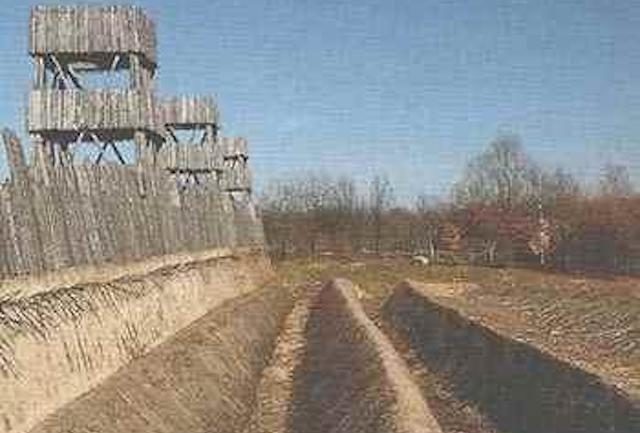
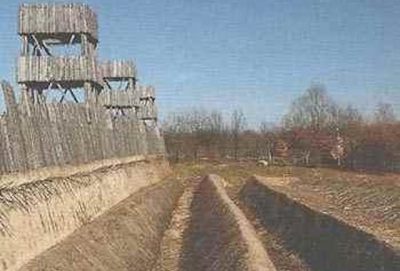
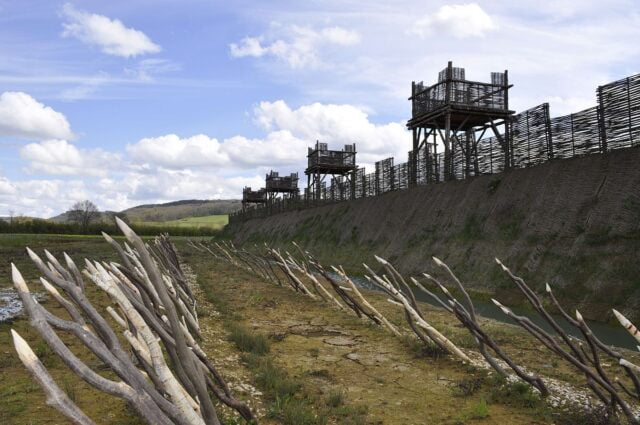
Caesar began the siege by encircling the city on each side with a 4-meter-high embankment. The line of fortifications was 17 kilometers which was an enormous construction feat for the legionaries. While the workers created trenches and camps, the cavalry and support forces patrolled and guarded the worksite. The fortification line was separated by 23 forts connected by a rampart and a moat. Before the ring closed, Vercingetorix ordered some of his soldiers to return to their tribes and assemble a mighty army that could come and drive the enemy away from Alesia. The defenders had a food supply for 30 days, which gave them a chance for a long resistance. Upon learning of Vercingetorix’s plans, he immediately dispatched reinforcements to strengthen the unfinished sections that were only two meters high or less.

The Gallic cavalry, however, managed to slip out of the ring, which was a great concern for Caesar, as he could expect attacks from outside and inside at the same time. He also ordered to build an outer ring to defend against an external aggressor. The defensive fortifications of the Roman legions were truly stunning. The city was surrounded by a 6-meter ditch. The main earth and wood embankment was about 400 paces from the moat and was protected by two additional ditches, each 4.5 meters wide, with the internal one flooded with water. The embankment itself was almost 4 meters high, there was a pavement on its top, and turrets were placed every 24 meters. Sharpened piles were hammered from the front in neat rows, behind them there were rows of smaller piles hidden in the pits and still further rows of iron blades attached to wooden logs buried in the ground. Erecting fortifications near Aleja was a huge undertaking. Vercingetorix tried to hinder the work, but his attacks were repelled by the legionaries.
Meanwhile, the tribes notified of the siege sent to relief an army far in excess of Caesar’s. The Roman commander himself reported 250,000 infantry and 8,000 cavalries, which, however, is not a very real figure. However, it cannot be denied that the army united to free Vercingetorix was truly huge.
When the siege was prolonged, the commander of the Gallic army decided to throw out all those unable to fight, including women and children, outside the city. Food supplies were scarce and those who did not take part in the fighting were fed unnecessarily. Caesar did not allow the “outcasts” to pass, and the exiles died between the two camps.
Soon on the horizon on the opposite hill appeared a huge Gallic army under Commius (king of Atrebates) to rescue his comrades. It set up camp a mile from the Romans, and the next day it launched an attack. This is how Caesar describes the situation:
Meanwhile Commius and the other leaders entrusted with the supreme command reached the neighbourhood of Alesia with all their force, and, seizing a hill outside, halted not more than a mile from our entrenchments. The day after they brought their horsemen out of camp and filled the whole of that plain which we have described as extending for a length of three miles; their force of footmen they posted a little way back from the spot, on the higher ground. There was a bird’s‑eye view from the town of Alesia over the plain. At sight of these reinforcements the others hastened together with mutual congratulation, and all minds were stirred to joy. So they brought out their force and halted in front of the town; they covered over the nearest trench5 with hurdles and filled it in with earth, and prepared for a sally and for every emergency.
– Gaius Julius Caesar, Gallic Wars, VII 79
Vercingetorix, seeing his comrades fighting from the outside, launched an attack on the Roman formations from the inside, ordering the wide moat to be filled up in front of the Roman fortifications. Caesar divided the army, after which he sent cavalry to occupy the Gallic horsemen. Both attacks were repulsed. The armies of the Gauls suffered heavy losses. The next day was quiet as the Gauls were preparing ladders and tools to attack the fortifications. The night after the construction was completed, a Gallic trumpeter trumpeted an attack on enemy positions. The fight was fierce, and in the darkness, many Gallic soldiers fell on stakes and iron traps. Scorpions placed on Roman forts accurately shelled the Gauls. There were also many fallen on the side of the Romans, but the attack was repulsed again.
The next morning, the next attack was directed at the weaker section of the fortifications, which was on the plain, not in a good position to defend. Many Gauls rushed to this part of the front, and their offensive was led by a certain Vercassivellaunos, a close relative of Vercingetorix. Only two legions, supported by auxiliary troops and cavalry, defended against 60 thousand people. Caesar realized that if the Gauls broke through the fortifications and got inside, they could slaughter everyone without a problem. So he set off for the hot spot of events, fueling faith in the fighters and, having drawn his sword, he fought like an ordinary walker. He also sent additional cohorts to help defenders. Some Gauls managed to break through the embankments. They began digging up the fortifications, not realizing that several cohorts were attacking them from behind. They were slaughtered and the rest of the attackers were attacked by driving from behind, causing panic and fleeing to the city. The Gauls were also rejected this time by Caesar’s infantry supported by the Germanic cavalry (they allegedly panicked at the sight of Caesar’s red cloak, who personally intervened in the battle). Already around midnight, the Roman cavalry set out in pursuit of the fleeing Gauls; many died, the rest fled to their homelands.
The next day, diplomats arrived at the camp demanding unconditional surrender. Vercingetorix was captured and many of his soldiers were executed. This situation is described by Caesar:
On the morrow Vercingetorix summoned a council, at which he stated that he had undertaken that campaign, not for his own occasions, but for the general liberty; and as they must yield to fortune he offered himself to them for whichever course they pleased — to give satisfaction to the Romans by his death, or to deliver him alive. Deputies were despatched to Caesar to treat of this matter. He ordered the arms to be delivered up, the chiefs to be brought out. He himself took his seat in the entrenchments in front of the camp: the leaders were brought out to him there. Vercingetorix was surrendered, arms were thrown down. Keeping back the Aedui and the Arverni, to see if through them he could recover their states, he distributed the rest of the prisoners, one apiece to each man throughout the army, by way of plunder.
– Gaius Julius Caesar, Gallic Wars, VII 89
Julius Caesar could celebrate his great triumph and practically announce the suppression of the great rebellion.
Consequences
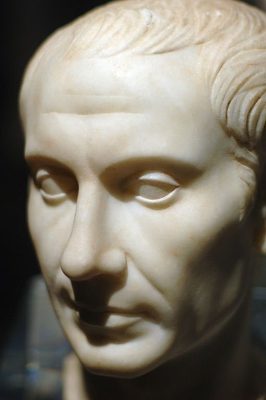
As a result of this battle, one of the greatest uprisings ever to break out in Gaul ended. Nearly a million people were taken captive, the Gallic commander Vercingetorix was imprisoned for several years (Vercingetorix acknowledged his defeat and offered himself as a slave for his people), then in Caesar’s triumph (already during his dictatorship) Rome to be strangled. This victory had a huge impact on the future of Gaul. Despite another rebellion in 51 BCE, which Caesar dealt quickly with, there never was such a major uprising again. The Aedui and Roman allies who opposed him were treated lightly. An agreement was also made with the heads of the Gallic tribes on moderate tributes in favor of Rome.
The Roman Senate, as a thank you to Caesar for crushing the rebellion, recognized a 20-day time of joy in Rome; however, he did not agree to the triumph, which was a purely political act of Caesar’s enemies.
For over four centuries, Gaul was one of the most important, “romanized” and the richest, next to Egypt, province of the Roman Empire. Caesar, by suppressing the rebellion and conquering Gaul, proved his great martial craftsmanship and confirmed that luck was still in his favor.
However, Julius Caesar himself benefited most from the war. Defeating the mighty army of barbarians made him famous in Rome. The Gaul Vanquisher had a devoted army of veterans behind him, who had gotten rich in this whole affair. It is not clear to what extent the successes in Gaul contributed to the ambitions of Caesar, but there is no doubt that without his victory at Alesia there would be no Rubicon. Alesia can be regarded as one of the stages on Rome’s road from Republic to Empire.