Chapters
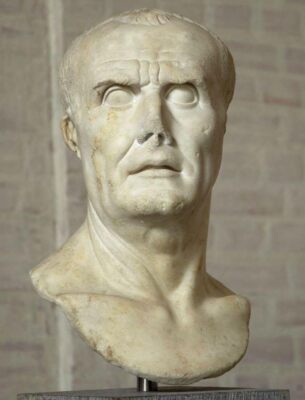
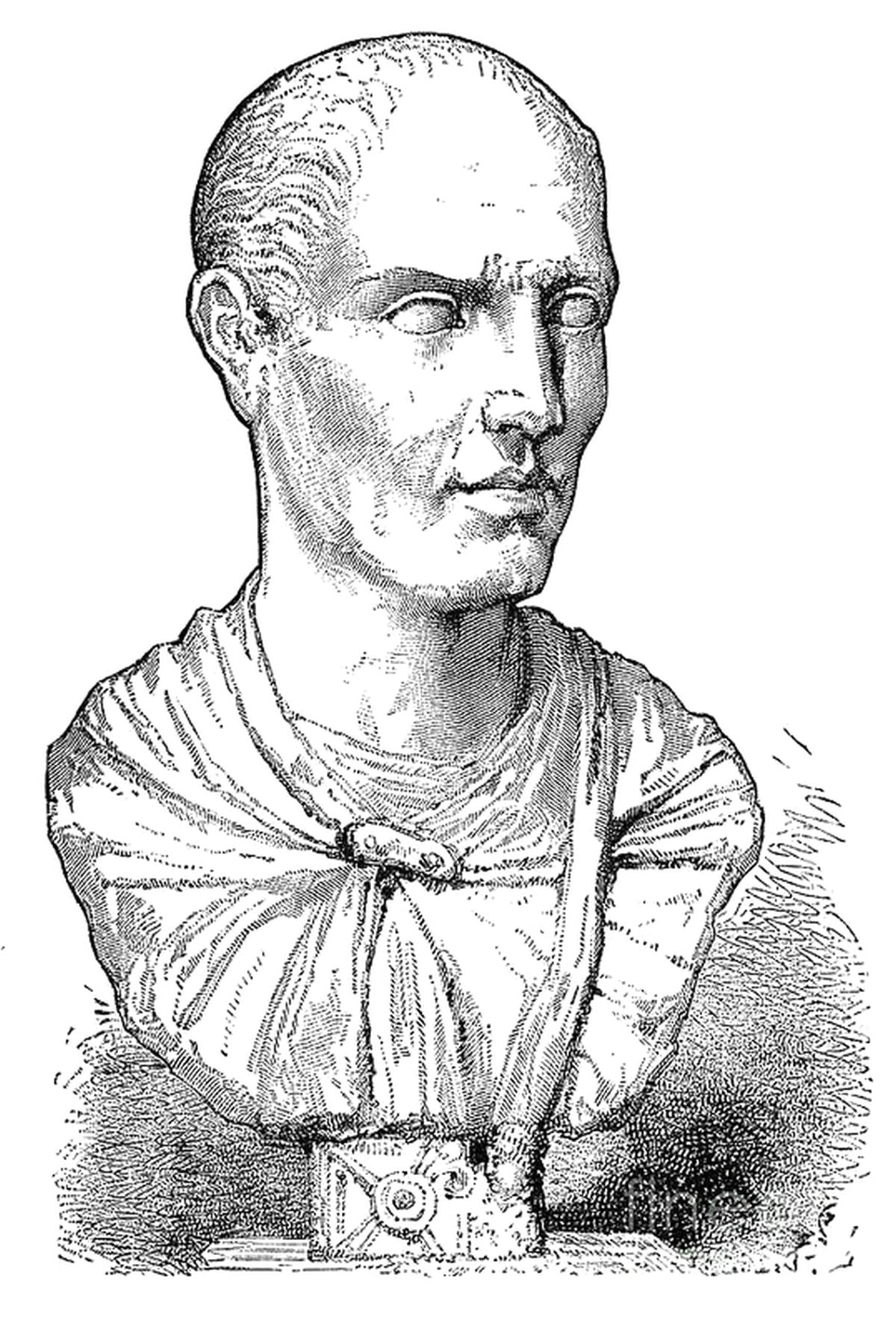
Gaius Marius (Gaius Marius) was born in 156 or 157 BCE in Cereatea near Arpinum in southern Lazio. He was one of the most famous Roman leaders. He became famous for defeating the Teutons and Cimbri tribes and carrying out a thorough reform of the Roman army, which was considered the third founder of Rome (after Romulus and Camillus). Seven times elected consul (107, 104, 103, 102, 101, 100 and 86 BCE).
Origin
Marius came from a not-very-wealthy family. His parents were clients of the respected plebeian family of Herennius. At first, young Marius worked as an ordinary peasant before joining the army.
There is a legend saying that Marius as a young man found an eagle’s nest with seven chicks. As eagles were considered sacred animals of Jupiter, the most important god of the Romans, this event was later seen as an omen that heralded Marius being elected consul seven times. Later, Marius issued a decree recognizing the eagle as a symbol of the Senate and the Roman People (Senatus Populusque Romanus – SPQR).
Military and political career
In 134 BCE he joined the army of Scipio the Younger. His abilities were noticed during the siege of Numantia during the war in Spain. Gradually, Marius began to think more and more realistically about his political career. To this end, he took part in the election for one of the 24 special military stands of the first four legions. Then he took part in the elections for the office of quaestor, after an unsuccessful election for the office in Arpinum.
In 119 BCE he assumed the office of people’s tribune for a year, with the support of Quintus Caecilius Metellus (later known as Metellus Numidicus), a member of one of the most influential families of the period. During his office, he clearly supported the popular party, and through his activities, he soon became the leader of the party. His achievements include, for example, the passing of a law prohibiting the use of wealth and property in elections.
After leaving office, he took part in the elections for curule and plebeian edicts, which he, however, lost. In 116 BCE he won the election as praetor for a year and was quickly charged with ambitus (electoral corruption). He managed to win an acquittal and calmly completed his office. In 114 BCE Marius’ imperium was postponed and sent to the Iberian Peninsula to govern Lusitania (present-day Portugal) as a propretor. During his reign, he undertook several small military operations of little importance (including the fight against rebel tribes). He resigned his office in 113 BCE
He did not apply for a consulate due to his lack of success. In order to raise his political rank, he married Julia (Julius Caesar’s aunt), thanks to which he became connected with the patrician family.
In 109 BCE his former protector Quintus Caecilius Metellus, who was his opponent under Marius’ tribunal, appointed Gaius as his legate in the campaign in Africa against Jugurtha king of Numidia. The legates (legati) were usually envoys of the senate, but a man appointed as legate by the Senate was used as the chief deputy general. Metellus obtained the Senate’s approval to recognize Marius as his legate and could go to war. During the Metellus campaign, he used Marius’s military experience, which gradually strengthened his political position.

In 108 BCE, Marius felt strong enough to run in the upcoming consular elections. Despite the lack of support from Metellus, who advised Marius to run in the next elections with his son, he started an election campaign. He began to win his electorate among soldiers and merchants, whom he flattered by saying that if he had only half of the soldiers of Metellus, the war would have been over long ago. Through intrigues and false accusations, Marius eventually took his command and obtained a consulate in 107 BCE.
In order to increase the size of the army for the war in Africa, Marius carried out military reform, which allowed him to recruit a huge number of new recruits and to completely modernize and improve the Roman “war machine” (this reform is detailed in a separate section).
With time, however, Marius realized that it would not be as easy to win the war as he had thought at first. He succeeded, however, gradually over the course of 107 BCE and the following year, to push the Yugurta southwest towards Mauritania. At that time, the quaestor in Marius’ army was Lucius Cornelius Sulla, the perfect leader who would be his future main rival for power in Rome. By the end of 105 BCE, he had won several victories and finally ended the war by making an alliance with Bokchus, King of Mauritania, who treacherously captured Jugurtha and handed him over to the Romans. For the victory over Jugurtha, Marius received the right to triumph, which he made on January 1, 104 BCE. The main prisoner was, of course, Jugurtha:
But we are told that when he had been led in triumph he lost his reason; and that when, after the triumph, he was cast into prison, where some tore his tunic from his body, and others were so eager to snatch away his golden earring that they tore off with it the lobe of his ear, and when he had been thrust down naked into the dungeon pit, in utter bewilderment and with a grin on his lips he said: “Hercules! How cold this Roman bath is!”.
– Plutarch of Cheronea, Life of Marius, 12
Invasion of the Cimbri and Teutons
Unexpectedly, in the north, there was a threat of an invasion by the barbarian tribes of Italy itself. At about 120 BCE, the Germanic tribes of Cimbri, Teuton and Ambros from the Jutland Peninsula began their journey through Europe. In 113 BCE the barbarians passed through Noricum (Austria) and continued south. In the vicinity of today’s Ljubljana, they defeated the army of consul Gaius Papirius Carbo, who wanted to keep them away from Italy. Consul Marcus Junius Silanus in 109 BCE replaced the Germans on the way over the upper Rhone, but also suffered a defeat. After this victory, the visitors from the north did not cross the borders of Rome but headed for Gaul.
Invasion of the Cimbri and Teutons
The influx of barbaric peoples from the north forced the Romans to fight for independence.
The Romans tried to defeat them in 105 BCE, but despite their superiority in numbers, the army of Gnaeus Malius Maximus suffered a terrible defeat at Arausio. The Romans felt fear. The Senate called on Marius to fight the barbarians, offering him the post of consul for the second time in 104 BCE. The only forces at his disposal (20,000 legionaries) were demoralized and were hiding behind the walls of Massalia. An experienced commander began to reorganize them, and the changes introduced by him soon covered the entire Roman army. These reforms include, for example, the unification of armaments and the break with the age division into hastati, principes and triarii formations, the dissolution of equites cavalry and its replacement with mercenaries, the allocation of ballistae and catapults to each legion, and the reduction of rolling stock (legionaries carried almost everything themselves, therefore called their “Marius’s mules”). The changes turned out to be effective. The barbarians unsuccessfully tried to capture Marius’s camp in Ernaginum. In 103 BCE, Marius received a consulate for the third time.
In 102 BCE he took over the consulate for the fourth time. That same year, under Aquae Sextiae, Marius defeated the Ambrons, whose people were completely extinct in that battle. Disciplined legionaries easily defeated the disorderly crowd of Germans. Two days later came the Teutons who again, like Ambronii at Aquae Sextiae, were defeated. The barbarians could not take advantage of their numbers because they had to attack uphill, huddled in a narrow valley between two hills. Part of the legionaries held back the Teutons, and a dedicated detachment walked around them, invisible beyond the hills, and blocked the exit from the valley. Marius’s trap slammed shut. The Germans were unable to break through the Roman ranks. They died under a hail of javelins and the blows of short gladius, perfect for fighting in a crush (unlike the long swords and great axes of the Germans). Teutonic warriors were beaten to the leg. Their number is unknown, but probably exceeded 100,000 (the Roman army was only 40,000). At least twice as many were taken prisoner. They were mainly women and children, but Marius had no mercy – he ordered the prisoners to be chased up the mountain and thrown into the abyss.
More about the battle of Aquae Sextiae
The legionaries left unburied, rotting Teutons’ corpses to fear the coming Cimbri. After defeating the Teutons, Marius went to Rome in 101 BCE to take over the consulate for the fifth time and to triumph on the occasion of the defeat of the Teutons. That same year, Marius defeated the Cimbri at Vecellae. It was the enormous size of the Cimbri army that was one of the reasons for their defeat. Squeezed side by side, they were easy targets for Roman javelins, and in hand-to-hand combat, they interfered with each other. With no room in the crowd to attack with their long, heavy weapons, they were completely defenceless. 120,000 Cimbri died in the battle, and the tribe ceased to exist. After these victories, Marius was proclaimed the third founder of Rome and as a reward, he was awarded the sixth consulate for 100 BCE. Saturnin, in agreement with Marius, had to murder Quintus Nunnius in order to receive the office of the people’s tribune.
To complete the image of Marius as a leader, it is worth mentioning that he was extremely superstitious, he believed in signs, omens and sacrifices. During the war campaigns, he was accompanied by a fortune-teller called Marta the Sorceress. Marius reportedly never started a battle if she did not think that the gods were in his favour.
Competing with Sulla

During his consulate in 100 BCE, Marius acted rashly in the political sphere. He lowered grain prices and wanted, together with Saturnin and Galicia, to grant the veterans land in Africa. A commission headed by Marius was to be appointed to carry out this award. Under duress, the Senate accepted the law. However, the following year Saturnin again applied for office, this time consul, and again murdered his opponent from the popular party – Memmius. This has already exceeded the measure of the senate’s patience. He demanded from the consul Marius to take military action. And whether he wanted it or not, he had to start a fight with his old allies. An army under the command of Scaurus smashed the defenders of Saturnin and Galicia on the Capitol in 100 BCE. After this event, Marius’s popularity dropped significantly, his supporters turned away from him, and there was no question of another consulate. Having argued with almost everyone, he withdrew from public life and headed east.
Until 95 BCE there was relative stability in the state. It was then that the Roman Senate issued a law on the expulsion of all non-Roman citizens from the city, and in 91 BCE the people’s tribune was murdered – Marcus Livius Drusus. These events led to the outbreak of the so-called wars with allies (91-88 BCE), where Italics demanded that they be granted Roman citizenship.
Marius returned in 90 BCE with several victories.
In 88 BCE he had to flee Rome when the city was taken by his former subordinate – Lucius Cornelius Sulla. Thus, the First Civil War took place. Marius, with the help of his supporter, the tribune of the people, Publius Sulpicius, led him to take command of the army from him, because he himself wanted to command the war with Mithridates, king of Pontus. The bloody riots in the streets of the Eternal City foreshadowed future events. Marius went to Africa, and the Senate, under the pressure of Sulla, declared Marius a public enemy.
In 87 BCE Lucius Cornelius Cinna of the popular party became the consul. His decisions led to further fights, as a result of which Cinna was banished. He returned to Italy a year later with Marius when Sulla was in the east. The followers of the old leader marched on Rome with him. After conquering the city, the fury and anger of the populares were so great that they started mass-murdering political opponents. The heads of senators were cut off and impaled on the prows of ships that decorated the Roman rostrum – rostra. According to Plutarch, Gaius Marius had an “interesting” way of determining who should be murdered. When he walked the streets of Rome and did not shake hands when greeting someone, it meant that he should be killed. There was great fear and barbarity in the streets of Rome; Sulla’s companions were killed, their property confiscated, and Sulla himself was declared a public enemy. Ordinary citizens could not be safe in Rome, because many slaves also entered the city, who were promised freedom in exchange for enlarging the army of the populares. The slaves from Illyria were especially cruel – “[they] butchered fathers of families in their houses, outraged their children, violated their wives”1. The scale of the cruelty made the representative of the populares, Quintus Sertorius, order to kill them – a total of 4,000 brutal tormentors were to die.
Marius also received the main command in the war in the east. Cinna and Marius became consuls for 86 BCE. However, just a month after arriving in Rome, Marius died at the age of 71.
Death
He died on January 13, 86 BCE. His final years, proved how much he craved power and what he was willing to do to regain it. Sulla’s last act of revenge against Marius was the destruction of his grave and the scattering of ashes.