

If you have found a spelling error, please, notify us by selecting that text and pressing Ctrl+Enter.
Curiosities of ancient Rome
The world of the ancient Romans was rich in extraordinary, and sometimes even surprising, facts. We draw our knowledge of Roman daily life, customs, and mentality primarily from works left by ancient writers and historians. It is thanks to them that we discover information that is astonishing today – sometimes even hard to believe. Below are some interesting facts that reveal a lesser-known and less obvious side of the Roman world.
I encourage you to submit your own suggestions and to report any corrections or inaccuracies.
Incorruptible and brave Gaius Fabricius
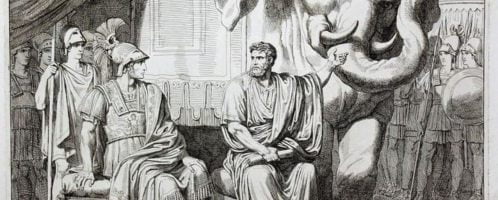
Gaius Fabricius, in Roman transmissions, was an example of an incorruptible politician and an extremely honourable and brave man. This is evidenced by the history of the war with Pyrrhus (282-272 BCE).

Mourning woman and Trajan
Trajan was one of the most respected Roman emperors. Over the centuries, it was believed that the conqueror-emperor showed extraordinary rule of law, and he made decisions based on the opinion of his closest council of advisers. Until our times, the probably imaginary, although widespread and popular in the Middle Ages story about the meeting of the emperor with a mourning woman has survived.

Trajan’s uncompromising attitude in fight for Armenia
The throne of Armenia, a country at the confluence of Roman and Parthian influences, was informally consulted and established between the two then powers over the years. When in 110 CE king Osroes I of the Parthians appointed his nephew Axidares, son of former king Pacorus II, to the throne of Armenia, there was a breach of an unwritten rule, and Rome was not asked to accept the new candidacy.


Roman perfurme vessel
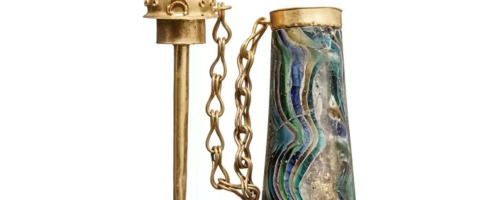
Roman perfume vessel, made of Roman glass with a golden cup in the shape of a woman’s head. Thanks to the long skewer, it was possible to remove the liquid from the glass container, drop by drop. Object dated to the 1st century CE.
Hadrian was not designated successor to Trajan
It is commonly believed that the reign of Nerva, Trajan, Hadrian, Antoninus Pius and Marcus Aurelius, was a time of stabilization and peaceful transfer of power in the Roman Empire, through adoption and the choice of a sane successor. Hadrian, who took over power after the great Trajan, was not particularly favoured by him, and the adoption document could have been forged.
Doping in antiquity
In ancient times, athletes used substances to increase the body’s efficiency. Sophist Flavius Philostrat – Greek biographer from 2nd-3rd century CE – remembers that the medics gave the players a decoction of mushrooms or bread with spices and poppy extract, containing alkaloids stimulating the body.

Apparently, donuts were already loved by ancient Romans
It is said that donuts were already loved by the ancient Romans, who spent the last days of the carnival partying and eating (the so-called Bacchanalia). In this way, the departure of winter and the arrival of spring were celebrated.
