If you have found a spelling error, please, notify us by selecting that text and pressing Ctrl+Enter.

Curiosities of ancient Rome

The world of the ancient Romans was rich in extraordinary, and sometimes even surprising, facts. We draw our knowledge of Roman daily life, customs, and mentality primarily from works left by ancient writers and historians. It is thanks to them that we discover information that is astonishing today – sometimes even hard to believe. Below are some interesting facts that reveal a lesser-known and less obvious side of the Roman world.

I encourage you to submit your own suggestions and to report any corrections or inaccuracies.

Monumentum Liviae

Via Appia in Ancient Rome was the main cemetery avenue. There were countless monuments and monumental tombs of the most important Roman families. Among them, there were also mass graves for a less wealthy society.

Reconstruction of Columbarium Livia

Oracles of Astrampsychus

It is a known fact that in the world of ancient Romans, the poorer bourgeoisie could not count on the rights that wealthy Romans had only from being born into an eminent family. Unfortunately, plebeians tried unsuccessfully to fight for their rights, but in general official legal institutions were not interested in the problems of ordinary people.

Roman mosaic

Ancient buildings on Roman mosaic

A detail of a beautiful Roman mosaic showing the buildings at Hippo Regius in Algeria. The object is dated to the 2nd century CE. We can see beautiful porticos, columns, bars or even a quadriga crowning the monument.

Ancient buildings on Roman mosaic

Great defeats with Persians and Empire’s rematch in 3rd century CE

The greatest defeat in Roman history is considered to be the battle with Hannibal at Cannae in 216 BCE. There are also known hecatombs in the Teutoburg Forest in 9 CE and under Adrianople in 378 CE. However, a little known fact is that in the 3rd century CE, during the reign of Emperor Valerian, the Empire suffered two major defeats with the Persian state of King Shapur I. At Barbalissos and Edessa, two large Roman armies of around 60,000-70,000 were probably defeated and destroyed. people. The empire suffered the greatest humiliation in its history – the emperor became a prisoner of the Persian ruler. The Romans did not forget about the rematch – as early as 282, Emperor Carus conquered Mesopotamia with the Persian capital Ctesiphon, and only his unexpected death stopped the further march of the legions to the east.

The Persian king Shapur I using the former Emperor Valerian as a footstool when mounting his horse

Myth about laurel branch and white chicken

In 1863, during the excavations, the Villa Livia was discovered – archaeologists saw chambers full of unusual frescoes. Particularly noteworthy is the room with frescoes depicting a fabulous Mediterranean garden – and really, dear reader, when looking at the paintings, we get the impression that we are in a real garden, full of flowers, palm trees, pine trees and orange and lemon trees (it makes you want to reach out and pick this fruit).

Fresco in Villa of Livia

Trauma after defeat of Varus

In 15 CE, a Roman punitive expedition, led by Aulus Cecina, returning to bases on the Rhine, was surrounded by the Germans. The legionaries, despite being highly disciplined, were also very superstitious and quickly associated the facts.

An ambush of the Germans on Roman soldiers in 9 CE

Quintuplets in message of Gellius

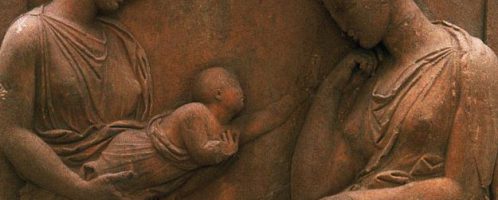
It is difficult to imagine that more children than two / three could be born and survived in the world at one time in antiquity. Mostly multiple babies are premature babies, and the more babies there are, the more difficult it is to maintain the pregnancy and keep them and their mother alive after birth.

Roman relief showing a woman and a child

Spelling error report

The following text will be sent to our editors: