If you have found a spelling error, please, notify us by selecting that text and pressing Ctrl+Enter.

Curiosities of ancient Rome

The world of the ancient Romans was rich in extraordinary, and sometimes even surprising, facts. We draw our knowledge of Roman daily life, customs, and mentality primarily from works left by ancient writers and historians. It is thanks to them that we discover information that is astonishing today – sometimes even hard to believe. Below are some interesting facts that reveal a lesser-known and less obvious side of the Roman world.

I encourage you to submit your own suggestions and to report any corrections or inaccuracies.

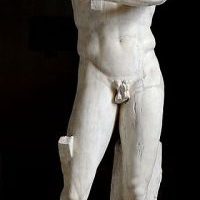
Tiberius and Apoxyomenos

Emperor Tiberius admired very much the statue of the Lysippos – showing Apoxyomenos, an athlete cleaning his body with a wooden scraper (stryngilos). The original statue has not survived to our times. The sculpture is known for its marble copy at the Pio-Clementino Museum in the Vatican.

Apoxyomenos

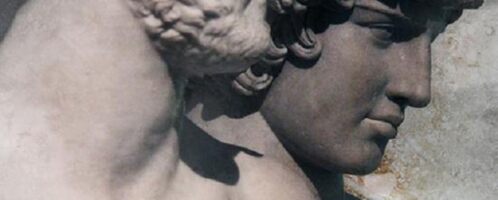
Antinous, Hadrian’s lover

Antinous was a Greek youth from Bithynia (he was born in Claudiopolis – the current city of Bolu, in Turkey), who when was 12 years old was taken in by the court of Hadrian. Emperor Hadrian met him during one of his many journeys and – delighted with his beauty – made him his lover.

Antinous and Hadrian

Voting in ancient Rome

Ovile was a separate space on the Campus Martius in Rome, where votes were cast. The name literally means “sheep’s farm”. Originally, the place to vote was a wooden structure, which in time was replaced by a larger and more prestigious, marble building Saepta Julia.

Sheep

Chamber pots in ancient Rome

Chamber pots in ancient Rome were not designed for both sexes equally. Both men and women had their own versions: the female sex was using scaphium when gentlemen matella. The larger chamber pots on the streets were for men whose urine was then collected and sold. Urine was used by fullones for cleaning fabrics.

Potty pits in ancient Rome

Beautiful gladiator helmet

Roman bronze gladiator helmet featuring the hero Hercules on the front and the defeated Nemeian Lion on the base of the comb. Dated back to 1st – 2nd century CE. Object located in Higgins Armory Museum (USA).

Beautiful gladiator helmet

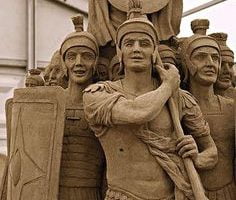
Roman sculpture from sand

The 7th edition of the International Festival in sculpting in the sand (2009), which taks place every year in Portugal. One of the participants decided to create a sculpture showing Roman soldiers.

Roman sand sculpture

Reconstruction of Roman inkwell and stylus

Reconstruction of the Roman inkwell and the rilca (stilus). The writing instrument was based on a find from Vindolanda, a Roman camp located in Britain, between the rivers Tyne and Solway. The simplest Romans usually wrote on wooden tablets covered with wax. The wooden plates found in Vindolanda are considered the oldest handwriting in Britain.

Reconstruction of a Roman inkwell and stylus

Spelling error report

The following text will be sent to our editors: