
Chapters
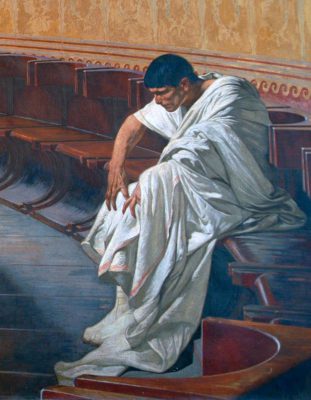

Lucius Sergius Catilina was born in 108 BCE. He was a Roman senator in the 1st century BCE who went down in history as the initiator of a conspiracy called the Conspiracy of Catilina. This plot was aimed at overthrowing the republic and the aristocratic Senate. However, the famous speaker and politician Cicero prevented him as a last resort.
Family
Catilina was born into one of the oldest families of Roman patricians – gens Sergia. Although the family had many ancestors with the title of consul, it was gradually deteriorating both socially and financially. Virgil then “gave” in “Aeneid” to this ancestral lineage, Sergestus, who was to come to Italy with Aeneas. Such a procedure was surely aimed at getting the family out of the crisis and underlining its former importance. The last consul in the family was Gnaeus Sergius Fidenas Coxo in 380 BCE starting a conspiracy. It was the dreams of rebuilding the prestige and political role of the Sergia family that led Catilina to decide to set up a conspiracy.
Military service and political career
Catilina was a capable commander with an outstanding military career. He served during the war with allies (91-88 BCE) with Gnaeus Pompey the Great and Cicero under the command of Gnaeus Pompey Strabo in 89 BCE. During the regime of Gaius Marius, Lucius Cornelius Cinna and Gnaeus Papirius Carbo, Catilina did not play any significant role, but he had a stable and secure political position. During the First Civil War (84-81 BCE) he supported Lucius Cornelius Sulla. The enactment of the prescription revealed the worst qualities of a young and ambitious politician. He allegedly tortured, mutilated and decapitated his brother-in-law, Marius Gratidianus in the tomb of Catullus. Then Catilina was to carry the head of the dead man through the streets of Rome, take it and throw it at Sulla’s feet in the temple of Apollo. He was also accused of the murder of his first wife and son, which he was to do in order to marry the rich and beautiful Aurelia Orestilla, the daughter of the consul for 71 BCE – Gnaeus Aufidius Orestes.
In the early 70s, he served abroad, possibly with Publius Servilius Watia Izauri in Cilicia. In 73 BCE he was brought for adultery with the Vestal girl Fabia, who was the half-sister of Cicero’s wife, Terentia. Ultimately, however, Quintus Lutacius, the Capitoline Catullian, leader of the Optimates, acquitted Catilina.
In 68 BCE he became praetor, and for the next two years, he was the propreator of the Africa Proconsularis province. In 66 BCE he returned to the capital and submitted his candidacy in the consular elections. However, a delegation from the African province made accusations of alleged abuses, and the 66 BCE consul – Lucius Volcatius Tullus – did not agree to Catilina’s candidacy in the next election. Catilina was finally brought to trial in 65 BCE, where she received great support from many influential politicians, including former consuls. The current consul of this year also expressed his support – Lucius Manlius Torquatus and Cicero. Ultimately, he was pardoned for the charges against him.
Involvement in the first conspiracies
In late 66 BCE, Marcus Licinius Crassus secretly endorsed a conspiracy to remove the consuls midway through 65 BCE. seeing it as an opportunity to obtain certain benefits. He was the soul of this conspiracy, wanting to overthrow the power of Pompey the Great, who was then staying outside Rome. Julius Caesar and Gnaeus Calpurnius Piso were also present. The first according to the plan was to go to Egypt in order to liquidate that kingdom and gain its resources. The second of them was to take over the management of Spain. Crassus himself was to take over the dictatorship and restore two