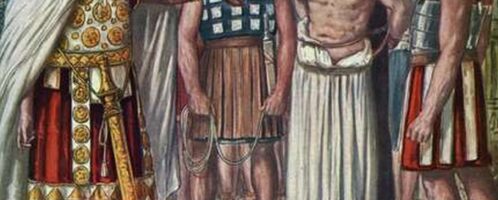
Alexander the Great was worshiped
Alexander the Great and his conquests have always passed into the memory of posterity. Ancient Romans were a people who very often referred to the feats of the Macedonian leader – especially the generals.
If you have found a spelling error, please, notify us by selecting that text and pressing Ctrl+Enter.
Ancient stories are curiosities revealing lesser-known, surprising, or unusual episodes from the world of ancient Rome and antiquity. This category includes short stories about events, people, and situations that don’t always make it into classical works, yet allow for a better understanding of the realities and mentality of the era.
Alexander the Great and his conquests have always passed into the memory of posterity. Ancient Romans were a people who very often referred to the feats of the Macedonian leader – especially the generals.
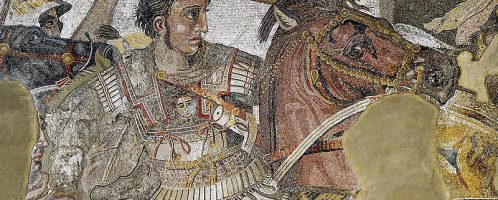
Augustus while tring to cut the fights in the arena by replacing it with sports competitions, he was also believed to invent an exceptionally cruel spectacle. In order to exemplify the punishment of one of the convicts, Selouros, he ordered to erect a pillory on the Forum, to which then hungry panthers and leopards were released.

When Augustus married Livia Drusilla, she was in advanced pregnancy. Her youngest son was born three months after the wedding with the ruler of Rome. The malicious people in the Eternal City used to say that the lucky ones are having children already born after three months.

According to Suetonius, Augustus, when assessing his rule, said: “I found Rome a city of bricks and left it a city of marble”. The question is, had Rome really undergone reconstruction to such an extent under his rule? To this end, a professor of architecture and urban planning from the University of California – Diane Favro – created a computer model of the Eternal City of the time of Augustus, where the individual buildings were marked with colours, depending on what they were made of. However, as the study showed, Rome did not change as much as the first emperor claimed.
Before the battle of Actium, young Gaius Octavius, adopted son of Julius Caesar, met on the road man with a donkey. Asking a man for a name, he heard that this is called Eutyches, which means “happy” in Greek. In addition, the donkey was to be named Nikon. What is important, the goddess of victory was “Nike”.

Crowing of rooster was considered as a bad sign. Petronius in “Trimalchio’s feast” describes the scene, as Trimalchio, frightened by the voice of a crowing rooster, ordered to pour wine under the table and sprinkle the lamp with wine. He also translated the ring from left to right. All this to overcome the misfortune, for which the divination was considered crowing rooster.

The Battle of Naulochos in the year 36 BCE finally ended the problem with the pirates of Sextus Pompey, guaranteeing for a long time peace at sea, and thus supplies to Rome. However, Mark Antony lost on this battle.

During the civil war between Caesar and Pompey there was a surprising incident. In the year 48 BCE legio XXIV Victrix Rapax commanded by legate Gaius Antonius (brother of Mark Antony) was cut off on the island and surrounded by faithful troops of Pompey.

In 75 BCE, while travelling to Rhodes to study with Apolloninos Molon, the 25-year-old Gaius Julius Caesar was kidnapped by Cilician pirates (praedo). The Cilicians, inhabiting what is now southeastern Turkey, according to Plutarch, were “the most murderous of men”.
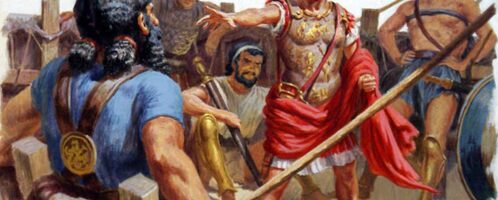
Marcus Atilius Regulus is one of the Roman heroes who embodied the most important virtues: bravery (virtus) and duty towards the state (officium). During First Punic War (264-241 BCE), he fought against Carthaginian army and even threatened capital, Carthage. However, in the spring of the year 255 BCE, there was a battle at Tunis, where the Carthaginian army completely smashed Regulus’s army and he was taken as prisoner.