
They say you need three things to fight a war: money, money, and more money. Regardless of whether or not we accept this sentence as true, money undoubtedly helps in war. Of course, it was no different in ancient times. In ancient Rome, troops were paid primarily with silver denarii, sometimes, in exceptional circumstances, and also with gold coins, i.e. aureus.
One of the most popular coins of antiquity were coins minted at the behest of Mark Antony. Antony’s so-called legionary denarii (modern name) were minted in the eastern part of the Empire in 32-31 BCE. So they were broadcast during the civil war in which Antony fought against Octavian. All legionaries’ denarii (aureuses also appear, but they are much rarer) look practically the same. The obverse shows a gallery with a decorated bow and a mast tilted forward. The legend of the obverse reads as follows: ANT AVG III VIR R P C, which stands for Antoni auguris, tresviri rei publicae constituendae (coin of Antony, augur and one of the triumvirs)

The reverse shows a legionary eagle (aquila) accompanied by two banners. The legend on the reverse is the LEG plus the number of the legion you wanted to capture on the broadcast.
The coins weigh around 3.9 g, which is roughly the same as the standard denarius. However, their silver content is 92.2%, which is over 4% less than the denarii minted at that time in Rome. The explanation of this procedure is simple, more denarii were minted, and thus more troops could be paid. The amount of coins minted was enormous. As many as 39 emissions were probably produced. According to the Copernicus-Gresham law, these coins could function in circulation for a very long time (a weak coin displaces a better one). For example, Antony’s legionary denarii account for 20% of the coins found in Pompeii. During the time of Marcus Aurelius (161-180 CE), they probably accounted for about 10% of the silver coins in circulation. Of course, their number decreased over time, but they appeared in treasures until the 3rd century, so over 300 years after their issue! Due to this popularity, the ancients probably invented a special name for this type of coin, which were denariiratiti (ship denarii).
What was the purpose of selecting such a monetary iconography? Probably Antony wanted to emphasize his military power and legitimate power in this way. On the coin we find information that he is a triumvir, although this title was no longer entitled to him from 34 BCE. At the same time, the legionaries themselves could feel honoured in some way, although it is unlikely that a given legion would receive coins commemorating this particular unit.
Mark Antony’s legionary denars were also an inspiration for subsequent coin issuers. Later, several similar attempts were made in the coinage to emphasize the importance of specific legions. In 68, one of Nero’s legates, Lucius Clodius Macer, rebelled against the emperor in Africa. During his ephemeral reign, he produced monetary issues that used the iconography of the sides of Mark Antony’s coins. In this case, however, there were legends referring to only two legions: LEGIO III AVGVSTA and LEGIO I MACRIAN. Despite the long time between the two issues, there is no doubt that Antony’s series was the direct inspiration for the coins of Clodius Macer. The re-use of this theme undoubtedly testifies to its attractiveness and popularity in antiquity. The context in which this iconography appeared on the coins is very telling, i.e. the times of internal unrest in the Roman state, when the loyalty of the legions was of particular importance for individual leaders.

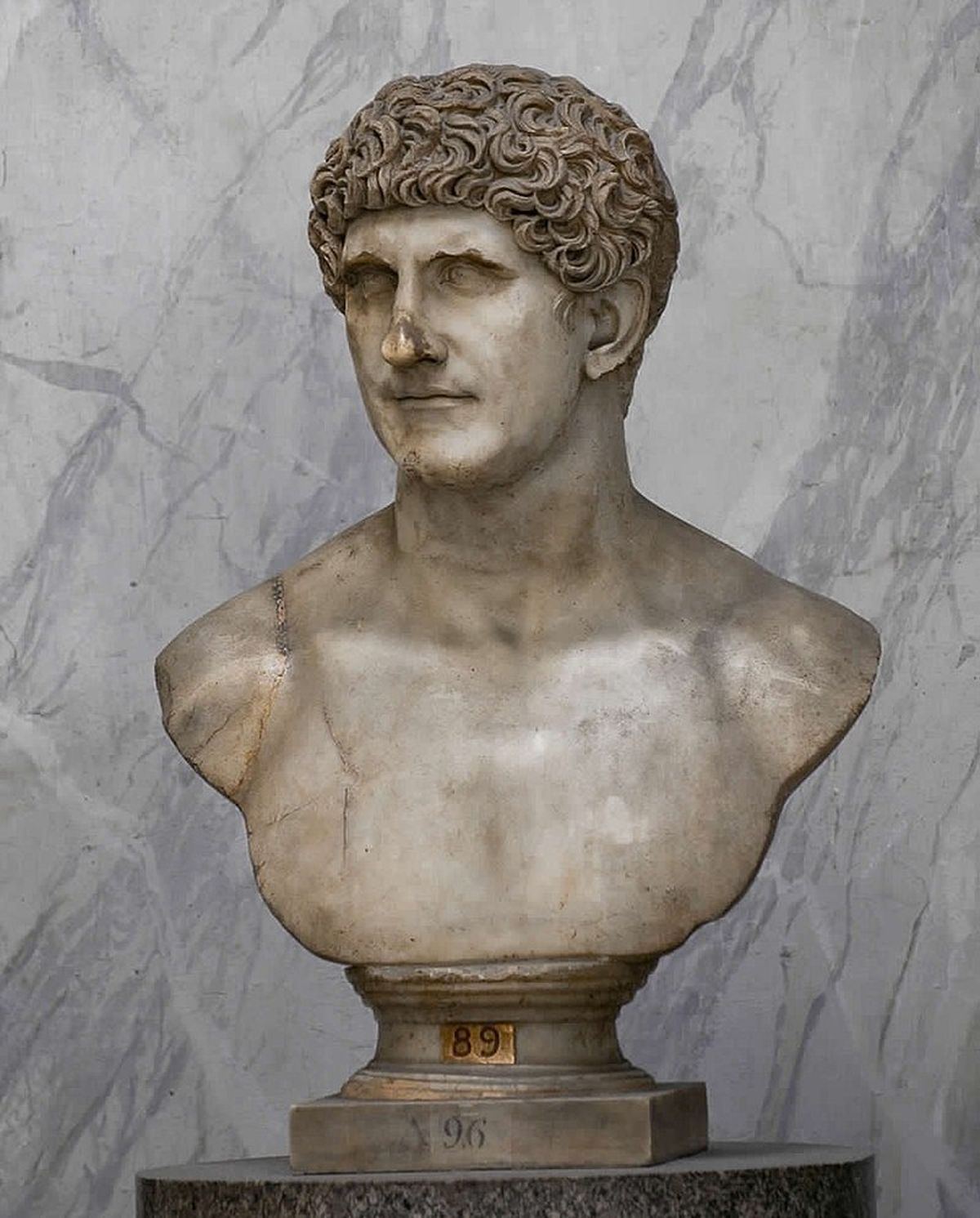
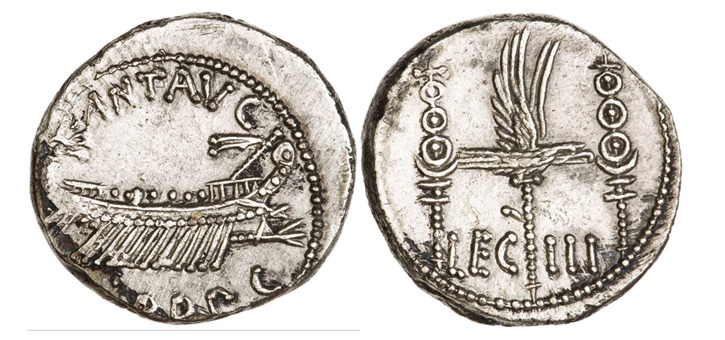

A series of legionary denarii were also minted during the co-rule of Marcus Aurelius and Lucius Verus. In the sixties of the 2nd century CE Mark Antony’s coins were restored. At that time, denarii were issued, resembling those from over the second century. The restitution kept the original part of the legend, adding to it the inscription ANTONINVS ET VERVS AVG (VSTI) REST (ITVERVNT). This time only the coins commemorated the VI Legion.