If you have found a spelling error, please, notify us by selecting that text and pressing Ctrl+Enter.
Curiosities of ancient Rome
The world of the ancient Romans was rich in extraordinary, and sometimes even surprising, facts. We draw our knowledge of Roman daily life, customs, and mentality primarily from works left by ancient writers and historians. It is thanks to them that we discover information that is astonishing today – sometimes even hard to believe. Below are some interesting facts that reveal a lesser-known and less obvious side of the Roman world.
I encourage you to submit your own suggestions and to report any corrections or inaccuracies.
First dentures
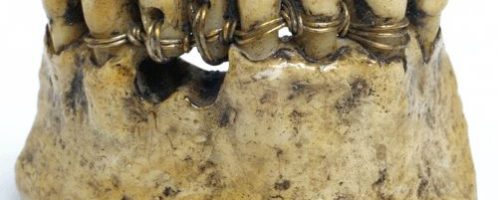
From about 700 BCE the Etruscans, people who lived in Etruria (today’s Umbria and Tuscany in Italy), were the first able to create dentures and artificial teeth. The teeth were either from another person or from an animal such as an ox – they were placed in a golden rim with a metal pin/tang and fitted to the remaining teeth. Only the rich could afford such a “dentist”.
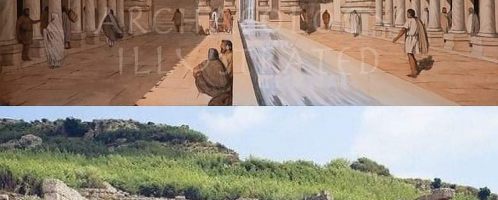
Reconstruction of Hadrian’s nymphaeum in Perge
Reconstruction of Hadrian’s nymphaeum in Perge, in the south of Turkey. The ancient city existed even before the Roman rule, but it was the Romans who made the city one of the most beautiful in Asia Minor. To this day, in Perge there are remains of a pillared street, a bathhouse, a theater and a stadium.
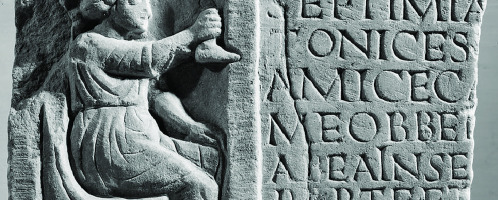
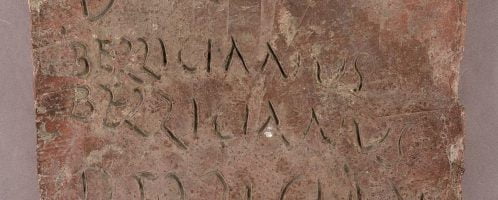
Roman brick from Caerwent
Roman brick from Caerwent (Wales) with visible inscriptions. Perhaps someone learned to write, in wet clay before burning, its name – Bellicianus.
Pottery remains from Boudica times
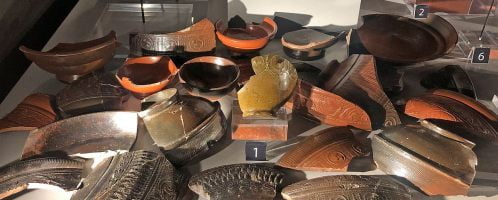
Fragments of Roman pottery found in the area of modern Colchester (East England) and the Roman city of Camulodunum. The artifacts are blackened from fire and heat, and have been found in a thick layer of burnt earth that has been preserved for nearly two thousand years.