If you have found a spelling error, please, notify us by selecting that text and pressing Ctrl+Enter.
Curiosities of ancient Rome
The world of the ancient Romans was rich in extraordinary, and sometimes even surprising, facts. We draw our knowledge of Roman daily life, customs, and mentality primarily from works left by ancient writers and historians. It is thanks to them that we discover information that is astonishing today – sometimes even hard to believe. Below are some interesting facts that reveal a lesser-known and less obvious side of the Roman world.
I encourage you to submit your own suggestions and to report any corrections or inaccuracies.
What did Vesuvius look like in ancient times?
View of Vesuvius through the gate at Palestra Samnitica, in Pompeii. What is worth emphasizing, the mountain was not as visible as it is now. The inhabitants of Pompeii and the Herculaneum painted frescoes with Vesuvius, although they did not know how much of a threat this mountain had to them1.

Caesar and his campaigns across Rhine
Julius Caesar is one of the greatest leaders in world history. This is evidenced by his victories in Spain (61 BCE), the conquest of Gaul (58-50 BCE), the invasion of Britain (54-53 BCE) or, for example, military campaigns east of the Rhine (55 and 53 BCE). Especially, the expeditions against the Germanic tribes prove how bold and ambitious Caesar was, who for the purposes of the campaign decided on an extremely complicated move for those times – the construction of a bridge over one of the longest rivers in Europe.


Gladiatorial fight – secutor and retiarius
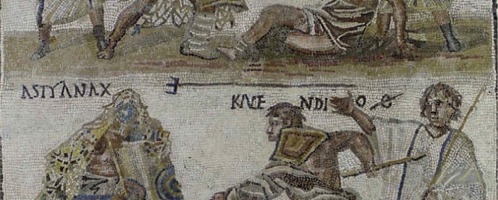
One of the most popular gladiator fights in ancient Rome was the clash of secutor (“the chaser”1) and retiarius (“net-man”). Roman mosaic from the 3rd century CE depicts perfectly the way of fighting of the “net-man”, who tried to keep his distance and immobilize his rival at all costs by throwing a net with sinkers on him and then stabbing him with a trident.
Teacher with three students on tombstone
Roman tombstone relief showing a teacher with three students. The object is dated to the end of the 2nd century CE and comes from Neumagen (west Germany).


Roman marble statue depicting young man – called Britannicus
Roman marble statue depicting a young man – called Britannicus. The photo was taken in 2011 in the so-called Nero’s Cryptoporticus in Rome. The object is dated to the 1st century CE and it was excavated at Pompeii.