If you have found a spelling error, please, notify us by selecting that text and pressing Ctrl+Enter.

Curiosities of ancient Rome

The world of the ancient Romans was rich in extraordinary, and sometimes even surprising, facts. We draw our knowledge of Roman daily life, customs, and mentality primarily from works left by ancient writers and historians. It is thanks to them that we discover information that is astonishing today – sometimes even hard to believe. Below are some interesting facts that reveal a lesser-known and less obvious side of the Roman world.

I encourage you to submit your own suggestions and to report any corrections or inaccuracies.

Roman castellum Celemantia

Roman castellum Celemantia in Slovakia, at the Danube. Castellum is hard to define unequivocally. In sources it was described as a fortification, fort or fortress, which in practice also served as a watchtower.

Castellum is a word derived from a diminutive of castrum, or Roman camp – the so-called “little fort”. This is mentioned, among others, by Vegetius: “And if no ancient fortifications are to be met with, small forts must be built in proper situations, surrounded with large ditches, for the reception of detachments of horse and foot, so that the convoys will be effectually protected. For an enemy will hardly venture far into a country where he knows his adversary’s troops are so disposed as to be ready to encompass him on all sides”1.

Roman castellum Celemantia

Strange openings on Macellum columns in Pozzuoli

Puteoli or today’s Pozzuoli. Known mainly for the nearby layers of volcanic sand called “pozzolana”. Once a magnificent Roman port on the Gulf of Naples. Many different buildings have been preserved there from Roman times. One of such places is Macellum the market.

Columns on the Macellum in Pozzuoli

Roman bust of elegant woman

Roman bust of an elegant woman, with a hairstyle typical of the aristocracy at the turn of the 1st-2nd century CE. The high social position is indicated not only by the hairstyle, but also by the hair tiara. The sculpture is located in the Hermitage in St. Petersburg, Russia.

Roman bust of elegant woman

Caesar’s unrealized plans

Many historians consider the murder of Julius Caesar to be one of the most important turning points in the history of civilization. Some go further and ask what would have happened to Rome without the murder, or what would have happened if Caesar had survived. Thanks to the preserved texts from that time, we have some insight into Caesar’s plans, which were ultimately never realized.

Bust of Gaius Julius Caesar

Fayum portrait of man

Fayum portrait of a man in a blue cloak. The painting was made with the encaustic method on a wooden panel. The object comes from the 1st-2nd century CE and is located as an exhibit at the Pushkin State Museum of Fine Arts in Moscow (Russia).

Fayum portrait of man

Roman bronze bowl

Roman bronze bowl found near Chatham in the southeast of England. The object is dated to the 1st century CE. On the inside of the artifact, there is an inscription “Africanus” indicating the craftsman.

Roman bronze bowl

Expedition of merchant Alexander

From the beginning of the 1st century CE, Roman society, and especially aristocratic families demanded more and more luxury goods imported from India. Among the Romans, pepper, ginger, all kinds of spices and exotic animals in the form of elephants or monkeys were in demand. This resulted in a huge increase in Roman trade expeditions to India, but they focused mainly on the west coast of the peninsula.

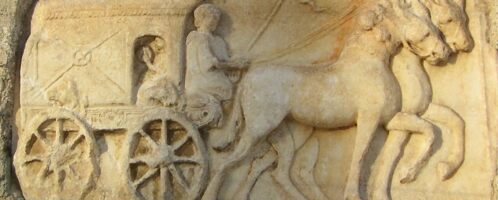
Roman relief showing a cart drawn by four horses

Visualization of tenement house in ancient Rome

A very interesting visualization of a tenement house in ancient Rome, the so-called insula. Insula was the residence of ordinary Roman citizens, something like the present blocks. The tenement houses had several floors, and the walls had windows and doors overlooking the streets, which usually surrounded them on four sides.

Visualization of tenement house in ancient Rome

Spelling error report

The following text will be sent to our editors: