If you have found a spelling error, please, notify us by selecting that text and pressing Ctrl+Enter.
Curiosities of ancient Rome
The world of the ancient Romans was rich in extraordinary, and sometimes even surprising, facts. We draw our knowledge of Roman daily life, customs, and mentality primarily from works left by ancient writers and historians. It is thanks to them that we discover information that is astonishing today – sometimes even hard to believe. Below are some interesting facts that reveal a lesser-known and less obvious side of the Roman world.
I encourage you to submit your own suggestions and to report any corrections or inaccuracies.
Tomb of Roman legionary Lucius Poblicius
The tomb of the Roman legionary Lucius Poblicius, built between 40 and 50 CE is one of the most impressive exhibits of the Römisch Germanisches Museum in Cologne. It is believed to be the best-preserved object of this type north of the Alps, and its rich decorations deserve attention: reliefs depicting the Roman god Pan and his priestesses, as well as floral motifs. In the upper part of the tomb, there is a sculpture of Polblicius himself wearing a toga – an attire that proves to belong to the higher social classes.

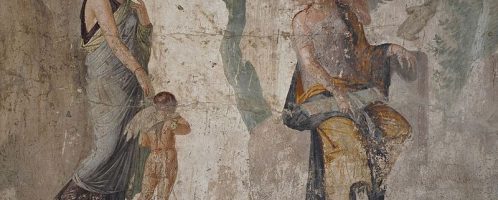
Roman fresco depicting punishment of Amor by Venus
Roman fresco depicting the punishment of Amor by Venus. The object was found in Pompeii and is dated to 25 BCE. It is currently stored at the National Archaeological Museum in Naples (Italy).
Misunderstanding of Caesar’s speech
According to Suetonius, when Julius Caesar in 49 BCE crossed the Rubicon, he decided to appear at a rally in front of his soldiers and speak to them to prove his point.

Roman theater in Pietravairano
A wonderful Roman theater in Pietravairano, in Campania, in central Italy. There was a temple at the top of the hill. The facility has been recently renovated.

Tombstone of Roman silversmith
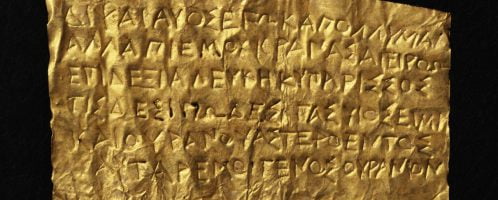
Tombstone of a Roman goldsmith, one Publius Curtilius Agatho. The man was a freedman and died in the early 1st century CE. His names “Publius Curtilius” came from his former owner. His proper name/nickname (Agatho) in Greek means “good”.

Plan of Roman house
The plan shows a typical Roman house (domus) in ancient Rome. Obviously, the number of rooms and the structure changed, depending on the times and wealth of the host; nevertheless, the layout and location of the rooms in the house were basically similar.