If you have found a spelling error, please, notify us by selecting that text and pressing Ctrl+Enter.

Curiosities of ancient Rome

The world of the ancient Romans was rich in extraordinary, and sometimes even surprising, facts. We draw our knowledge of Roman daily life, customs, and mentality primarily from works left by ancient writers and historians. It is thanks to them that we discover information that is astonishing today – sometimes even hard to believe. Below are some interesting facts that reveal a lesser-known and less obvious side of the Roman world.

I encourage you to submit your own suggestions and to report any corrections or inaccuracies.

Unusual legionary Aquila

During the war between Macrinus and Elagabalus, the Battle of Immae in 218 took place. The Praetorians were to face the famous Legio II Parthica. This battle was unusual from the beginning: Cassius Dio reports that the emperor ordered his army to fight without armour. Despite the lack of armour, the praetorians forced the army of the usurper, but for some reason, Macrinus chickened out and fled the battlefield, thanks to what Elagabalus finally won (Cassius Dio LXXVIII 37).

Photo of the tombstone of Felsonius Verus

Roman Mysteries

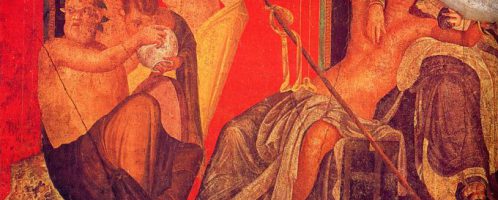
Ancient Romans worshipped many gods and, like the ancient Greeks, performed mysteries and took part in cult ceremonies, often of an orgiastic nature. Many of them are still shrouded in mystery and little can be said about these practices.

Bacchanalia

Reconstruction of Roman fort Richborough

Reconstruction of the Roman fort Richborough (Rutupiae) in the South East of England. Probably after the battle of Mons Graupius (83 CE), a triumphal arch was erected in the fort to commemorate the conquest of Britain. The foundations of the building and the remains of the walls have survived to this day.

Reconstruction of Roman fort Richborough

Roman statue of Fortune

Roman marble statue Fortuna (goddess of happiness and misfortune), restored with a woman’s head with Flavian dynasty (69-96 CE). Object dated to the 1st-2nd century CE. The symbols of the goddess are visible: the cornucopia and the rudder.

Roman statue of Fortune

Spelling error report

The following text will be sent to our editors: