Roman Empire and North America
Comparison of the area of the Roman Empire and the North American continent. The map shows the Roman Empire around 117 CE, when the lands under Roman rule stretched from Egypt to Britain.
If you have found a spelling error, please, notify us by selecting that text and pressing Ctrl+Enter.
The world of the ancient Romans was rich in extraordinary, and sometimes even surprising, facts. We draw our knowledge of Roman daily life, customs, and mentality primarily from works left by ancient writers and historians. It is thanks to them that we discover information that is astonishing today – sometimes even hard to believe. Below are some interesting facts that reveal a lesser-known and less obvious side of the Roman world.
I encourage you to submit your own suggestions and to report any corrections or inaccuracies.
Comparison of the area of the Roman Empire and the North American continent. The map shows the Roman Empire around 117 CE, when the lands under Roman rule stretched from Egypt to Britain.

In ancient Rome, the ritual suovetaurilia was practised, consisting in sacrificing to the god of war, Mars a pig (sus), sheep (ovis) and a bull (taurus). In this way, they wanted to gain his support and purify the earth – the so-called lustratio.

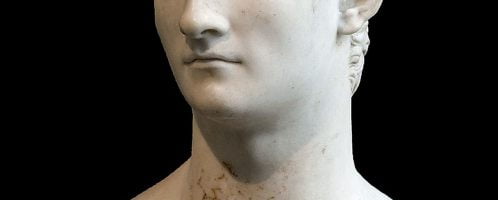
Most historians agree that epilepsy is the most likely candidate for Caligula’s disease. There are several details in Caligula’s biography that support this argument. It is suggested that members of Julius’ family suffered from epilepsy. Additionally, several historians point out that during his childhood, Caligula had episodes of sudden falls during which he lost consciousness and had difficulty staying upright. Analyzed from a modern perspective, these episodes may indicate atonic seizures.
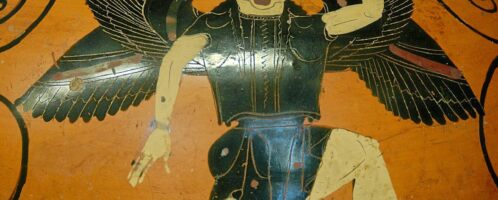
Roman painting showing Heron – the Egyptian god – who was identified with Horus and attributed to him the role of restorer and guardian of justice. In the painting, Heron was shown dressed as a Roman soldier: wearing a breastplate, protective greaves and a cape. The god offers incense and makes a liquid offering next to the column supporting the gryphon of Nemesis, the goddess of divine vengeance.
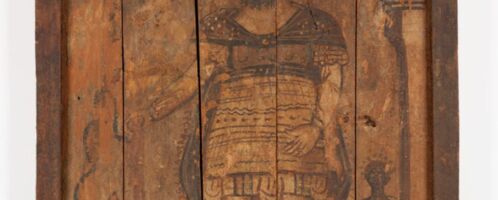
Preserved in poor condition, one of the few Roman paintings in a frame. The antique painting shows a portrait of a woman made on wood and placed in a wooden frame. Much of the paint peeled off and fell off, leaving part of the face and arms visible.

Gaius Lalius Sapiens was a Roman politician in the mid-2nd century BCE and friend of the famous Roman leader Scipio Africanus the Younger – the conqueror of Carthage in 146 BCE. Lelius received his nickname Sapiens, meaning “Wise”, from his contemporaries for the decision to abandon the proposal to reform the law on agricultural land.
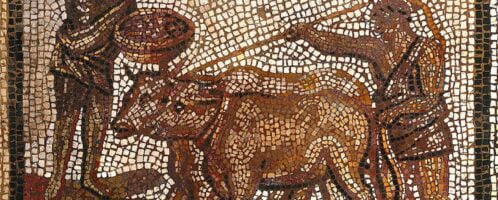
Slave revolts in ancient Rome were not uncommon. However, a more interesting event is certainly the slave uprising in Campania in 104 BCE, which was started by a Roman citizen and equestrian – a certain Titus Vettius.
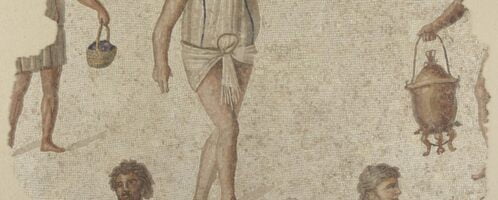
The first century BCE was an extremely turbulent period in the history of ancient Rome. During this time, there were struggles for power and influence between the populares and the optimates. The main enemies were Gaius Marius and Lucius Cornelius Sulla, who committed a huge number of murders.