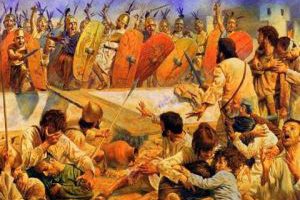
Process of development of Roman state
Wars have accompanied the Romans from the very beginning. During the Roman Kingdom, any skirmishes and fights were rare and they were mostly local.
If you have found a spelling error, please, notify us by selecting that text and pressing Ctrl+Enter.
Ancient Rome’s wars and military played a crucial role in building and maintaining the Roman Empire. In this category, you’ll find articles on the Roman army, legions, weaponry, military tactics, and the most important armed conflicts of the ancient world. We cover both major campaigns and battles, as well as the daily operations of the army, soldier training, and logistics. The articles explore the military dimension of Roman history, drawing on historical sources.
Wars have accompanied the Romans from the very beginning. During the Roman Kingdom, any skirmishes and fights were rare and they were mostly local.
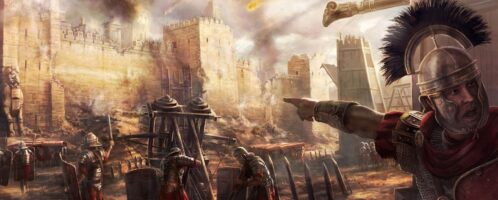
The wars fought by the Romans in the late Republic era made many legions, and even individual soldiers, almost as famous as their leaders. At that time, the Roman army was practically a professional army.

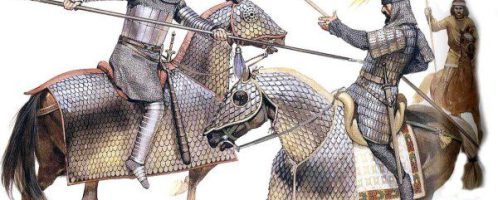
The history of the heavily armed cavalry probably dates back to the steppe areas, where it developed among the Turkestan nomads. Herodotus, known as the “father of history”, mentions in his work the heavy Massagec cavalry fighting in the army of the kings of the Achaemenid dynasty. Heavy cavalry was the basis of the Persian military power, and the main role was played by the Median cavalry.
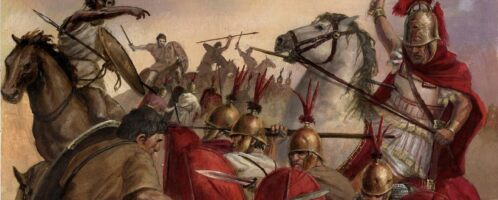
Jugurtha (born around 160 BCE and died in 104 BCE) was the grandson of Masinissa, meaning the ruler of Numidia who at the end of the Second Punic War went over to Rome, contributing to the victory of Scipio Africanus the Elder took over Hannibal in the battle of Zama in 202 BCE and which he acknowledges he was crowned Numidia.
The Marcomannic Wars is a series of wars that the Roman Empire waged in the years 167-180 CE with barbarian tribes living in the areas neighbouring its northern borders. During the entire period of the conflict, many ethnically different barbarian tribes took part, such as the German Longobards, Marcomannians, Narists, Quads or Boers, but also the Celtic Kotyns, the Danish Kostobok and finally the Sarmatian Iazyges and Roxolani.

Gabiniani – this name was related to the group of Roman mercenaries fighting for Egyptian kings – Ptolemy XII and Ptolemy XIII. This term was derived from the name of the governor of Syria, Aulus Gabinius, who left in Egypt part of his troops participating in the recovery of the throne for Ptolemy XII.
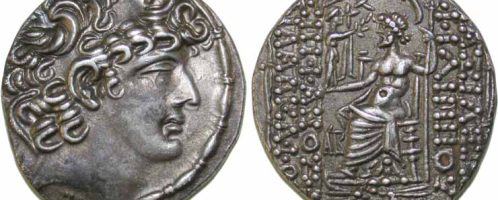
The Roman Legion (legio) was organized to ensure maximum efficiency not only at the level of the entire legion, but also at its individual units. To this end, a strict command structure and precise division into individual units was created, which was largely due to the long evolution of the Roman army throughout history.
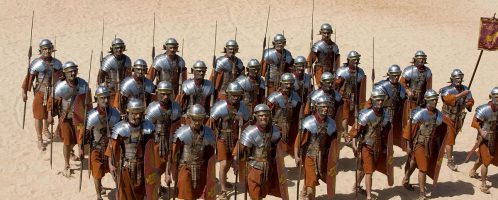
The history of ancient Rome is widely associated with the successes of the invincible legions that crushed the armies of the enemies of the Empire. In such situations, many people think of Caesar’s exploits under Alesia, Scipio under Zama or Marius under Vercellae. This very simplified image of ancient Rome does not take into account the broad context of the history of Roman military. Few people remember that the Roman state also experienced in its history moments of crisis in many areas, including military aspects.
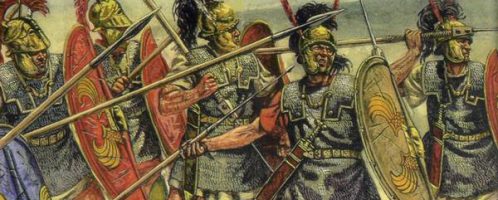
Researchers have been looking for relics of Punic Wars for years. Underwater archaeology is very helpful in this. The seabed off the coast of Sicily has been explored for years, in the Aegean Islands (currently Aegadian Islands, or simply Aegadian Islands), where March 10, 241 BCE, during the First Punic War there was a battle between Carthage’s fleet and the Roman fleet. In the course of the work, numerous rams (rostrum) were discovered and excavated, once menacingly mounted on the beaks of Roman and Carthaginian warships. Since they were cast in bronze, the rams did not corrode and remained in excellent condition.
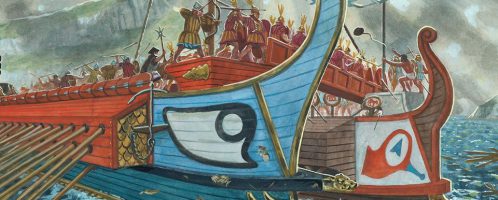
Everyone has heard something about Punic wars, everyone knows something. It was called the war of the Roman Republic with Carthage, a Phoenician colony that became a separate state. Qart Hadasht (New Town) was the capital of the North African country. A country that possessed great wealth, mainly thanks to its excellent fleet and well-developed trade, was second to none because of the merchants of Carthagina. But why do we call the Rome-Carthage wars the Punic? Well, because in Latin the word Punicus meant Carthaginian.