Chapters
Wars have accompanied the Romans from the very beginning. During the Roman Kingdom, any skirmishes and fights were rare and they were mostly local.
The situation changed after the overthrow of the last king Lucius Tarquinius Superbus and the introduction of the republic. This was the beginning of Rome’s extensive, expansive policy. Fights with Latin tribes associated in the Latin League at the turn of the 6th and 5th century BCE eventually ended with Rome’s success. The confederation became thus Rome’s instrument in the conquest of the Apennine Peninsula.
First, the Etruscans stood in the Romans’ way. The fights continued uninterrupted until the 4th century BCE. The turning point was the war with the city Veii in the years 405 – 396 BCE. The victorious conflict allowed Rome to take over the control of the areas north of the Tiber. The slow expansion of Rome was stopped by the invasion of the Gauls in 390 BCE, who plundered Rome. In a sense, this tragic event mobilized the Romans for further expansion, but 50 years later.
Another war broke out in 343 BCE. This time, the Romans began spreading their influence in the south of Italy. Defeating the Samnites – the mountain tribe inhabiting Italy, brought Rome to the role of the largest state of the Peninsula. Further fights were fought against Greek cities such as: Taranto or Sybaris located in the south of Italy. Supported by the King of Epirus, Pyrrhus, they were eventually defeated. Rome practically ended the conquest of the Apennine Peninsula with the occupation of Volsinii in 264 BCE.
Further expansion was carried out outside the Peninsula. Romans began to be interested in Sicily, which, from the 5th century BCE, was under the control of Carthage. However, the immediate cause of the conflict was Rome’s involvement in the feud over Messina (264 BCE). Thus the invasion of Sicily began. The Roman fleet won the first naval battle of Mylae in 260 BCE. The next battle, also won by them, was the battle of Cape Ecnomus (256 BCE) which is considered to be one of the greatest battles in antiquity. Further military operations took place in Sicily. The final clash of the First Punic War took place in 241 BCE and was fought off the Aegadian Islands. Rome recognized Sicily as its first province. Due to the loss of Sicily, Carthage got interested in Spain. Thanks to the leaders Hamilcar and Hasdrubal, the Punic sphere of influence reached the Ebro river.

After the death of Hasdrubal, the son of Hamilcar, Hannibal, became the new commander in chief. After conquering Sagunto (219 BCE), a city allied with Rome, he wanted to transfer military operations to Italy. The route of his tripled through the Alps, where nearly half of the army died. The first battle was fought at Lake Trasimeno, where 15, 000 Romans were killed. Although the whole of Italy stood open in front of Hannibal, he bypassed Rome and headed towards the shores of the Adriatic Sea. In 216 BCE there was another battle, at Cannae, where the Romans suffered the greatest defeat in history. After this defeat, many of Rome’s allies went over to Carthage. The capital was open again, but this time Hannibal did not decide to attack. Gaining time, the Romans bothered the Carthaginians with minor attacks. The commander in chief slowly retreated, handing over the occupied lands. After breaking up the army (207 BCE), Hannibal retreated to Bruttium and left Italy in 203 BCE. Hannibal stood in the battle for the last time at Zama (202 BCE) against Publius Cornelius Scipio, assisted by the king of Numidia, Masynissa. He lost, which forced Carthage to leave all of its estates outside Africa, give up the fleet and pay a contribution of 10, 000 talents. King of Numidia took over the control over Carthage, on behalf of Rome.
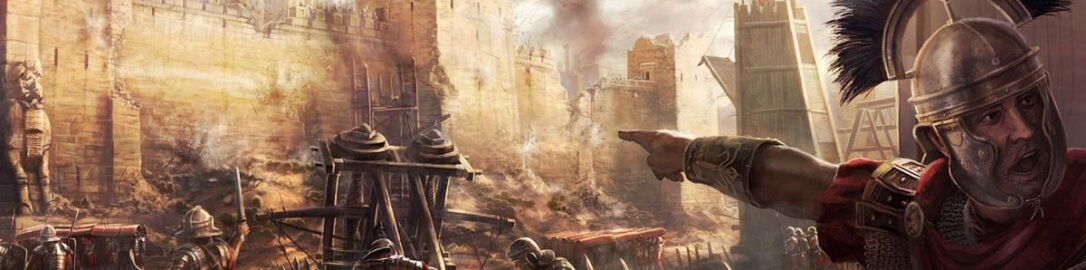
Rome, not wasting time, expanded towards the east. As a result of the three Macedonian Wars (215-167 BCE) and the so-called Syrian war (192-188 BCE), the Romans occupied the Illyrian coast. Then they took control over Greece, entered Asia Minor, and after the victorious battle of Pydna (168 BCE) they divided Macedonia into four republics. The matter of Carthage appeared again. Cato’s words: “Carthage must be destroyed” found their counterpart in deeds, triggering the Third Punic War. Using the pretext of a conflict between the Punics and Masynissa, Scipio Africanus the Younger, after the three-year siege of Carthage (149-146 BCE), destroyed it completely by the decision of the Senate. The area of the former city was devoted to underground gods, which meant that no one would dare to live there.

Along with the expansion, there must have been factors facilitating control over the whole country. Thus appeared a very extensive road system. Military bases were built for subsequent expeditions, which became fortresses, colonies, and then the germs of the Italian cities. The colonies were created in areas not fully mastered and they guarded the safety of conquered lands. The process of creating colonies was in line with Etruscan traditions and principles. The new cities became replicas of Rome. At the head of the colony stood two officials called duumviri. The residents of the municipal had limited rights. They were former Italic boroughs, which obliged to perform “imperialist” tasks for Rome. Municipia became cities only by operation of Caesar’s law in 45 BCE. Initially, the residents did not have political rights. The attitude of the Romans to the municipia was very gentle, they gradually introduced their administrative system. Politics, or colonies, were never given political rights. You had to deserve them.
Areas outside of Italy, attached to the country from the 2nd century BCE were called provinces. The management was entrusted to former consuls and praetors. The first provinces of Rome that appeared after the First Punic War were: Sicily, Sardinia and Corsica. In 219 BCE Illyria was attached. Two provinces were formed in Spain: Hispanic Ulterior and Citerior. In 148 BCE the province of Macedonia was founded. After the destruction of the Achaean League and the destruction of Corinth in 146 BCE, a province named Achaia was created. After the destruction of Carthage, “Africa” was created in the area adjacent to it. Attalus III (king of Pergamon) gave Rome Asia (133 BCE) in his last will. In 118 BCE the areas of today’s southern France were occupied. The whole area of the northern Mediterranean coast, Asia Minor and the coast of Africa were also taken. At the end of the old era, the empire included Syria (63 BCE), Cyprus (58 BCE, Raetia and Noricum (15 BCE), Spain (16 BCE), Gaul (up to 4 BCE) and Egypt (30 BCE). Thanks to territorial gains and new, informal unions, the legal code was constantly developing, learning new experiences, provinces distinguished by the obligation to pay taxes and donate 10% of grain harvests.

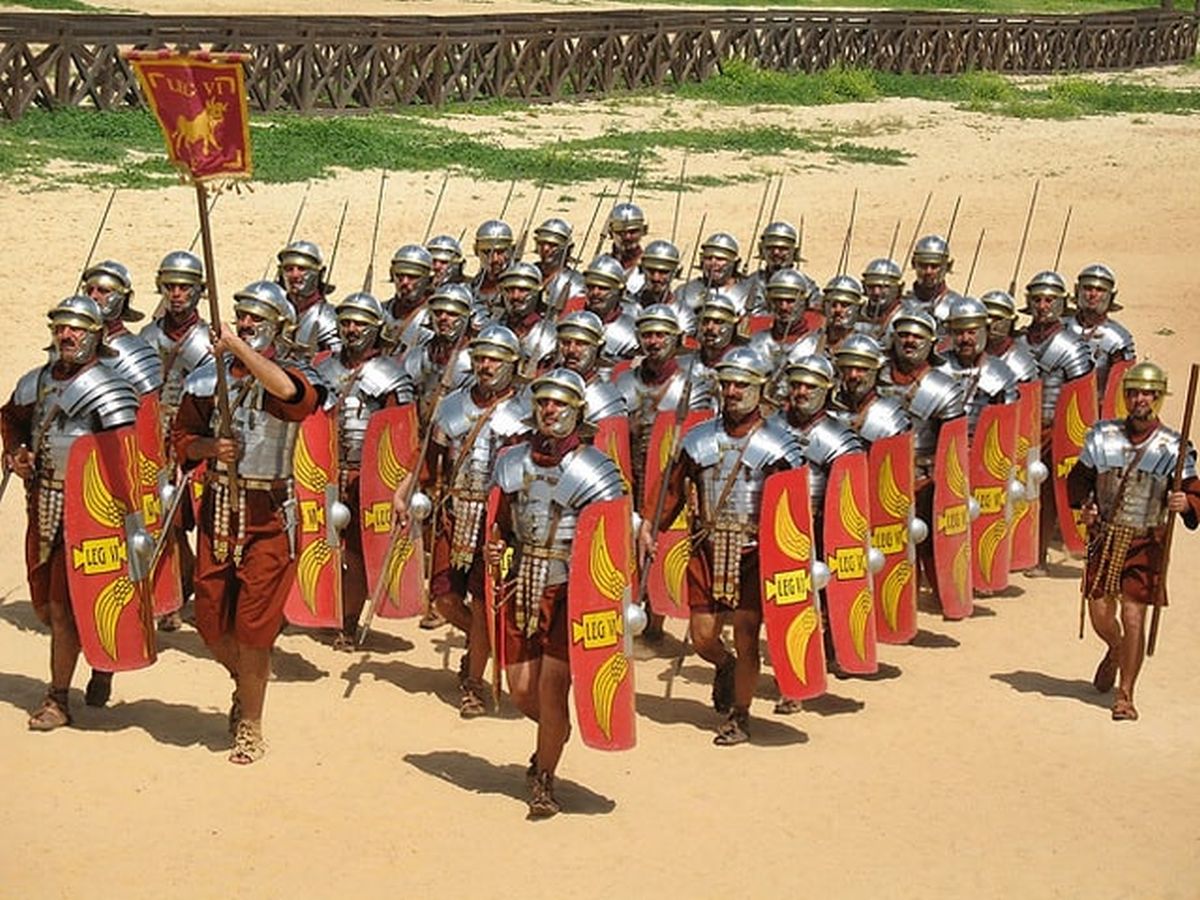
It was a kind of tactic used to defend against archers. It consisted in creating a compact rectangular formation (column), in which the legionaries from the first row and from the sides of the formation held their shields in front of them, while the legionaries from the inner ranks held the shields horizontally above each other and over the legionaries of the first and later ranks, thus creating a shield for the whole formation.
Along with the end of the republic after the battle of Actium (31 BCE) and proclaiming Augustus princeps, the expansion began to grow. Subordination of Spain, Gaul, areas of the Middle East, Britain. During this time, a huge number of wars were waged. At the same time, numerous uprisings broke out, including Spartacist, Jewish, or Boudica in 61 CE. The battles were fought on a mass scale after the death of the last member of the Severus family, Alexander Severus in 235 CE. For ordinary external wars, there were fights for the throne, which introduced total confusion in the structure of the Roman state.
Reasons for the expansion
The reasons for the expansion of the Romans on the Apennine Peninsula, and gradually beyond it was greatly presented by the king of Pontus – Mithridates VI, who in the letter to the king of the Parthian Empire – Arsaces shows the true face of the “sons of the she-wolf”. The letter is summoned by a Roman historian, Sallustius:
In fact, the Romans have one inveterate motive for making war upon all nations, peoples and kings; namely, a deep-seated desire for dominion and for riches. Therefore they first began a war with Philippus, king of Macedonia, having pretended to be his friends as long as they were hard pressed by the Carthaginians. When Antiochus came to his aid, they craftily diverted him from his purpose by the surrender of Asia, and then, after Philippus’ power had been broken, Antiochus was robbed of all the territory this side Taurus, and of ten thousand talents. Next Perseus, the son of Philippus, after many battles with varying results, was formally taken under their protection before the gods of Samothrace; and then those masters of craft and artists in treachery caused his death from want of sleep, since they had made a compact not to kill him. Eumenes, whose friendship they boastfully parade, they first betrayed to Antiochus as the price of peace; later, having made him the guardian of a captured territory, they transformed him by means of imposts and insults from a king into the most wretched of slaves. Then, having forged an unnatural will, they led his son Aristonicus in triumph like an enemy, because he had tried to recover his father’s realm. They took possession of Asia, and finally, on the death of Nicomedes, they seized upon all Bithynia, although Nysa, whom Nicomedes had called queen, unquestionably had a son.
– Sallustius, Histories, IV, 69