If you have found a spelling error, please, notify us by selecting that text and pressing Ctrl+Enter.

Articles (War and army)

Ancient Rome’s wars and military played a crucial role in building and maintaining the Roman Empire. In this category, you’ll find articles on the Roman army, legions, weaponry, military tactics, and the most important armed conflicts of the ancient world. We cover both major campaigns and battles, as well as the daily operations of the army, soldier training, and logistics. The articles explore the military dimension of Roman history, drawing on historical sources.

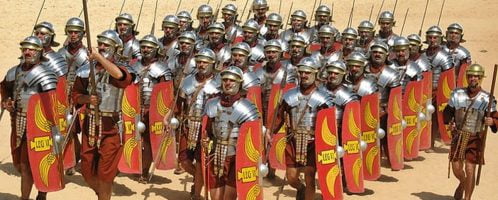
How did the Romans march?

Roman legion conjures up images of a perfectly synchronized formation marching in lockstep. Yet, did legionaries truly move to a rhythm resembling the modern parade step? Historical sources and analyses of the distances covered by the troops suggest a more complex picture: the army of the time was trained primarily for efficient, rapid marching while carrying heavy gear, with pace and distance determined by the type of march and local conditions. What, then, was the legionaries’ actual speed, how far could they march in a day, and how did they maintain the rhythm of a long march?

Roman army march

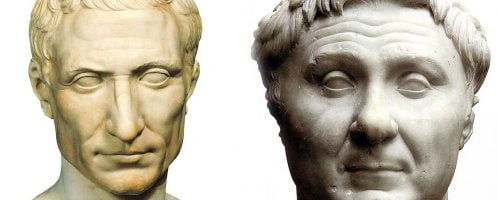
Julius Caesar’s Civil War with Pompey the Great

The Caesar-Pompey War erupted in 49 BCE, a Roman Republic in serious political crisis. The conflict lasted until 45 BCE and was an event permanently etched in the annals of history. The two brilliant generals, who, with the support of their loyal legions, had achieved great victories beyond the borders of the Republic, decided to oppose each other in a decisive battle for control of the Eternal City.

Busts of Julius Caesar and Pompey the Great

Roman conquest of Mona

The Isle of Anglesey (Ynys Môn), known to the Romans as Mona, is located on the northwestern edge of Wales. Separated from the mainland by the Menai Strait, it covers an area of 678.9 km², making it the largest island in the region.

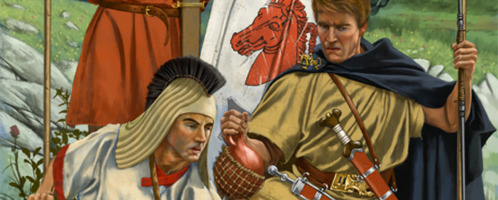
Roman Generals and Emperors and Tacitus, William Brassey Hole, 1897.

Gain and loss of Agri Decumates

On the European continent, the Roman Empire based its border on two great rivers: the Rhine and the Danube. There was, however, a fundamental problem with this concept – both rivers in their initial course diverge, creating an obtuse angle on the map. This meant that the area between them cut quite deep into the Roman territory to the southwest. So it was a sensitive place where barbarians could easily enter the Empire. To prevent this, the Romans took over the lands between the upper reaches of the Rhine and Danube rivers. These areas in ancient times were called Agri Decumates, which means “tithe lands” in Polish. Today, the area is mostly located in the state of Baden-Württemberg in Germany.

Roman territorial expansion in southwestern Germany in the 1st and 2nd centuries CE

The Political Significance of Veterans in the Late Roman Republic

The army was the most important element of Roman territorial expansion. Today we commonly associate it mainly with great discipline and organization. In the first centuries of the republic, however, it was not a professional force. It consisted mainly of Roman citizens who were drafted into the army when needed. Moreover, the Roman state did not provide the soldiers with weapons, the funds to purchase them or a pay. Consequently, not every citizen was able to provide himself with proper equipment, which significantly reduced his combat value and, consequently, his social status.

In peacetime, citizens were demobilized and returned to work, mainly on their farms. However, this system eventually stopped functioning. This was caused, among other things, by the rapid expansion of the Roman state. At the time, wars were fought almost continuously, which made it impossible for soldiers to fulfill their family and professional duties. Over time, the Roman army became increasingly professional, and soldiers began to demand fair compensation for their arduous service. Land grants became a particularly popular form of payment.

This not only provided soldiers with a steady livelihood after many years of war but also helped rebuild the agricultural economy, which had been devastated by the ravaging armies of Hannibal in Italy. However, land grants at that time did not have a permanent, institutionalized character and were carried out ad hoc. A revolution in this area came with the reforms of Gaius Marius, which forever changed the nature of the Roman army. From then on, military service became much more professional. Among other things, the length of service was precisely defined, and the recruitment of poor people who did not own property was made possible. Land grants were to serve as compensation for long years of service. In this way, a new social group emerged: the so-called veterans.

The responsibility for paying the soldiers mainly rested with their commanders, which significantly strengthened their relationships. This group quickly began to play an important role in Roman politics. Their mere presence could have a significant influence, as in 101 BCE, when Marius’ veterans appeared in Rome to support his candidacy for the office of consul. In the capital of the empire, street clashes between different rival groups were not uncommon. Veterans, due to their many years of military experience, often participated in these conflicts and usually emerged victorious. In this way, they became a very effective political tool, through which individual commanders could exert influence on the functioning of the Roman state.

A particularly large settlement campaign was carried out by Lucius Cornelius Sulla in 80 BCE. It is assumed that up to 100,000 soldiers may have been rewarded with land grants at that time. In this way, Sulla secured important political and military support. The veterans had to be aware that if their commander lost power, it could result in the confiscation of their new property.

Veterans often contributed to social unrest. Former soldiers, accustomed to a different way of life, lacked experience in managing agricultural estates, which occasionally resulted in them forfeiting their land grants and falling into debt. Some Roman politicians tried to exploit their discontent, including Catiline, who gained the sympathy of many desperate veterans through populist promises of debt relief for citizens.

Veterans played a particularly important role during the civil war between Pompey and Caesar. Many of them enlisted again in the armies of their respective commanders. The winner of this conflict, Gaius Julius Caesar, carried out another land redistribution for his soldiers. However, this time it was done without the displacement of the local population. The land used for this purpose was either part of the ager publicus (public/state land) or was purchased by Caesar himself.

At the end of the Republic, prominent commanders constantly competed for the support of veterans. Due to their many years of military experience, they were excellent soldiers, which could often decide the outcome of battles. This situation occurred, for example, after the assassination of Julius Caesar. Some of the veterans of the late dictator supported one of his commanders, Mark Antony, who promised them that Caesar’s decisions would remain in effect. Others, on the other hand, joined the forces of young Octavian, Caesar’s official heir. He offered 500 denarii to each soldier who joined his army.

Meanwhile, veterans committed numerous abuses against the population of Italy. For example, soldiers sometimes seized more land than they had been allocated without justification. At the same time, they could feel immune to punishment because they were aware of their position. Both commanders were dependent on them and fulfilled their demands. In this context, a brief civil war broke out (the so-called Perusine War, 41–40 BCE) between Octavian, who supported the veterans, and Lucius Antonius, the brother of Mark Antony, who stood up for the wronged population.

In conclusion, veterans as a social group emerged with the military reforms of Gaius Marius, and from that point on, they became one of the most important elements of Roman politics. However, they never formed a separate political faction to fight for their interests. Veterans were simply tools in the hands of commanders, who used them for their own purposes. In return for their loyal service, they were generously rewarded, including through land grants, which often came at the expense of the local population.


  1. Królczyk K., Weterani w polityce rzymskiej schyłku republiki (od Mariusza do Oktawiana), [w:] Materiały konferencji Komisji Historii Starożytnej PTH, Rzeszów 12-14 września 2000, s. 201–215.
Julius Caesar at the head of the Roman army

Hostilities in Sardinia during Second Punic War. Rise of Ampsicora

At the end of 216 BCE, the strategic position of the Romans was not interesting. Barkida operated in Campania, and the second army, led by Hanno son of Bomilcar, operated in Bruttium. In response, the Republic recruited masses of troops; but in many cases, they were untrained recruits. Some southern Italian cities went over to Hannibal’s side, seeing the defeats of Rome. In addition, Hannibal’s countrymen from the motherland came to the aid of Hannibal in Italy, who sent Magon with 12,000 infantry, 1,500 cavalry and 20 elephants to the Apennines.

Roman soldiers from the 3rd-2nd century BCE

Phalanx in Caracalla’s army?

In the history of the Roman army, the phalanx was nothing new. This system was adopted by the Etruscans in the early period of Rome’s existence. During the second war with the Samnites, the greatest disadvantages of this formation were revealed, namely the lack of manoeuvrability. The Romans decided to move away from the phalanx after the infamous battle in the Caudine Forks, in favour of a manipulative order.

Alexander the Great’s influence on the emperor

Silhouette of a Roman soldier fighting Parthians as phalangaria

If we were to indicate the greatest authority of Caracalla, it would certainly be Alexander the Great. The emperor was so fascinated by the figure of the Macedonian king that he wanted to connect Rome with Parthia by marrying the daughter of Artaban IV, but he was refused, which resulted in new wars. So it was only a matter of time before the crazy emperor created his own phalanx.
Cassius Dio says that in 217, Caracalla, preparing for the war, formed a phalanx consisting of about 16,000 people from Macedonia and armed in the ancient way (pikes and linen armour). Herodian confirms Dion’s account and adds that a similar unit of Spartan phalanxes was formed.

Real image of the imperial phalangaria

The tombstones of the Spartan phalangites have survived to this day, such as the one above belonging to Aurelius Alexianus. The soldier depicted is armed with: lorica segmentata, a mid-length sword commonly used in the 3rd century CE, an oval shield that will begin to replace the cylindrical scutum, the traditional Spartan, pilos and club – a symbol of Heracles or fustis – in the 3rd century CE.
Alexianus’ armament is therefore typical of a legionary of the first half of the 3rd century, and there is no indication that the legions or auxiliary troops changed their tactics.

Therefore, one can guess that Caracalla, going to war with the Parthians, wanted to match Alexander, who conquered the east thanks to the phalanx.
The “Macedonians” of the emperor were most likely praetorians and II Parthica legionnaires from Macedonia and Thrace. Numbers close to 15/16 thousand soldiers would be true. Reference to pikes may refer to spears or pila, and cloth cuirass to thoracomachus or subarmilis, quilted caftans worn under armour. Alexander Severus, who was at war with the Parthians in 231-233, also had his own phalanx, but this too was not armed in the ancient Macedonian manner:

Finally, he provided himself with soldiers armed with silver shields and with golden, and also a phalanx of thirty thousand men, whom he ordered to be called phalangarii, and with these he won many victories in Persia. This phalanx, as a matter of fact, was formed from six legions, and was armed like the other troops, but after the Persian wars received higher pay.

– Historia Augusta, Alexander Severus

Real image of imperial phalangaria

Most likely, the II Parthica legion was the only composed of the phalanx, since it was the only legion that made up the entire field army. The Historia Augusta and the image of Alexianus on the tombstone prove that the phalanx was just an honorary title given to a unit fighting in the East, imitating the deeds of Alexander the Great.

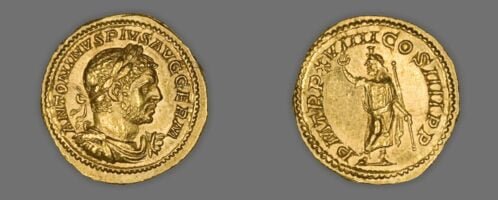
Coin with the image of Caracalla

Reconstruction of Roman legionary in movies on biblical themes

One of the most famous events in human history is undoubtedly the crucifixion of Jesus Christ in the early 30s of the 1st century CE. For this reason, along with the development of cinematography, many works were created to show the life of Christ: his birth, teaching, death and resurrection. Most of these works show Roman soldiers, specifically – legionarys, who most of the time appear only as a background.

Testudo

War of two Scipio. Warfare in Spain in 218-211 BCE

In the second half of the third century BCE, the Iberian Peninsula was inhabited by three peoples divided into tribes. In the west, in the areas roughly equivalent to today’s Portugal, the Lusitannians lived. In the north were the lands of the Celtybers – a people created by the mixing of migrating Celts with the Iberians. The Celtybers created a culture distinct from both the Celts and the Iberians. The latter inhabited the south and middle of the peninsula.

The Carthaginian army consisted of various nationalities. In the picture we can see Iberian, Celt and Numidan

Spelling error report

The following text will be sent to our editors: