Chapters
Roman fleet was named in ancient Rome as clasis. Its main centres were in Ravenna and Misenum, and smaller ones in some coastal provinces and on the Rhine and Danube. Seamen were recruited from the lowest sections of Roman society, even from slaves. From the time of Claudius, only freedmen and inhabitants of coastal provinces could serve in the fleet. As commanders (praefecti classis) under Octavian Augustus still served the freedmen – later the equites
Development of the Roman sea fleet

In the early days of its existence, royal Rome maintained the organizational structure of the city-state, fighting mainly with its land-based neighbours to seize hegemony in the Apennine Peninsula. Even when the republic’s sphere of influence reached the shores of the Tyrrhenian Sea, the matters of the defence of the sea borders were treated marginally, because the only opponent who could not undermine Roman power were pirates who occasionally ravaged coastal cities. To defend against them, small squadrons were formed, which were basically fleets of Greek colonies scattered in great numbers in southern Italy.
These Greeks had ships, they had experienced crews and commanders, for whom the secrets of navigation were no stranger to them, and as a sea nation they had already established their sailing traditions. The crews of these ships were free men who undertook service for a considerable earnings of 183 drachmas per year.
The recruitment of rowers with a chance of a solid salary offered, on the one hand, the possibility of life stabilization for the plebeian community, which, due to their low social status, could not count on a career in the army, and on the other hand guaranteed them a job.
The very development of the Roman fleet was very lagging behind other Mediterranean countries. At a time when the young Republic fought for hegemony on the peninsula, sea battles were rare, but if they were fought, they were of a modest nature. During the conflict with the city of Antium, the Romans threw into battle a fleet of only six ships, while in 348 BCE the Senate ordered war with the Greek colonists living in southern Italy, it was limited only to a demonstrative occupation of the coast on which the Greeks could land. These delays, however, resulted from the bad organization of the navy and the lack of practice and appropriate patterns. Already during the First Punic War, the commanders of the republican navies began to develop their own tactical assumptions, which were partly an adaptation of Greek military thought, and partly the result of their own reflections, as well as technical inventions.
It is worth noting, however, that the first symptoms of the Romans’ interest in the sea fleet appeared at the end of the 4th century BCE because in 310 BCE Rome created a special college overseeing the construction of the duoviri navales fleet. Still, Rome was mainly focused on land wars.
This situation changed with the increasing possessiveness of Rome. When the country began to conquer the more and more extensive areas of the peninsula, it became necessary to have a permanent, regular navy. Some of their own ships were built from state funds, the main base of which was the capital’s river port and the colony at the mouth of the Tiber, Ostia. However, these forces were too small, so the obligation was introduced to provide ships with crews by allied Italian states in the event of a war threat, thus creating a system of coastal allied sea cities (socii navales). Of course, those charged with the duty of serving in the navy were paid wages. They also participated in the distribution of general war profits, but all the amounts allocated to them were lower than the payments to the citizens of the republic who performed a similar service.
Deep changes in the structure and power of the Roman navy took place after 264 BCE when there was an open conflict, the so-called First Punic War, in which Rome’s first enemy was the overseas state, i.e. Carthage. In order to achieve a balance with the enemy with a huge fleet, the Romans, as in the next two Punic wars, had to build up a powerful fleet and call a huge number of people to the oar. They then copied a standard Carthaginian ship, a five-row gallery. There are assumptions that Roman units, at least in the initial period of the Punic Wars, were significantly structurally very similar to Carthaginian units, which of course does not mean that the Romans and later rigidly adhered to the prototype.
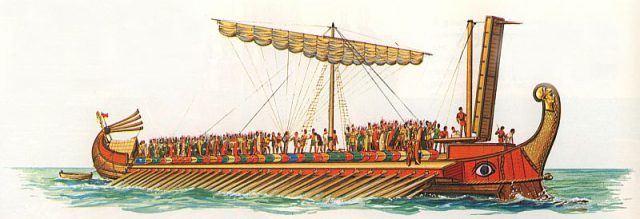
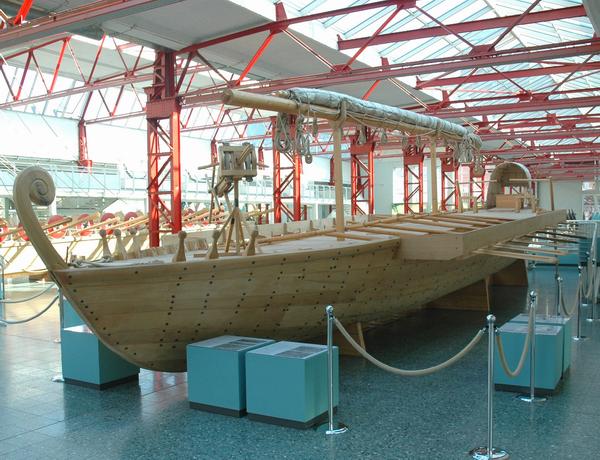
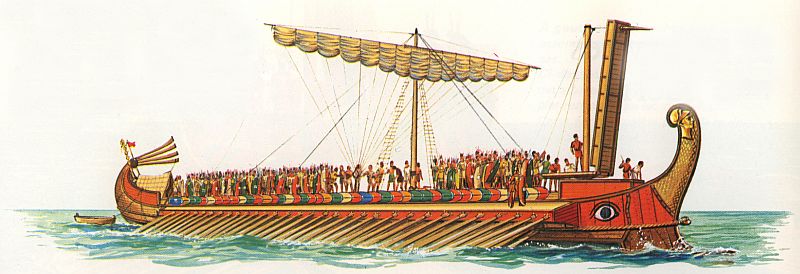
A typical Roman quinquereme (also called panther) had a length of 37 m, a fuselage width of 4 m, a width of the deck with wings 5 m, draft 1, 2 m. It was serviced by 112 rowers on the upper benches, 108 on the middle, 50 on the lower, and 30 sailors, 40 soldiers in peacetime (the number was 120 during the war). Sometimes, when there were not enough financial resources in the treasury, a national loan was written out. At that time, wealthier citizens, having the guarantee of the state, transferred to the fleet of rowers they hired, providing them with pay and food for a month. Another possibility was to send young and strong slaves or prisoners of war to the oars. However, in exceptionally difficult situations, freedom was given to slaves selected in terms of health, who, after paying compensation to their current owners, were sent to work on oars.
However, regardless of the success of their fleet, the Romans were always willing to entrust the waging of naval wars in their interests to nations with well-established sailing traditions. At the very beginning of Rome, the main allies in these matters were the Greeks, later their unchanging allies at sea were the inhabitants of the island of Rhodes. The Rhodes were able to profitably sell their services by renting three-row ships for 10,000 drachmas a month, with the minimum maintenance costs of crews of 6,000 and 1,500 for the maintenance of ships. Such a transaction gave the Rhodesians a profit, and the Romans guaranteed navigation experience and the bravery of the crew. Among the auxiliary fleets of Rome taking part in numerous war brawls were also the armadas of the Syracusan tyrant Hieron, the king of Pergamon Eumenes, and the Egyptian monarchs.
The Romans also obligated defeated opponents to cooperate. After the Second Punic War, the ships of the defeated Carthage cooperated with the republic’s fleet in its fight against the Macedonian king Philip V. The latter, having lost the war, supported the Roman squadrons with his units in the struggle against the Syrian Antiochus monarch. As time passed, Rome could afford to have only a fraction of the fleet put into battle. To the required number, it was supplemented by allied units joining during the voyage towards the enemy.

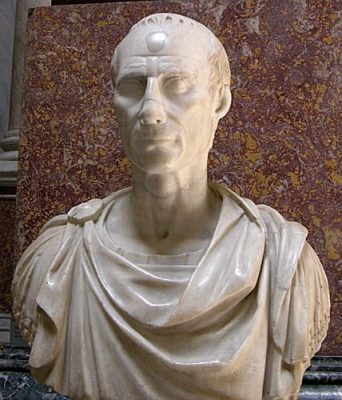
The most troublesome matter informing the fleet was gathering the crew. The Romans were reluctant to serve in the fleet. The reluctance to serve in the fleet particularly affected rowers and deck sailors who had no other choice. It should be noted, however, that it was similar in the case of the marines, which had a much more interesting alternative in the form of an assignment to legions. The idea of land service could be overcome or at least compensated by the increase in social status, remuneration proportional to the hardships of the ship service and the possibility of promotion not worse than in the army. The implementation of these postulates was very difficult, because the servicing of the fleet, both in the case of the Romans and their allies, came from the lowest social classes, which depreciated the course of the career. Moreover, the nature of naval wars was definitely limited by the incentives, such as the possibility of earning money and promotion. These factors increased with the increasing threat of war, but both concerned the army particularly strongly. Most of the conflicts, mainly the wars with the Italian tribes for supremacy in the Apennine Peninsula, the wars in Spain or the Gallic struggle of Julius Caesar were land campaigns. The battles fought during them had a spectacular course, they also mainly brought profits and glory to both the army and the leaders.
Sea battles were struggles of anonymous masses of people enclosed in wooden hulls. The reality at sea was prosaic and cruel. The hundreds of rowers dying in crushed ships or burning ships did not even see their enemy. They died wielding oar bars in their hands instead of swords, as befits the Romans. The combination of these factors meant that the fleet was treated with reserve by the soldiers of the land forces and their commanders, and this ratio also radiated to the general public, not only Roman.
In such a situation, the consolidation of the Roman armed forces resulting from increasing the rank of service in the fleet could be achieved in two ways. The first was the increase in financial benefits to sailors and marines, and the second – was psychological influences, and the role was played by the authority and personal example of the commander, as well as devotion to the good and honour of the Republic of Poland, characteristic of every Roman. It was a special phenomenon.
Ship types
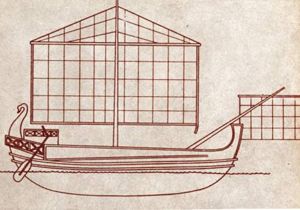
The Roman warships were called naves longae (“longships”) because they had to carry a considerable number of soldiers on board in long ranks. The transport ships were called naves onerariae. They were short and bulky so that they could take as much cargo as possible. Such ships were ordered by Caesar during the Gallic War on the Loire. The Gaul transport ships in the service of the Romans were called naves gallicae. The scout ships, in turn, speculatoria navigia. They were small, light and without any special bows to pierce enemy ships.
Combat tactics
Paradoxically, after Rome’s victory over Carthage, a naval power, the importance of a strong fleet for Rome increased. After dealing with the most dangerous enemy, Rome moved to the stage of waging wars in regions more distant from Italy, where larger military groups could only be moved by sea. Thus, the Roman fleet had to adapt to new conditions, where its main task was to support the actions of land forces – frequent and numerous. In addition, the fleet had to face new convoy and patrol challenges, which were directly related to the increased threat from pirates. Thanks to this, unlike the period of the first and second Punic wars, the Roman fleet began to focus not on large combat ships, but on a larger number of smaller, but faster and more manoeuvrable ships – capable of both recognizing and quickly transmitting important information, as well as fighting against light pirate ships.
On the upper deck of the larger warships of that period, apart from the throwing machines, sometimes two or three-story towers were placed, from which archers could more effectively fire at enemy ships. Incendiary projectiles and branders were also used. Interesting – and it seems quite effective – the invention came from the hands of the Rhodian navy commander and inventor of Pausystrates in 191 BCE: a long beam projecting forward was set up at the bow of the ship, to which a metal container with a mixture was attached incendiary (probably a mixture of tar and oils). The inclination of the container was adjusted from the deck by tight chains. When hitting the enemy ship, the container overturned, spilling incendiary mixture on the deck of the enemy ship. The rest were completed by archers with fired arrows. Also around this period (2nd century BCE to 3rd Punic War), the harbours began to be strengthened by building defence and watchtowers at the entrance to the port basin, and ports “closed” with thick chains.
Following the example of Hellenistic armadas to the numerical strengthening of the fleet, the Romans saw the benefits of its high mobility. As I mentioned, according to the concept of the time, the naval battle was not to be a random series of skirmishes between ships that did not have a common goal, but a planned action, carried out at the will of the combatants, using the art of war, i.e. master manoeuvring of the unit. On the other hand, the most important factor in assessing the strength of the fleet should be its size and mobility. According to the assumptions of experienced commanders, static duels of military crews fighting on decks of ships standing next to each other should be transformed into a struggle of movement.
According to such interpretations, the Romans prepared to wage wars at sea. The high mobility of ships remained an important factor due to the continued popularity of the ramming manoeuvre throughout the ancient era. It was brought to perfection – the attacking ship was gaining momentum moving spur towards the weakest point of the enemy, which was the side, and just before the impact, they were rowing backwards so as not to damage their own unit and prevent the ram from getting jammed too much. The latter option was especially dangerous because in the event of the attacked ship sinking, it could pull the other unit.
It should be noted, however, that the ramming of the ship by no means meant that it would sink mechanically. The weight of the ballast of ancient ships and the equipment they carried (war machines, food supplies and missiles) was relatively small, so naval units could stay afloat for a long time even after piercing the side of the waterline. For example, by moving all the heavy things and 3/4 of the rowers to the side undamaged and throwing out some of the oars, the ship was heeling so that the hole in the side went up above the waterline – in this position it was possible to temporarily patch a hole even in the high seas (as long as there are calm waves) and tow the ship to the nearest marina for renovation.
Soon, the next step in the development of military technology was made by inventing a method to prevent ramming. Here, on the bows of warships, they began to install long booms ending with containers with easily flammable material – tar or charcoal. During the fight, these vessels were set on fire, which became dangerous for the opponents attacking from the forehead, threatening to pour the burning cargo onto their decks. The steersmen, wanting to avoid such a risk, turned in fear, revealing the sides of their own ships as an excellent target for ramming. Often, seeing fire on the booms, the enemies would withdraw without a fight at all. This use of fire became, among other things, a decisive factor in the success of the Romans in the Battle of Cape Myonnesos, fought in 190 BCE, during the Syrian war.
Over time, the attacking tactic has improved. As it was difficult to line up for hitting the side, and in view of the increase in the number of fleets, the sea buoys usually began with a frontal engagement of two arrays, so a new manoeuvre called diekplus expected the attacking unit to pass between two enemy ships moving in the opposite direction after pulling their own oars. In view of the minimum safety distances maintained by the ships sailing information, such a charge ended irrevocably with the crushing of the oars on one side of both attacked ships. Deprived of propulsion and immobilized, they became a convenient target for proper ramming or boarding.
When Rome’s opponents became overseas, the tactical rules were extended to take into account two new factors – the extension of their own and hostile supply lines and the possibility of accessing a sensitive place, which for each enemy was their own economic and demographic base. For example, during the Second Punic War the three most important tasks set for the Roman fleet in 215 BCE stationed in Sicily were: ravaging the Carthaginian shores of Africa, defending the shores of Italy against retaliatory enemy actions, destroying enemy convoys carrying supplies for the army of Hannibal fighting at that time with the legions already on the territory of the republic.
Attacks on convoys have since become a regular feature of wars. Due to the significant distance of the battlefields from the metropolis, the obligations of not only delivering meals but also the supply of weapons, clothing, food and even horses have increased. Warships were not suitable for this kind of cargo. Therefore, for these transports began to be used unarmed and unsuitable for fighting at sea transport ships. Convoys, not always escorted, became slower as a result, they lost their ability to manoeuvre quickly, and the headwind could immobilize sailing supply ships even for longer periods. Attacking such teams just got easier.

The scorched earth tactic that was used on enemy shores underwent a great evolution. Initially, these were semi-pirate actions undertaken by local naval garrison commanders. These people, mostly of the rank of praetor, had great independence, without having to obtain the consent of the senate or consul for the planned robberies. Therefore, mainly the poorly urbanized shores of the enemy were plundered by tormenting the villages – crops were destroyed, cattle were killed, the population was kidnapped and sold after returning to the base into slavery, which not only deprived the enemy of hands to work and conscripts to the army, but also improved the material situation of soldiers and seamen dealing in captured prisoners on their own account.
About 500 Roman ships took part in the war with Mithridates – king of Pontus (1st century BCE). Due to the fact that the navy gained a permanent character (previously, the ships were built in greater numbers after the start of a larger campaign) and more and more often participated in military operations cooperating with the land forces, in this period the “regulation” tactic was developed, and training naval officers has been standardized in terms of their ability to perform certain manoeuvres.
And so, during the march, the ships always went in two columns, sometimes shielded by single light units. These columns, when approaching the enemy, were to turn right and left, respectively, so that after developing the formation they would turn the battle line towards the enemy. When the first line of ships with the outstretched front turned towards the enemy or waited for his attack, the second line performed the same manoeuvre. The art and purpose of all fleet commanders were to attack the enemy when the second line had not yet had time to line up, filling the gaps between the ships of the first line. Then the opponent fought not only with the weakened rival – but also the ships sailing far from each other, it was much easier to break the oars by attacking them from two sides and thus permanently immobilizing them. When the ships of the first line were without oars on both sides and unable to perform the maneuver, the attacking fleet could “take care” of the ships of the second line without interrupting the fire of already immobilized enemy ships. In a word, surprise the enemy with an attack even before he developed both lines of ships, made it possible to break the enemy fleet.
Probably during the war in Mithridates, the custom of signalling the attack by raising a red flag became established in the fleet. At the same time, simultaneously with the raising of the red flag, the trumpeters unanimously began to win the signal to “attack” on the fleet commander’s ship. Occasionally, the rowers would also start shouting a battle anthem.
Over time, the landings took on the character of regular combat actions. The fleet, sailing along the shore, was blowing up the troops at intervals, this time making a deep foray into hostile areas. However, these were already army-level actions, commanded by consuls. They took siege equipment that allowed the capture of fortified cities. Often, in the case of coastal centres, the navy was involved in the siege, or, if the city under attack was farther from the sea, marines or even armed rowers were led into battle.
It should be added that since the Second Punic War, both the Romans and their opponents (pirates, less significant countries of the Mediterranean) successfully used the tactic of the “wolf pack”: when a few light units managed to target a smaller number less manoeuvrable, albeit larger ships, they always tried to attack one enemy ship at a time. It is easy to imagine that even the massive structure of the five-liner could not be intact when it was simultaneously exposed to attacks from 4-5 liburna rams, in addition to attacks from both sides. When well-trained lighter units managed to surprise a few transport ships of weaker construction, not defended by numerous archers and slingers, the transports had little chance of escaping such a meeting.
The Romans in the mature Republic were already known in the Mediterranean world as perfect soldiers. However, the main problem of the fleet commanders was the fact that they could not demonstrate all the qualities of their martial art precisely in ship battles. The main drawback of transferring the principles of ground combat to these specific conditions was the difficulty in the transition of units from their own to the enemy ship. A device called “raven” (corvus) remedied this.

The essence of this invention was an additional, low mast erected in the forepart of the ship. Ropes threaded through its top lifted a movable platform 1.2 m wide and about 11 m long, which additionally could be turned to any side – left or right. The starting position for the operation of this device was the vertical position. When approaching the enemy unit, the footbridge was lowered, so that with its end it fell onto the deck of the attacked enemy, hammering into it with a special spike, which made it impossible for the defenders to drop the pier and held the enemy ship in place in the event of an escape attempt. Along the footbridge, in the blink of an eye, a boarding unit ran over the captured unit, which, being able to develop its usual formation there, was defeating the enemy marines at a rapid pace.

First, corvus was used in 260 BCE during the Battle of Cape Mylae. The Carthaginian commanders, trusting in their navigational abilities, which the slow and inexperienced Roman fleet lacked, disregarded the mysterious structures rising on the enemy ships. Soon, however, their confidence turned to terror as the piers dropped, holding the Poeni, and the Roman naval forces, dominating in their numbers, turned the naval combat into an almost land battle. The Carthaginian armada was smashed – some units were captured, some fled to bases. The victor, consul Gnaeus Duilius, not only triumphed, but a column (columna rostrata) decorated with the bows of captured ships were built in Rome to celebrate the victory.
Over time, the Romans began to make the sea struggles more like land battles. An important factor of this was the introduction of throwing machines – catapults, onto the ships. This type of armament of vessels was mainly related to a new way of using them – siege battles around coastal fortresses.
The Romans during sea siege fights, wanting to eliminate the difference in the levels of attackers in relation to the height of the fortifications, began to erect towers on the ships. Wanting to increase their height, which would also violate their stability, they began to connect combat units with each other on an ad hoc basis, and thus built multi-level towers on the resulting floating platforms, often having machines to attack the besieged walls with special battering rams.
Such catamarans were still mobile – they were powered by oars on the outer sides of interconnected ships. Thanks to this, they could attack the walls wherever you could swim near them. A classic example of such an action was the siege of Syracuse in the spring of 213 BCE, by the proconsul Marcus Claudius Marcellusalong the walls of this seaside fortress, he placed many floating siege towers, one of the largest rising on a bridge along the connected with the sides of five five-row ships. Meanwhile, the ships in the second line were firing catapults at the city, preventing the defenders from attacking the siege engines.
Famous Roman admirals |
|
Two new innovations that enhanced the tactical value of the Roman fleet were the aforementioned liburna and harpax.
Liburna (navis liburnae) came from the Dalmatian coast. The prototype was the ships of Liburnian, an Illyrian tribe from the Dalmatian coast, engaged in piracy. The Romans copied this type of construction and in the 1st century BCE introduced the liburna for use in their fleet. Liburnias were not very large, light, double-breasted, with low displacement. The crew consisted of 50-80 rowers and 30-50 marines, depending on the size of the ship. These ships had no deck, only a narrow deck connecting the pointed bow with an equally sharp stern. According to Pliny, they had a sharp beak to resist the water as little as possible. A characteristic feature of these units was a small cabin located at the rear of the ship, providing shelter to the helmsman and officers from lighter missiles. The length of the liburna was approximately 36 m.
These ships, due to their small dimensions and high manoeuvrability, were mainly used as reconnaissance units, although source records also inform about their participation in the battles of large fleets. They were first used in the battle of Actium. They were used throughout the Roman Empire, not only at sea but also on the Nile, Rhine and Danube, for example.
According to historical sources, where the terminology is not uniform, liburnas were used for every Roman ship, from biremes to galleys with six rows of oars. In the days of Augustus, even six-row liburnas were considered small and quick compared to Antony’s bulk y ships used at Actium.
Harpaxwas invented and put into use quite late, only in the 2nd half of the 1st century BCE. The originator was the commander of the Roman fleet Marcus Vipsanius Agrippa, therefore, taking into account his experience gained in numerous expeditions, it can be stated that this invention was the crowning achievement of the centuries-old aspirations of the Romans, who wanted to bring the ship battle closer to land combat.

The essence of using the harpax was to immobilize and bring the enemy ship closer so that it could not use its manoeuvring abilities, and the Roman marines could board it faster than the narrow “crow” allowed. The realization of these assumptions was achieved by Agrippa in an extremely easy way – harpax was simply a heavy log fired at the enemy using a ship’s catapult. In the case of an accurate shot, the projectile stuck into the deck with numerous spikes with which it bristled. The special shape of these blades made it difficult to pull out a stuck log, while on the attacking Roman ship the rope attached to it was stretched. The tension on the rope made it quite impossible to pull the harpax from the deck, and the captured ship was pulled to the attacking unit, from which the marines were jumping.
Ship types
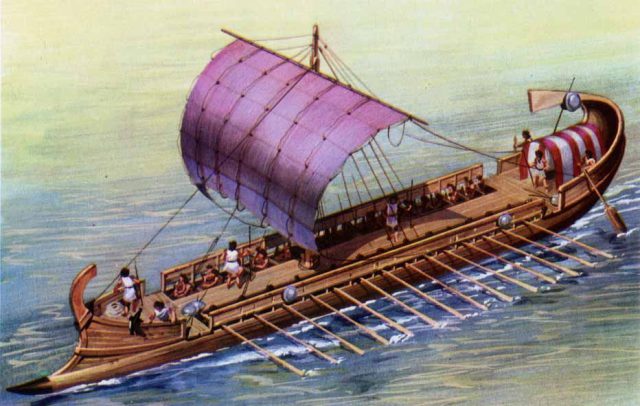
- Trirema was the dominant ship in the Mediterranean Sea until the 3rd century BCE. It was small, agile, and in large numbers. It had a sail and rowing drive, but the sail was not used in battle. It was modelled on the Greek trier. During the battle, the ships tried to destroy each other with battering rams, or by transferring “crows” (battle bridges) to the decks of the enemy ships, over which the soldiers boarded.
- Quinquereme was the main Roman warship during and after the Punic Wars. Also referred to as pentera was a ship type previously used by the Greeks, the Phoenicians. It was very similar to the trireme but much larger than it. It’s displacement was about 300 tons. The penteres were equipped with two masts placed diagonally at the bow and square sails. The crew consisted of 300 rowers and 200 soldiers. Mostly one oar was handled by five rowers. They were armed with ballistae and catapults. Roman quinqueremes were modelled after Carthaginian Fridays and were used en masse in the First Punic War. The ship was approximately 37 meters long and 4 meters wide.
- Liburna was a small and agile ship that could take 300 to 400 people on board. (the unit is described in more detail before).
Roman ships usually bore the names of gods (Jupiter, Minerva, Neptune), heroes (such as Hercules) or concepts (Truth, Victory, Loyalty).
Ports
The progressive development abounded in newer and newer design solutions, which in the battle of muscle strength were opposed to Roman technical thought. This applied not only to direct means of combat but also to military infrastructure. One of its important factors was the network of natural and artificial ports, constituting the supply and transhipment base for maritime operations.
The original ship securing system, still used in Greece, was hauling ships ashore after the end of the summer sailing season. When the state of the property of the state allowed it, hangars were built on the beach, in which there were several ships. Athens, as one of the early Mediterranean powers, had 350 such hangars. This method of overwintering under the roof saved the ships from the influence of the cold weather and facilitated renovation works.
These ports were adapted not only to reloading and the winter stationing of squadrons. They underwent major renovations and built new units. A well-developed technical base was necessary because it often happened that, after a few or several years of peace and inactivity of the fleet, the fleet was preparing for a new naval campaign, and most of the ships were no longer usable after a long break.
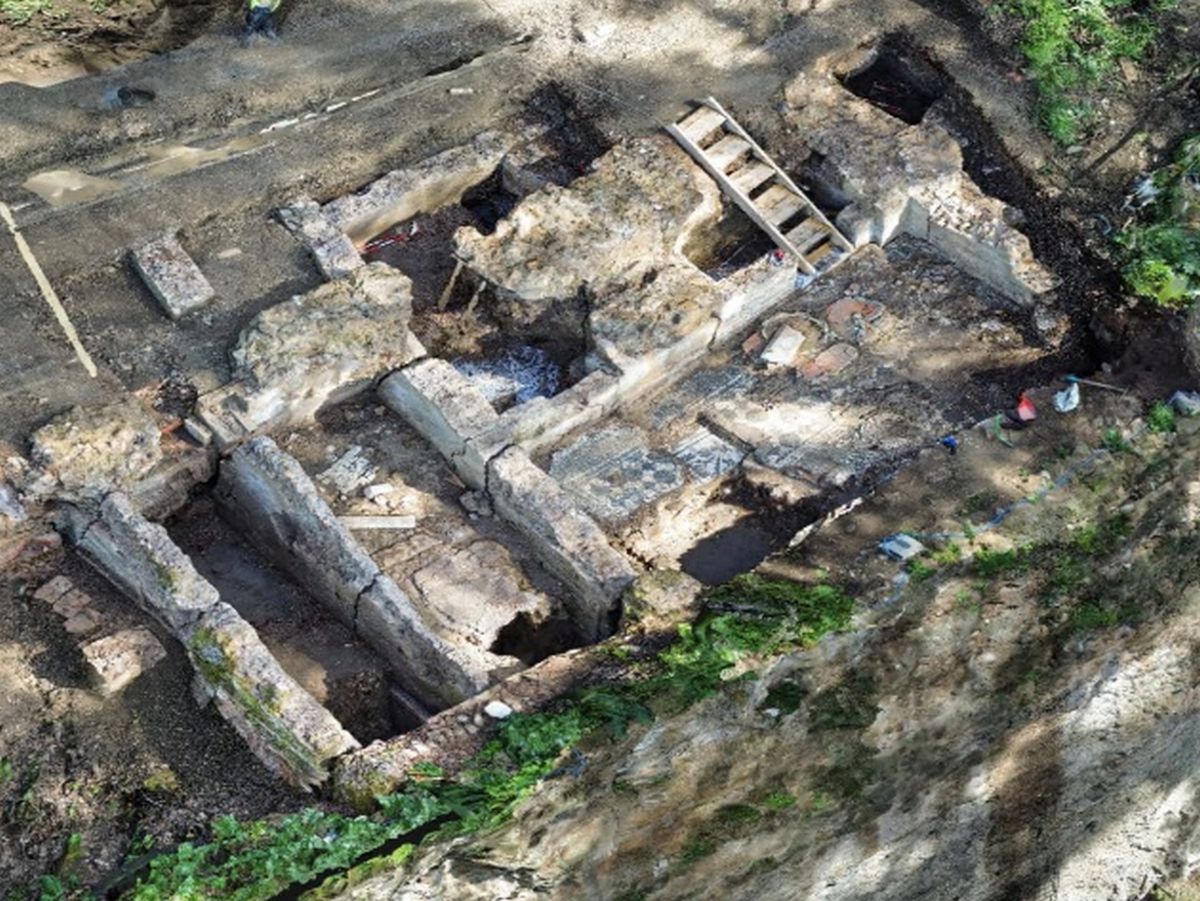
The most important Roman ports are worth mentioning: Misenum, Classis, near Ravenna, Alexandria, Leptis Magna, Ostia, Mogontiacum on the Rhine.

Vitruvius (1st century BCE) left the way ports were built. This famous Roman architect and war engineer is the author of the work “On the Architecture of the Ten Books”, which today is an invaluable source of knowledge about the architecture and building art of the ancient Greeks and Romans.
But, if the place be not thus fitted by nature, nor secure for ships in stormy weather, and there be no river there to prevent it, but on one side there is a proper shore, then on the other side, by means of building or heaps of stones, a projection is run out, and in this the enclosures of harbours are formed. Building in the sea is thus executed. That powder is procured, which is found in the country between Cumæ and the promontory of Minerva, and is mixed with the water in the proportion of two parts thereof to one of lime.
Then, in the place selected, dams are formed in the water, of oaken piles tied together with chain pieces, which are driven firmly into the bottom. Between the ranges of piles, below the level of the water, the bed is dug out and levelled, and the work carried up with stones and mortar, compounded as above directed, till the wall fills the vacant space of the dam. If, however, from the violence of the waves and open sea the dams cannot be kept together, then on the edge of the main land, a foundation for a wall is constructed of the greatest possible strength; this foundation is laid horizontally, throughout rather less than half its length; the remainder, which is towards the shore, is made to overhang.
Then, on the side towards the water, and on the flanks round the foundation, margins, projecting a foot and a half, are brought up to the level already mentioned. The overhanging part is filled up underneath with sand, brought up level with the foundation. On the level bed thus prepared, as large a pier as possible is built, which must remains for at least two months to set. The margin which incloses the sand is then removed, and the sand being washed away by the action of the waves causes the fall of the mass into the sea, and by a repetition of this expedient the work may be carried forward into the sea.
When the place does not afford the powder named, the following method is to be adopted. Double dams are constructed, well connected with planks and chain pieces, and the cavity between them is filled up with clay and marsh weed well rammed down. When rammed down and squeezed as close as possible, the water is emptied out with screw pumps or water wheels, and the place is emptied and dried, and the foundations excavated. If the bottom be of loose texture, it must be dug out till a solid bottom is come to, wider than the wall about to be erected, and the wall is then built of stone, lime, and sand.
But if the bottom be very soft, alder, olive, or oak piles, previously charred, must be driven, and the intervals between them filled with coals, as directed above for the foundations of theatres and walls. The wall is then raised with squared stones, the joints of which are to be as long as possible, in order that the middle stones may be well tied in. The inside of the wall is then filled with rubble or masonry; and on this, even a tower might be erected.
– Vitruvius, De Architectura, V.12
The river Ostia harbour and Pozzuoli harbour were the two main pillars of the Roman port system during the entire period of the Republic. Both the port of Pozzuoli, far from the capital, and the inland port of Ostia, in the era of rapid population growth in the times of the Empire, almost ceased to fulfil the functions imposed on them: main gates to supply the city with food. Ostia, as a river port with low transhipment capacity (one long berth lying along the river), could only be served by small river vessels. There was a fleet of small ships and boats (which were loaded with goods from anchored, larger sea-going ships) and then dragged along the banks of the Tiber by animals or slaves. An additional difficulty was the constant silting of the port by the river current.
Due to stormy weather conditions in winter, service in these ports was extremely difficult. As a rule, they were closed for several months, because no ship was safe on the open anchorages located at the entrances to these small ports. The great rulers were well aware of the vital importance of a great city having its own large maritime transhipment infrastructure. Julius Caesar planned, inter alia, changes in the course of the river’s current to make it accessible to large-sized vessels and thus eliminate the need for transhipment to smaller, river vessels. Emperor Augustus considered the possibility of carrying out port work at the mouth of the river itself. On the other hand, Caligula through an ill-considered decision – to use hundreds of transporters to your whim (a huge bridge across the Bay of Naples) – brought about a famine, the effects of which were felt for many years to come.
Finally, from Emperor Claudius (41-54 CE) – a great, artificial harbour (called Portus) saw “the light of day”. It should be emphasized that the construction costs were enormous and the size of the port was limited, precisely for financial reasons that could be met by the state treasury. Maintaining the port in a proper condition was quite difficult due to various sediments deposited by the river, but this was realized from the beginning of construction – in the final decision, the undeniable benefits related to the location and usefulness of the entire structure prevailed. Despite various restrictions – the construction site was located approx. 3 km north of the mouth of the Tiber. Half of the basin was dug out of the ground (digging a few hundred meters into the existing shoreline), and then the entire planned structure was surrounded by two long moles extending far out into the sea. 1500 m long north-west pier turned south-east in its final course. The second pier (several hundred meters long) turned north-west, towards the first pier. A space of about 500 meters was left between the two structures, in which an island with a lighthouse was placed. The lighthouse was built using the raw material of a huge ship built by Caligula to transport an obelisk for the amphitheatre (approx. 1000 – 1200 tons), while the construction of both large piers – breakwaters, wooden “caissons” were used, which were first anchored to piles driven into the ground – marking the main course of the structure, and then they were sunk, properly filled with ballast.
The entire structure covered an area of approximately 1,200 m by 1,300 m, but it was not a typical port in the strict sense of the word. Rather, it was a huge, sheltered anchorage connected by a “shortcut” to the course of the river at a distance of about 5 km from its mouth (thanks to this, several hours were gained in sailing against the current). There were reloading quays (approx. 1500 m long) deep inside the port. The port was completed in CE 64 by Nero (who, incidentally, honoured himself on coins specially minted for this occasion) and has been waiting since then at anchor, ships had “as such” cover. Of course, it was not 100 per cent – it turned out as early as 62 CE (according to historians, although it looks like the period before the official completion of construction) when about 200 ships sank or were badly damaged in a powerful storm, and almost twice as many – seeking shelters along the banks of the Tiber – burned down.
An undoubted development of the real port construction was the hexagonal port structure of Trajan (100 – 112 CE), which was an additional protection area against bad weather, while at the same time being an extension of the existing quay system and transhipment jetties. In addition, many different buildings were built (apart from the existing ones) at the airport, including the Harbor Master’s Office, cisterns, baths and warehouses that were an integral functional part of the entire system.
Ship naming
The maritime nomenclature used by the Romans has also been preserved. The ship’s hull is carina. In the front, we have a bow, i.e. prora, and in the back, a stern – puppis. The sides were simply called “walls”, meaning costa or paries. Inside the hull, there was a division into decks – tabula. There were usually two decks, though it happened and more. The upper, open deck was called forum. Also in the case when it was not a full deck, but afore and aft half deck.

A decorative aphlaston fan and (especially on large merchant ships) a bent neck and head of a goose – cheniscus were often placed on the stern. The aft superstructure and the helmsman’s position were sometimes called the same. Events that took place in this superstructure or at the controls were also described using the phrase in puppis foro, i.e. on the aft deck. In the construction of the rudder, which consisted of two large side oars, we can distinguish gubernaculum (proper oar) and clavus (tiller). These names, especially the governorate, were also used to denote the position of the helmsman. This stand was located on the aft superstructure, hence this superstructure was also sometimes called as such. Thanks to the tiller, consisting of several articulated arms, the helmsman could stand at a certain distance from the steering oars and use less force for work.
In the centre of the deck was the malus mast. The overwhelming majority of ancient ships were single-masted, although the dolon was also sometimes used, the front mast installed at the bow inclined like a bowsprit, or more vertically like a seal mast. The mainsail is acation, the headsail is artemon, and the topsel or triangular sail stretched over the mainsail above the mainsail is siparus. Often masts were crowned with an additional observation post, a narrow basket called carchesia. Reje – antennae a.re always plural because they consist of two arms. Lots of thinner and thicker lines were used to operate the masts and sails. Let me omit the names of the bras, sheets, countershots, geitavas, gords, topenant, etc. Generally, the rigging was called rudentes.
There was often a superstructure at the mast in the middle of the deck. Sometimes wooden, but mostly it was a canvas tent, stretched over poles. The tent was set up only for the duration of the cruise, while during port works it was folded so that it would not be in the way. The events that took place in the central superstructure were simply “at the mast”. For various reasons, mostly no superstructures were erected in the bow.
Below the proper deck, there was a rowing deck if the drive was to be a rowing machine, or immediately a cargo warehouse. The rowers’ benches, transtra, occupied the space under the sides, and a narrow path ran along the centre – agea for sailors. On the average ship of that period, there were no specially dedicated passenger cabins. They would limit the storage space and interfere with efficient loading and unloading. Therefore, travellers spent their journey on board or wedged in among the piles of goods below deck. For larger passengers, the crew could give up a place in the stern or mast superstructure. Of course, typical passenger ships also began to appear, but the irregularity of cruises and problems with finding a ship sailing in a specific direction meant that who had to make the journey was not particularly fussy. Ships’ cabins were called variously: cella, excursio, locus, vaco, so you can see that they were mostly synonyms of the words “room” (in the sense of “room” of course).
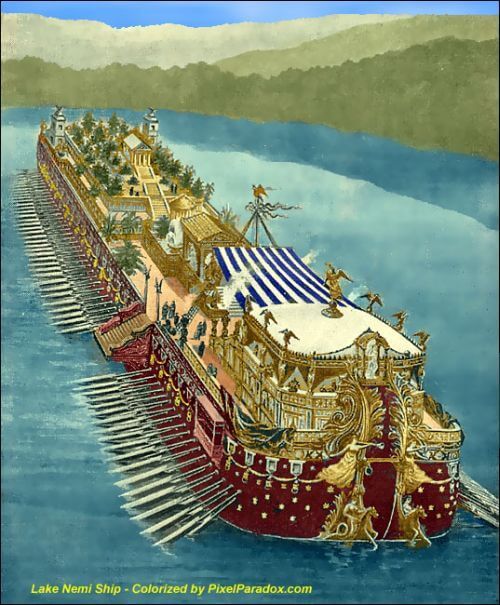
They were excavated from Lake Nemi – a tiny body of water 30 kilometres south of Rome. These were real floating palaces – with heating, baths and toilets. What prompted Caligula to build such large ships on such a small lake (1.67 km2)? According to Roman law, this lake was sacred, so it was absolutely forbidden to swim on it. Caligula was fascinated by the Egyptian goddess Isis as well as the lavish life of Ptolemy. So he wanted to create something the greatest – huge imperial ships, exceeding in size anything the world has seen. An additional aspect for which he decided to build his floating palaces was the specific microclimate of the place. The extremely clean region with slightly lower temperatures than in Rome meant that the richest citizens of Rome eagerly built their residences there. The lake was additionally connected with the capital, the famous Via Appia.
The ships were monumental and full of fantastic technology. They were over 70 meters long by 24 meters wide, a system for supplying hot and cold water (pipes signed with the emperor’s name), bathrooms and baths. All in marble, gold and ivory. Undoubtedly, they served the emperor’s private amusements – a large living room, kitchen or bedroom indicates that the ships were treated as mobile palaces. They contained (the oldest known) Archimedes’ bolts, an admiralty anchor extremely rare at the time; piston pumps (rediscovered only in the Middle Ages). Both had a system of moving sculptures (modelled on a theatre) with a system of ball bearings.
The two ships were slightly different from each other – one was a galley (driven by oars), and the other was sailing based on the wind force.
Later, private luxury ships also appeared with many cabins, decorated with columns, sculptures, mosaics, and even private altars. There were such and much earlier (before Rome ruled the Mare Internum), but they were built and used only by rulers, not private individuals. For example, the royal ship of Ptolemy IV Philopator, which, in addition to the huge audience hall oikos, and several banquet rooms symposion, had about twenty large rooms for the king and guests. It should be noted that the ship did not sail on sea voyages, but mostly moored at the Royal Port in Alexandria, or at the nearby islet of Antirrodos. This floating palace was moved with the help of towboats).
The most important additional equipment for each ship was the ancora – anchor, sometimes also called uncus, which probably refers to single-arm hook anchors. Each ship had at least a few anchors, which were used not only for mooring but mainly as a means of rescue during a storm if the ship was too close to shore.
Additional equipment is completed by a small boat, called navicula or carabus, pulled by the vessel in the tow. It was used for various works on the hull, bringing a local pilot on board, or as a last resort as a rescue boat.