Lack of slave equated to poverty
In ancient Rome, not having at least one slave meant living in poverty. It is worth mentioning that about 25% of the population of ancient Rome was enslaved at the end of the existence of the Republic.
If you have found a spelling error, please, notify us by selecting that text and pressing Ctrl+Enter.
The world of the ancient Romans was rich in extraordinary, and sometimes even surprising, facts. We draw our knowledge of Roman daily life, customs, and mentality primarily from works left by ancient writers and historians. It is thanks to them that we discover information that is astonishing today – sometimes even hard to believe. Below are some interesting facts that reveal a lesser-known and less obvious side of the Roman world.
I encourage you to submit your own suggestions and to report any corrections or inaccuracies.
In ancient Rome, not having at least one slave meant living in poverty. It is worth mentioning that about 25% of the population of ancient Rome was enslaved at the end of the existence of the Republic.

Column-shaped stone tombstone, dated to the 3rd century CE, with a visible Greek inscription.

As it turns out, the Romans took magic very seriously, because they even regulated its use legally in their famous 12 tables.

Punic urns that were discovered in the necropolis of Marsala (ancient Lilybaeum). The urns are made of white limestone and simply decorated. Remnants of cremated skeletons have been found in urns.

Wigs were worn in ancient Rome. Julius Caesar reportedly wore a wig and a laurel wreath to hide his progressive baldness. The Emperor’s wife herself Marcus Aurelius – Faustina the Elder (c. 100-141 CE) – had an impressive collection of at least 300 wigs.
Golden aureus Marcus Junius Brutus, one of the murderers of Julius Caesar. Object dated to 43-42 BCE. The artifact is in The British Museum.

The letter Y was not originally in Romans. Y was added to the Latin alphabet around the 1st century BCE to render Greek words better.

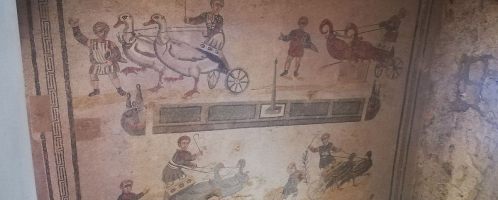
Interesting Roman mosaic showing the chariot race performed by children. The boys drive two-wheeled chariots drawn by birds. The colours of the teams were marked not only by the colour of the boys’ tunics but also by the species of birds: Whites have geese, Reds – flamingos; Blue – gallinula; Greens – pheasants.