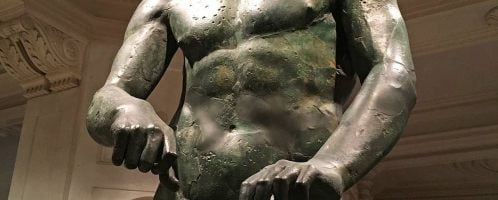
Remains of colossal statue of Domitian
Remains of a colossal Roman statue depicting Emperor Domitian (reigned from 81-96 CE). It is located in the Ephesus Museum in Selçuk, Turkey.
If you have found a spelling error, please, notify us by selecting that text and pressing Ctrl+Enter.
The world of the ancient Romans was rich in extraordinary, and sometimes even surprising, facts. We draw our knowledge of Roman daily life, customs, and mentality primarily from works left by ancient writers and historians. It is thanks to them that we discover information that is astonishing today – sometimes even hard to believe. Below are some interesting facts that reveal a lesser-known and less obvious side of the Roman world.
I encourage you to submit your own suggestions and to report any corrections or inaccuracies.
Remains of a colossal Roman statue depicting Emperor Domitian (reigned from 81-96 CE). It is located in the Ephesus Museum in Selçuk, Turkey.

The Baths of Caracalla were the largest baths in the empire. Built in 216 CE the baths could simultaneously accommodate 1,500 people. The bathing plan was as follows: upon entering, you entered the bathhouse, then into the heated tepidarium room, preparing the body for hot baths in the caldarium.

The portrait of the Roman Emperor Tiberius (ruled 14-37 CE) is considered part of the cult vessel. It is located in the Fitzwilliam Museum in Cambridge (England).

Roman glass fish over 1,800 years old. The object is 49 mm long.

Roman tombstone from the time of the reign of Octavian Augustus (27 BCE – 14 CE). The sculpture shows an eagle and weapons. In the past, the monument may have contained an urn with the ashes of Marcus Valerius Messalla Corvinus.

Cassius Dio tells about an interesting discussion between the wife of Septimius Severus – Julia Domna, and taken captive wife of the Caledonian chieftain, Argentocoxus, which is not known from the name. The conversation was supposed to take place during the emperor’s military campaign in the north of Britain.

An interesting find from the Roman fort of Arbeia in South Shields (North East of England). The subject shows the head of an animal, possibly either a fox or a bear. It was probably an amulet made of a jet (a type of brown coal).

Very interesting image of emperor Elagabalus (204-222 CE), based on the famous bust from the Capitoline Museum in Rome.