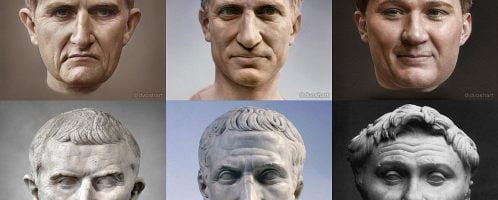
Reconstruction of images of first triumvirs
Reconstruction of the images of the first Roman triumvirs – Marcus Licinius Crassus, Julius Caesar and Pompey the Great. The reconstructions were made by “Dan Voshart”.
If you have found a spelling error, please, notify us by selecting that text and pressing Ctrl+Enter.
The world of the ancient Romans was rich in extraordinary, and sometimes even surprising, facts. We draw our knowledge of Roman daily life, customs, and mentality primarily from works left by ancient writers and historians. It is thanks to them that we discover information that is astonishing today – sometimes even hard to believe. Below are some interesting facts that reveal a lesser-known and less obvious side of the Roman world.
I encourage you to submit your own suggestions and to report any corrections or inaccuracies.
Reconstruction of the images of the first Roman triumvirs – Marcus Licinius Crassus, Julius Caesar and Pompey the Great. The reconstructions were made by “Dan Voshart”.
A preserved fragment of the Roman image of Emperor Caracalla (188-217 CE).

Roman brooch in the shape of a rabbit.

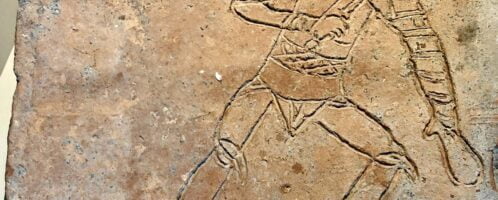
Almost 2000 years old brick with engraved image of gladiator of the type retiarius (“netman”) named Equoreus. The gladiator was shown fighting a prepared dagger, protected by a neck protector (galerus) and a shoulder protector (manica). The object is located in the Archaeological Museum of Zagreb (Croatia).
The Romans appreciated the possibility of relaxing in the baths. Of course, the full pleasure of bathing could be experienced thanks to special additives such as oils or scrapers. A slave or bathman (balneator) hired for an appropriate fee could definitely make the stay more enjoyable.

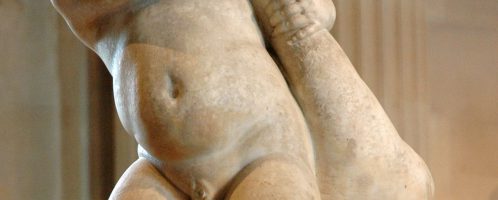
A sculpture showing a boy choking the goose. It is a Roman copy (from the 1st-2nd century CE) of a Greek original from the 2nd century BCE. The object is made of marble and was found in 1792 at the Villa of the Quintilii on Via Appia. It is currently located in the Louvre.
The remains of the earth from the Roman fort at Risingham (northern England), which was called Habitancum in Roman times. Its purpose was to defend the crossing of the Rede River. It was established in about 139 CE and was abandoned in the 4th century CE. The facility could accommodate a detachment of up to 1,000 people.