Chapters
| Name | Lucius Aurelius Commodus |
|---|---|
| Ruled as | Imperator Caesar Marcus Aurelius Commodus Antoninus Augustus |
| Reign | 17 March 180 – 31 December 192 CE |
| Born | 31 August 161 CE |
| Died | 31 December 192 CE |
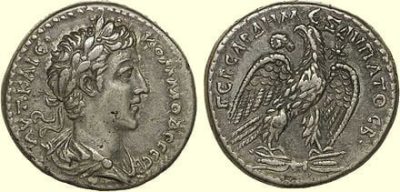
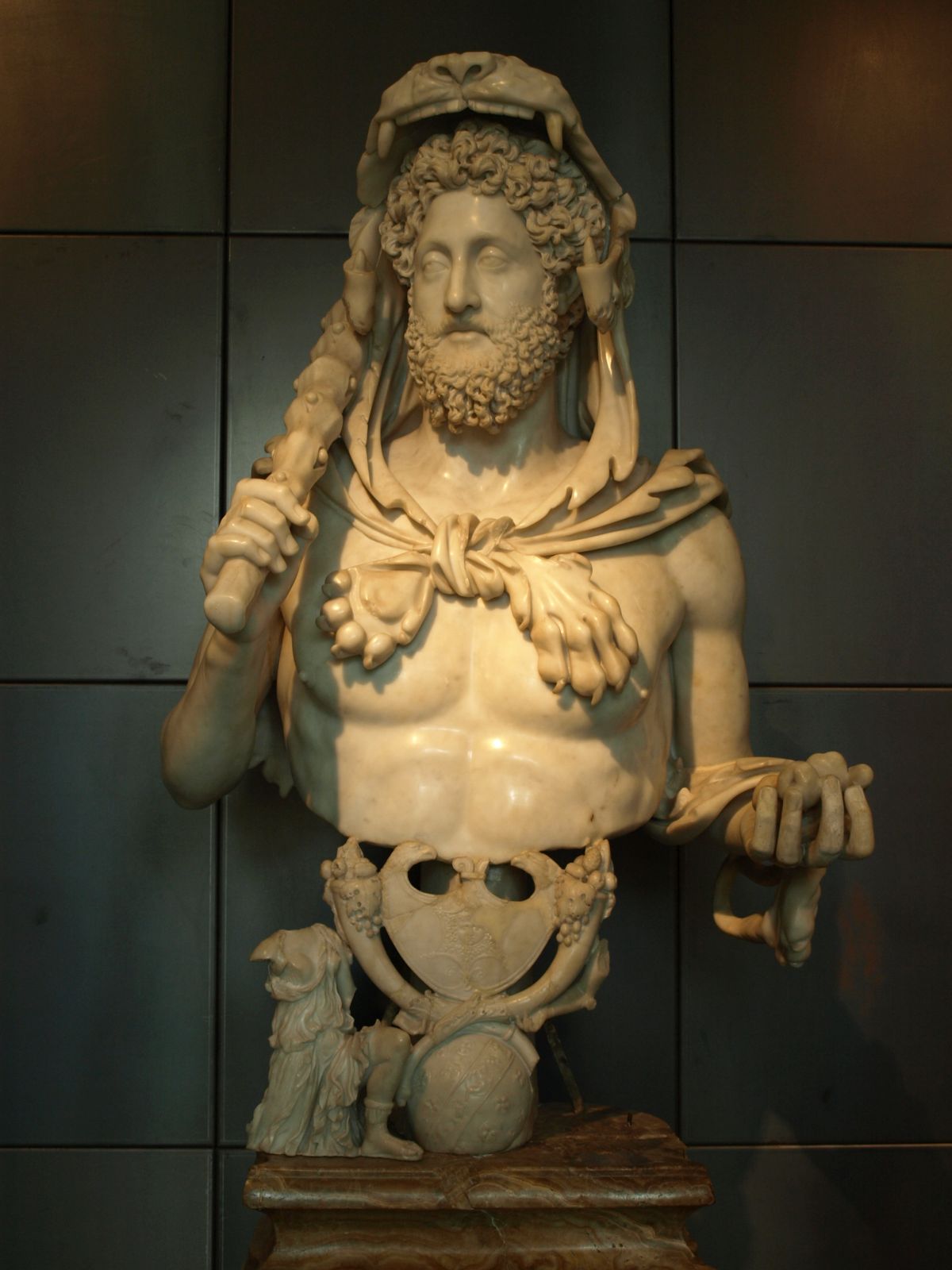
Commodus was born on August 31, 161 CE as Lucius Aurelius Commodus in Lanuvium. He was the son of Emperor Marcus Aurelius and Faustina. He had a twin brother, Aurelius Antonin, who died at the age of four. His wife was Bruttia Crispina, with whom he had no child. This was the first case of a son inheriting his father’s imperial position in many years, the first since Titus.
Commodus was the Roman emperor in the years 180-192 CE. He tried to establish absolute power, he demanded divine worship as the earthly incarnation of Hercules. He is known primarily from the movie “Gladiator”; he was remembered as a despot emperor.
Family and path to power
The nickname Commodus belonged to gens Ceionii and meant “pleasant”. This nickname was held by Lucius Ceionius Commodus, who was adopted by Emperor Hadrian and was planned as a successor. Ceionius, however, died young and was replaced by Antoninus Pius. Ceionius’ son was Lucius Verus, who was appointed co-ordinator by Marcus Aurelius. In his honour, the nickname Commodus was given to his son Lucius Aurelius, known in history as Commodus.
Emperor Marcus Aurelius, apart from Commodus, had more offspring, but almost died because of the unknown epidemic that came from the east with Emperor Verus. Apparently, young Commodus also suffered from illness, but he was cured by the famous doctor Galen. Aurelius, therefore, was only Commodus. No wonder the emperor greatly valued and worshipped his only heir. On the adolescence of the future emperor, the ancients convey a little vague judgment. Most probably already at that time Commodus showed great cruelty and ruthlessness as well as simply rudeness. But no one dared to open Aurelius’s eyes, blindly staring at his only son.
Marcus Aurelius never tried to hide that it was Commodus who would succeed him. In 166 CE, Lucius Commodus and his younger twin brother Aurelius Annius received the titles of Caesars during the triumph of Marcus Aurelius and Verus because of victories in the East. However, little Annius died 169 CE and only Lucius Commodus could succeed the emperor-philosopher. Aurelius guaranteed his only son the best education and the best teachers. He gave him great affection and protection.
Commodus was not yet 15 years old when he became a member of priesthood colleges in 175 CE On July 7 of the same year, he put on a men’s gown and later received the title of a youth leader.
From 176 CE, Commodus officially co-ruled with his father; received the office of people’s tribune. In the same year, together with his father, he took part in the expedition to the East against Avidius Cassius (governor of the whole East, who in 175 CE declared himself emperor – this happened after receiving false news about the death of Emperor Marcus Aurelius). In 177 CE he was appointed a co-coordinator with the title of Augusta. He also received the office of a high priest and father of the country. In the spring of 178 CE, Commodus, by the will of his father, married Bruttia Crispina, a girl from aristocratic spheres. He took part in the expedition against Marcomanni to create new provinces: Markomancy and Sarmacja. Unexpectedly, Marcus Aurelius died in 180 CE during the almost-ended war with the Germans (he passed away for natural reasons, although there were rumours in antiquity that his son had his fingers in the death of his father). Commodus immediately made peace and left the occupied lands (roughly Czech territory). However, this was not a sign of the peaceful disposition of the new ruler. The 19-year-old emperor simply wanted to be in Rome as soon as possible, offering numerous entertainment that was not in the wild forests of Central Europe. With his decision, Commodus ruined his father’s many years of effort and the sacrifice of thousands of soldiers. At that time Commodus in 180 CE became the actual and sole ruler of Rome.
Reign
Commodus, returning to Rome, only dealt with state affairs, in fact, his advisers ruled. In Rome, the ruler of the empire could enjoy the pleasures of life. His rule was mainly to watch the performances of clowns, actors and dancers, gladiator duels, and chariot races. Commodus took part in orgies, visited brothels and took part in hunting wild animals and other revellers that took him whole days. This did not disturb his advisers much. They had a free hand in management and believed that Commodus was just young and had to mature.

The turning point in his reign was the discovery of a plot on his life, which also involved in the sister of the head of state, Lucilla. However, due to the sluggishness of the bomber, Commodus saved his life. Lucilla was exiled to the island of Kaprela and executed there. Her fate was shared by even more people who did not report the plot in time. After the unsuccessful assassination attempt, the young ruler turned into an emperor-tyrant. From then on, he relied on a small group of favourites (Perennis and later Cleander) and the strength of praetorians. Perennis, who was the prefect of the Praetorians, became the first temple of the new emperor. He fulfilled his tasks in a very professional and competent manner. However, 185 CE turned out to be tragic for Perennis – Commodus sentenced him to death for treason. However, this allegation was completely unfounded. He replaced Cleander, who became the new praetorian commander. It was not a good choice. Cleander traded in both court judgments and positions in the state. The money he obtained was not only for his own needs. Commodus led an extremely lavish lifestyle, which had to be financed from something. In 190 CE, however, Commodus surrendered Kleander to his death in order to ease the emerging riots due to pervasive hunger. After his death, subsequent heads of pretoria were elected by Commodus’s lover, Marcia.
The new stage of Commodus’s rule was marked by trials, confiscation of property (that’s how Villa dei Quintili came into the hands of the emperor), exiles, forced suicides and executions. It was during his reign that wealthy people began to take forced loans. Many people lost their lives only so that their property could be confiscated. These repressions mainly affected senators with whom he was in constant conflict. Commodus led to the conviction of many senators. The ruler was going insane. He compared himself to Hercules (a cult widespread in the army); he had to present himself in the form of Hercules, in lion’s skin and with a club. Delusions of grandeur began to appear. Commodus gave himself many titles: Sarmatian, Germanic, Pious, Invincible and many others. In addition, he tried to bring absolute power. When the fire consumed a large part of Rome, he rebuilt the destroyed parts and renamed Rome to Colonia Commodiana. In addition, he also changed the names of the months to match his twelve (mainly assumed) names. The legions were renamed Commodianae, the fleet was Alexandria Commodiana Togata, and the Senate ordered it to be called Commodian, even the Romans ordered it to be called Commodian, and the legendary statue of Nero at the foot of the Colosseum chop off your head and insert your own. The elites were increasingly frightened and scandalized, but the people were happy. The emperor was still holding great games. Sometimes he even performed himself in the arena to the delight of the visitors. Herodian wrote about imperial performances:
Now the emperor, casting aside all restraint, took part in the public shows, promising to kill with his own hands wild animals of all kinds and to fight in gladiatorial combat against the bravest of the youths. When this news became known, people hastened to Rome from all over Italy and from the neighboring provinces to see what they had neither seen nor even heard of before. Special mention was made of the skill of his hands and the fact that he never missed when hurling javelins or shooting arrows.
His instructors were the most skillful of the Parthian bowmen and the most accurate of the Moroccan javelin men, but he surpassed them all in marksmanship. When the days for the show arrived, the amphitheaternote was completely filled. A terrace encircling the arena had been constructed for Commodus, enabling him to avoid risking his life by fighting the animals at close quarters; rather, by hurling his javelins down from a safe place, he offered a display of skill rather than of courage.
– Herodian, Roman History, 1.15.1-2
Commodus fought against the gladiators in the arena, which he had insidiously murdered. There is a message about the duel of the emperor with gladiator Sceva, who detected the deception of the emperor. After this fact, the scared emperor did not fight but dismissed the powerful gladiator.
The emperor ordered to build a small amphitheatre in Villa dei Quintili, where gladiators could practice. He probably trained there too. The remains of the arena were also discovered in the town of Genzano di Roma, located on Lake Nemi in the Albanian Mountains – 29 kilometres southeast of Rome, which belonged to the Antonin dynasty. It was likely that Commodus also exercised there.
In “Roman History” by Cassius Dio, there are descriptions of Emperor Commodus as a skilful left-handed hunter and assassin who liked to show off in the arena with his skill and cruelty towards humans and animals.
According to Cassius Dio, the emperor Commodus, just after taking power, gave demonstrations of his strength in the Roman Coliseum, appearing as Roman Hercules in gladiatorial battles, as well as killing bears, and tigers and elephants. Commodus’ favourite pastimes were archery with sickle-tipped arrowheads to ostriches running around the arena. He especially enjoyed the sight after the accurate shot, when the struck ostrich ran for some time after decapitation.
Also during his reign, the empire’s border was restored to Britain on Hadrian’s embankment, giving up the southern part of Caledonia joined by Antonin Pius.
Conspiracy
In 191 CE Rome was struck by a powerful fire, during which the Temple of Peace (Templum Pacis) was built during the reign of Emperor Vespasian. The event was perceived by Roman society as a sign of the upcoming unrest in the state. The element was so strong that it also burned down the markets, the imperial palace, numerous houses and the state archives.
In addition, the progressive madness of Commodus began to bother his immediate surroundings more and more. There was a conspiracy organized by the praetorian prefect Emilius Letus and the peaceful man Eklektus, in which his lover Marcia participated (other sources say he died in an accident). Marcia, the lover of Commodus, gave him poison for wine1, but the emperor was only sick. The weakened torso ruler was suffocated in his own bed by a strongman Narcissus, whose conspirators let him into the imperial bedroom2. Commodus was only 31 years old at the time.

Death
He died on December 31, 192 CE in Rome. After his death, at the request of Cincius Severus, he was recognized by the Senate as the emperor cursed on the basis of the resolution damnatio memoriae. Soon after, he was rehabilitated by Emperor Septimius Severus, who ordered him to deify. He did this not for substantive reasons (no one could say that Commodus was harmed by the resolution), but for political calculation: the new emperor decided that he would be the adopted son of Marcus Aurelius (father of Commodus), so he would be the brother of a cursed man. Commodus was counted among the gods as Divus Commodus.
Commodus’s rule was one of the cruellest in all of Rome’s history. During the exercise of power, he used the services of the secret police and thus did not give the Senate an opportunity to manifest his opposition to his rule. What particularly spread during the reign of Commodus were conspiracies and various plots.