If you have found a spelling error, please, notify us by selecting that text and pressing Ctrl+Enter.

Curiosities of ancient Rome

The world of the ancient Romans was rich in extraordinary, and sometimes even surprising, facts. We draw our knowledge of Roman daily life, customs, and mentality primarily from works left by ancient writers and historians. It is thanks to them that we discover information that is astonishing today – sometimes even hard to believe. Below are some interesting facts that reveal a lesser-known and less obvious side of the Roman world.

I encourage you to submit your own suggestions and to report any corrections or inaccuracies.

Short javelins – plumbatae

In the Roman legion, apart from the usual javelins (pilum), a type of short javelin (plumbatae) was also used. Plumbata was a kind of a dart approximately 60 cm with a lead load (ball), thanks to which the dart was stable during the flight. Its operation was similar to that of pilum with the difference, however, that it could be thrown much further. Thongs or something like wooden hand-held launchers was used for this.

Plumbatae

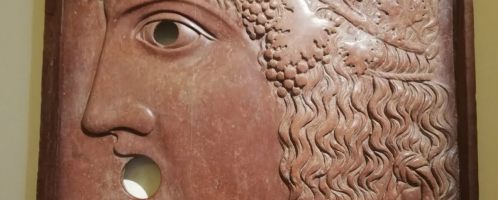
Relief with mask

Bas-relief shows the profile of a figure with long hair, wearing a diadem decorated with leaves and bunches of grapes. The head rests on a wicker basket, partially covered with goatskin.

Relief with mask

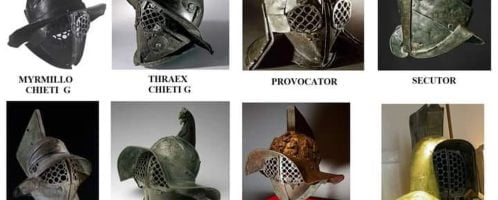
Helmets of Roman gladiators

Most publications on the Polish market are full of errors in this matter. Konstantin Nosow is the most perfect in the described subject (Osprey’s publication “Gladiators. Bloody spectacle in the history of Rome”, Polish version by Bellona). The illustration shows the most typical gladiators’ helmets from the 1st-4th century CE. The text describes much more matter.

Various helmets of Roman gladiators

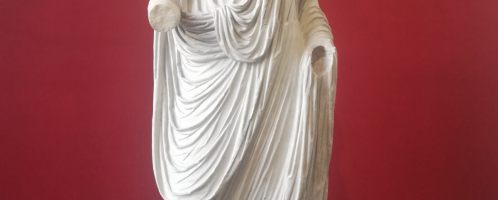
Octavian Augustus as highest priest

Sculpture depicts emperor Octavian Augustus dressed as Pontifex Maximus (the highest priest). He is wearing a toga and his head is covered. His feet are shod in calcei patricii (shoes worn by the upper class of Roman society). By the leg there is a container (capsa) for official documents. The right arm of the princeps indicates that he is in the process of making an offering, holding a sacrificial chalice (patera), ready for a libation.

Octavian Augustus as highest priest

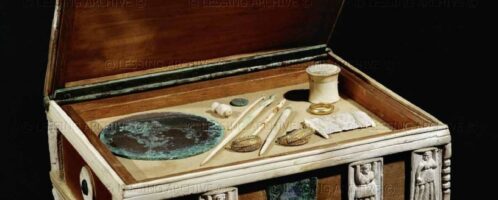
Roman toiletry bag

Roman toiletry bag of patrician. The makeup in ancient Rome mainly included the face and neck and shoulders. These parts of the body were sprinkled with white powder or pearl powder. Just like today, the illuminating and covering powder was supposed to cover discolouration, brighten the skin and give it uniformity.

Roman toiletry bag

Roman ring showing Titus Carvilius Gemello

Roman ring showing a certain Titus Carvilius Gemello. The man died at the age of 18, and the ring with his image was worn by his mother on a daily basis. The object is made of gold and quartz. The object is dated to the 1st century CE and was found in the Grottaferrata necropolis, near Rome.

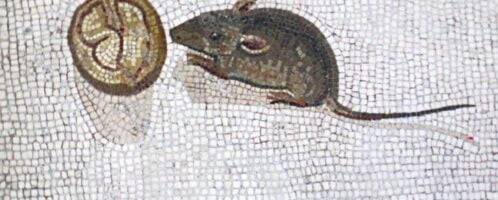
Squeak of mice – bad omen

Probably in 222 BCE, when Marcus Minucius Rufus assumed the office of Roman dictator, and Gaius Flaminius magister equitum (deputy dictator in political and military functions), a disturbing event occurred.

Roman mosaic showing a mouse eating a nut

Spelling error report

The following text will be sent to our editors: