If you have found a spelling error, please, notify us by selecting that text and pressing Ctrl+Enter.
Curiosities of ancient Rome
The world of the ancient Romans was rich in extraordinary, and sometimes even surprising, facts. We draw our knowledge of Roman daily life, customs, and mentality primarily from works left by ancient writers and historians. It is thanks to them that we discover information that is astonishing today – sometimes even hard to believe. Below are some interesting facts that reveal a lesser-known and less obvious side of the Roman world.
I encourage you to submit your own suggestions and to report any corrections or inaccuracies.
Roman bridge in Alcántara
Roman bridge at Alcántara in Spain is an example of the engineering genius of the Romans. The construction was built on the Tagus in 104-106 CE. The construction of the bridge was dedicated Emperor Trajan by the local community.

Marble slab with image of wool seller
The marble slab of the sarcophagus in which the freedman named Titus Aelius Evangelius is buried. The man was selling wool during his lifetime; on a stone he is shown surrounded by tools and objects that he used on a daily basis.


Nero – organist
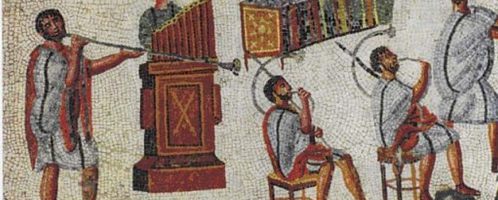
When Ctesibius, a 3rd century BCE Alexandrian mathematician, was constructing his hydraulis, the first water organ in history, certainly no one predicted him great successes. The instrument, intended as a syringa with a mechanical blast, initially functioned only as a technical curiosity. However, it took only two centuries for the music flowing from metal pipes to make a Mediterranean career – organ music is already mentioned with approval by Cicero himself (Tusc. III. 43).
Xylospongium – Roman progenitor of toilet paper
Xylospongium was used by the Romans to clean the anus, the Americans made it a device for cleaning the toilet.

Poverty in ancient Rome
According to Carl Gustav Jung, the individual culture of antiquity was higher and more developed than the modern one, at the price of a collective culture, which was handicapped compared to our times. For wonderful literary works by people like Cicero, multitudes of slaves had to work, whose efforts guaranteed the well-being of the upper classes.

Roman golden wreath
Roman golden wreath. Dated to 1st BCE – 1st century CE.

Strong words of Appius Claudius Caecus
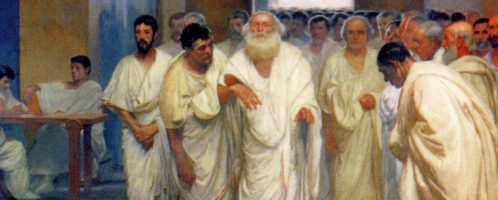
Appius Claudius Caecus (“the blind” – he received the nickname for having lost his eyesight at the end of his life) was a Roman politician and statesman, living between the 4th and 3rd centuries BCE. He belonged to a wealthy and influential family. He has had many functions in his life; he was: a curule edile, quaestor, military tribune, consul, censor, praetor, dictator and interrex (in the absence of consuls). Due to his achievements for the Republic, he was highly respected in his homeland.