
Roman tile with paw prints
Roman tile, with animal paw prints, from a military granary in Romania.
If you have found a spelling error, please, notify us by selecting that text and pressing Ctrl+Enter.
The world of the ancient Romans was rich in extraordinary, and sometimes even surprising, facts. We draw our knowledge of Roman daily life, customs, and mentality primarily from works left by ancient writers and historians. It is thanks to them that we discover information that is astonishing today – sometimes even hard to believe. Below are some interesting facts that reveal a lesser-known and less obvious side of the Roman world.
I encourage you to submit your own suggestions and to report any corrections or inaccuracies.
Roman tile, with animal paw prints, from a military granary in Romania.

Roman marble bust of a young man. Object dated to the 1st century CE. Located in the Vatican Museums.

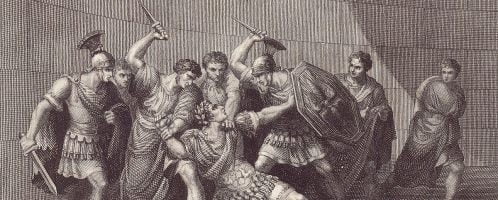
Cassius Chaerea was a Roman soldier serving in the Roman army during the fighting in Germania. However, we are best known from the accounts of Suetonius as the person who killed the emperor Caligula for personal reasons.
Roman marble bust of a lovely 16-year-old girl named Minatia Polla. The object is dated around 40 CE. Located in the Baths of Diocletian, Rome.

Visualization of Golden House of Nero, the great palace of the emperor, which was built in the years 64-68 CE. Construction work was stopped after his death. The Golden House of Nero, also known as Domus Aurea, was located between the Palatine and Esquiline hills. It was in the “Golden House” that Nero spent his last day of life in 68 CE.

A wonderful Roman pendant made of glass and gold. The object is dated 2nd BCE – 1st century CE.

A very interesting story about the presence of the Romans on the Elbe was left to us by Velleius Paterculus, a Roman historian who lived during the reigns of Octavian Augustus and Tiberius. In 5 CE the Roman army led by the future emperor – Tiberius stood on the Elbe. What Paterculus tells us?


