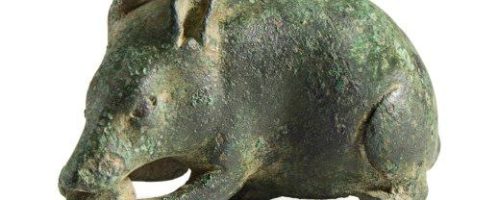
Roman bronze mouse
Roman bronze mouse from 1st-2nd century CE.
If you have found a spelling error, please, notify us by selecting that text and pressing Ctrl+Enter.
The world of the ancient Romans was rich in extraordinary, and sometimes even surprising, facts. We draw our knowledge of Roman daily life, customs, and mentality primarily from works left by ancient writers and historians. It is thanks to them that we discover information that is astonishing today – sometimes even hard to believe. Below are some interesting facts that reveal a lesser-known and less obvious side of the Roman world.
I encourage you to submit your own suggestions and to report any corrections or inaccuracies.
Roman bronze mouse from 1st-2nd century CE.
Roman cavalry parade face mask from a helmet. Dated back to II century CE.

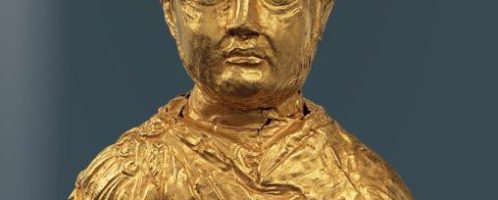
Roman bust hammered in gold leaf, showing emperor Licinius. Object dated back to III-IV century CE.
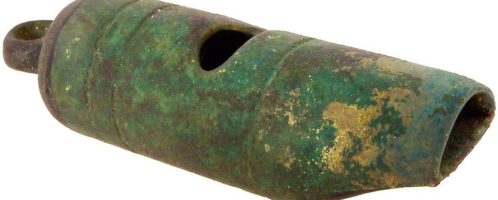
Roman bronze whistle. Dated back to I-III century CE.
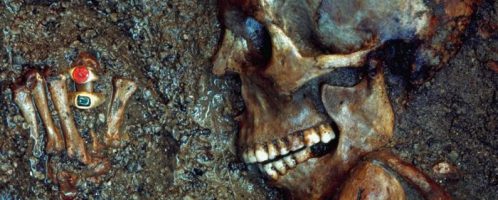
Roman remains with ring still on the finger. The deceased person was one of the many victims who died as a result of the Vesuvius eruption in 79 CE.
The find was discovered in Herculaneum.
Temple of Hercules Victor is a Roman temple in the Forum Boarium, close to the Tiber in Rome. Forum Boarium, near the Tiber.

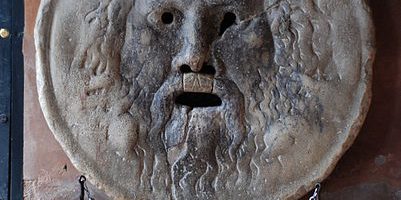
The “Mouth of Truth” is a Roman marble medallion showing the image of a Roman bearded deity with an open mouth. The object has a diameter of about 1.75 meters and weighs 1.3 t.
If you want to say hello in ancient Rome, it would be enough to say Salvē (in case of one recipient) or Salvēte, if we would welcome a larger group of people. Naturally, you could also use the word Avē. Avē and Salvē can simply be translated as “Hi”.