If you have found a spelling error, please, notify us by selecting that text and pressing Ctrl+Enter.

Curiosities of ancient Rome

The world of the ancient Romans was rich in extraordinary, and sometimes even surprising, facts. We draw our knowledge of Roman daily life, customs, and mentality primarily from works left by ancient writers and historians. It is thanks to them that we discover information that is astonishing today – sometimes even hard to believe. Below are some interesting facts that reveal a lesser-known and less obvious side of the Roman world.

I encourage you to submit your own suggestions and to report any corrections or inaccuracies.

Laurel on Arlia: How “Dragon Ball Z” combined Roman munera with damnation ad bestias

In pop culture, Rome is often recognized more quickly by its gesture than its name: the ruler sits above the arena, a red robe flowing from his shoulder, a laurel appears above his head, and the defeated disappears beneath the sand or into the jaws of a beast. A few such signs are enough to make the alien planet resemble an imperial amphitheater. The eleventh episode of the anime “Dragon Ball Z” uses this shortcut particularly prominently when Vegeta and Nappa arrive on Arlia, ruled by the Moai King. An arena operates in the tyrant’s palace, warriors battle before his throne, and the losers fall into a pit where the enormous monster Yeddy awaits.

Laurel on Arlia

Ceremonial chariot was discovered during excavations of Roman villa just outside walls of ancient Pompeii.

Ceremonial chariot was discovered during excavations of a Roman villa just outside the walls of ancient Pompeii. The four-wheeled vehicle, made of wood and iron, with bronze and tin decorations, was preserved almost perfectly when the city was buried by the eruption of Vesuvius in 79 CE. In 2018, it was discovered in a portico opposite the stables, where archaeologists found the remains of three horses, one still in harness.

Ceremonial chariot was discovered during excavations of Roman villa just outside walls of ancient Pompeii.

Marble sculpture of woman’s head

During archaeological excavations in ancient Corinth, a marble sculpture depicting a woman’s head was discovered. The monument dates back to the 2nd century CE, a period when the city was one of the most important centers of the Roman province of Achaea. The object is on display at the Archaeological Museum of Ancient Corinth.

Marble sculpture of woman's head

Scientists recreate face of Vesuvius’ victim

After nearly two thousand years, scientists have used artificial intelligence for the first time to recreate the appearance of one of the Pompeii residents who died during the eruption of Mount Vesuvius in 79 CE. The reconstruction was based on archaeological research and allows for a better understanding of the dramatic events that unfolded in the final hours of the city’s existence.

Scientists recreate face of Vesuvius' victim

Hercules depicted on herm

Hercules depicted on a herm discovered during archaeological excavations at the ancient theater in Corinth. The sculpture depicts one of the most famous heroes of Greek mythology, whose cult was also widespread in the Roman world. Currently on display at the Archaeological Museum of Corinth in Greece, the monument represents a valuable testament to the art and heritage of ancient Corinth.

Hercules depicted on herm

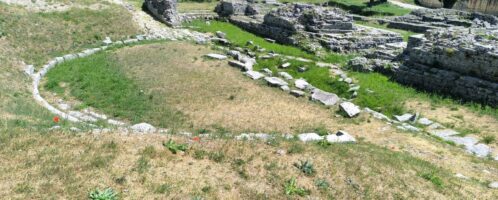
Roman theater in Salona

In ancient Salona, ​​located near modern-day Split in Croatia, the remains of a Roman theater have been preserved. It was one of the most important public buildings in the former capital of the province of Dalmatia. The city was one of the largest Roman centers on the Adriatic, playing a significant administrative, commercial, and cultural role.

Roman theater in Salona

Spelling error report

The following text will be sent to our editors: