
Constantine – good as Christian?
Constantine the Great, as he was officially the first Christian emperor, is seen today as a good ruler. It should be emphasized, however, that he had many lives on his conscience.
If you have found a spelling error, please, notify us by selecting that text and pressing Ctrl+Enter.
The world of the ancient Romans was rich in extraordinary, and sometimes even surprising, facts. We draw our knowledge of Roman daily life, customs, and mentality primarily from works left by ancient writers and historians. It is thanks to them that we discover information that is astonishing today – sometimes even hard to believe. Below are some interesting facts that reveal a lesser-known and less obvious side of the Roman world.
I encourage you to submit your own suggestions and to report any corrections or inaccuracies.
Constantine the Great, as he was officially the first Christian emperor, is seen today as a good ruler. It should be emphasized, however, that he had many lives on his conscience.

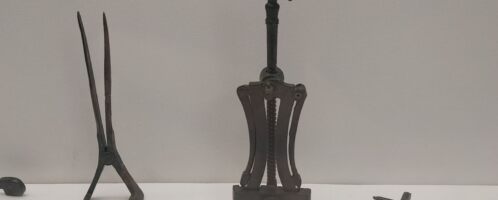
Item number 15 in the exhibition is a Roman gynecological speculum (speculum magnum matricis). Greco-Roman writers mention that medics recommended the use of such an instrument in the diagnosis and treatment of diseases of the vagina and uterus. However, as it turns out, many such devices have not survived our times. Mainly because they were made of bronze, so the material was used to make other products.
Constantine the Great after assuming imperial power tried in every possible way to emphasize his dominant position. A huge statue of the emperor was set up in Rome, the surviving fragments of which (head and foot) give an idea of the size of the monument. There is also a triumphal arch – one of the three preserved to our times.

The only ancient source of information about masks that were used in ancient times during theatrical performances is Julius Pollux, a Greek scientist from the 3rd century CE, who wrote the work Onomasticon. In his work, he lists a total of 44 different comic masks that could be used during the performance.

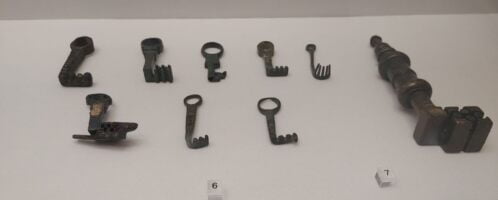
Different types of Roman keys. The artifacts are in the National Archaeological Museum in Naples.
Crates of Mallos, the Greek Stoic philosopher and grammarian of the ruler of Pergamon, is known as the creator of the first globe (c. 150 BCE) – a spherical model of the Earth. His globe differs from the modern ones for a simple reason – in his time people did not know as much about all the continents as they do today.

Introducing and killing wild animals for entertainment in amphitheatres or for expensive ivory or fur has led to a significant decline in species numbers across the Empire.

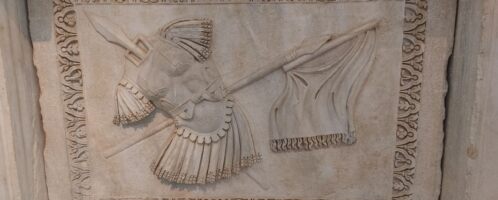
Roman relief showing tropaion. The tropaion was a form of military monument, erected by the Greeks and Romans in honour of the victory in battle. It was usually a vertical pole in the shape of a tree with outstretched arms (in later times, two crossed sticks), to which captured militaria was attached. The trophy was next sacrificed to the deities for victory.
Plutarch in his work (“Life of Alexander”, 8) mentions that Alexander the Great kept a special copy of the “Iliad” under his pillow while sleeping, with Aristotle’s commentaries. This was largely due to the love of the leader of this Greek epic and the character of Achilles.
