If you have found a spelling error, please, notify us by selecting that text and pressing Ctrl+Enter.

Curiosities of ancient Rome

The world of the ancient Romans was rich in extraordinary, and sometimes even surprising, facts. We draw our knowledge of Roman daily life, customs, and mentality primarily from works left by ancient writers and historians. It is thanks to them that we discover information that is astonishing today – sometimes even hard to believe. Below are some interesting facts that reveal a lesser-known and less obvious side of the Roman world.

I encourage you to submit your own suggestions and to report any corrections or inaccuracies.

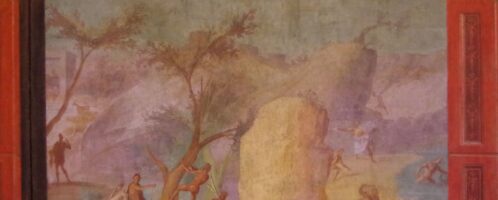
Roman fresco showing island of Laestrygonian giants

Roman fresco showing the island of the Laestrygonian giants-cannibals when Odysseus arrives. Interestingly, the Greeks identified this mythical place with either Sicily or Formia in Latium. The object was discovered in a domus on what is now the Roman road Via Cavour; now in the Vatican Museums in Rome. Dated to the 1st century BCE.
Roman fresco showing island of Laestrygonian giants

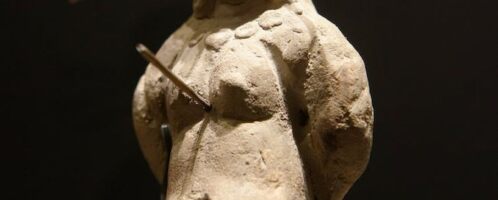
Greco-Roman “voodoo doll”

Greco-Roman “voodoo doll” pierced with 13 needles. Found in Egypt, it dates back to the 2nd century CE. It was in a vase along with a lead tablet with a spell on it.

Greco-Roman "voodoo doll"

Beautiful ship for Verres

In Roman times, it was very expensive and a lot of effort to put up a naval fleet. If the governor of the province received an order from the senate or decided that it was necessary to build, equip ships and train new crews, the entire financial burden naturally went to the cities of the province and their population.

Trire model

Apollodorus of Damascus

Living at the turn of the 1st and 2nd centuries CE, Apollodoros of Damascus was one of the most famous architects of antiquity. He worked for Emperor Trajan, for whom he was extremely useful, e.g. during the so-called Dacian Wars – designed a bridge that was thrown over the Danube to enable the Roman legions to cross the river. In addition, he designed the Trajan’s Forum, the emperor’s triumphal arches in Benevento and Ancona, perhaps he participated in the creation of one of the wonders of ancient architecture – Pantheon1.

Apollodorus of Damascus

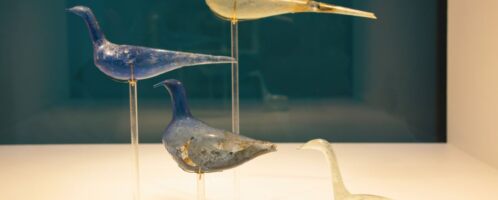
Roman small glass vessels in shape of birds

Roman small glass vessels in the shape of birds – known as unguentarium. They were used to store perfumes and oils. In order to pour out the contents, the “tail” was broken off. Object dated to the 1st century CE; it is now in the Archaeological Museum of Thessaloniki.

Roman small glass vessels in shape of birds

Roman prisoners fighting at funeral of Crixus

When in 72 BCE the insurgent army of Spartacus’ slaves marched north through Italy, towards the Alps, the insurgent forces split up. Gauls and Germans, under the command of a certain Crixus, went ahead to plunder Apulia (eastern, central Italy) freely. However, Crixus’ army was defeated by the Roman army and he himself was killed; 20,000 insurgents were to die. It was the first major victory of the Romans in the fight against the slaves of Spartacus.

A staging of a gladiator fight

Spelling error report

The following text will be sent to our editors: